 Wednesday, November 25, 2026
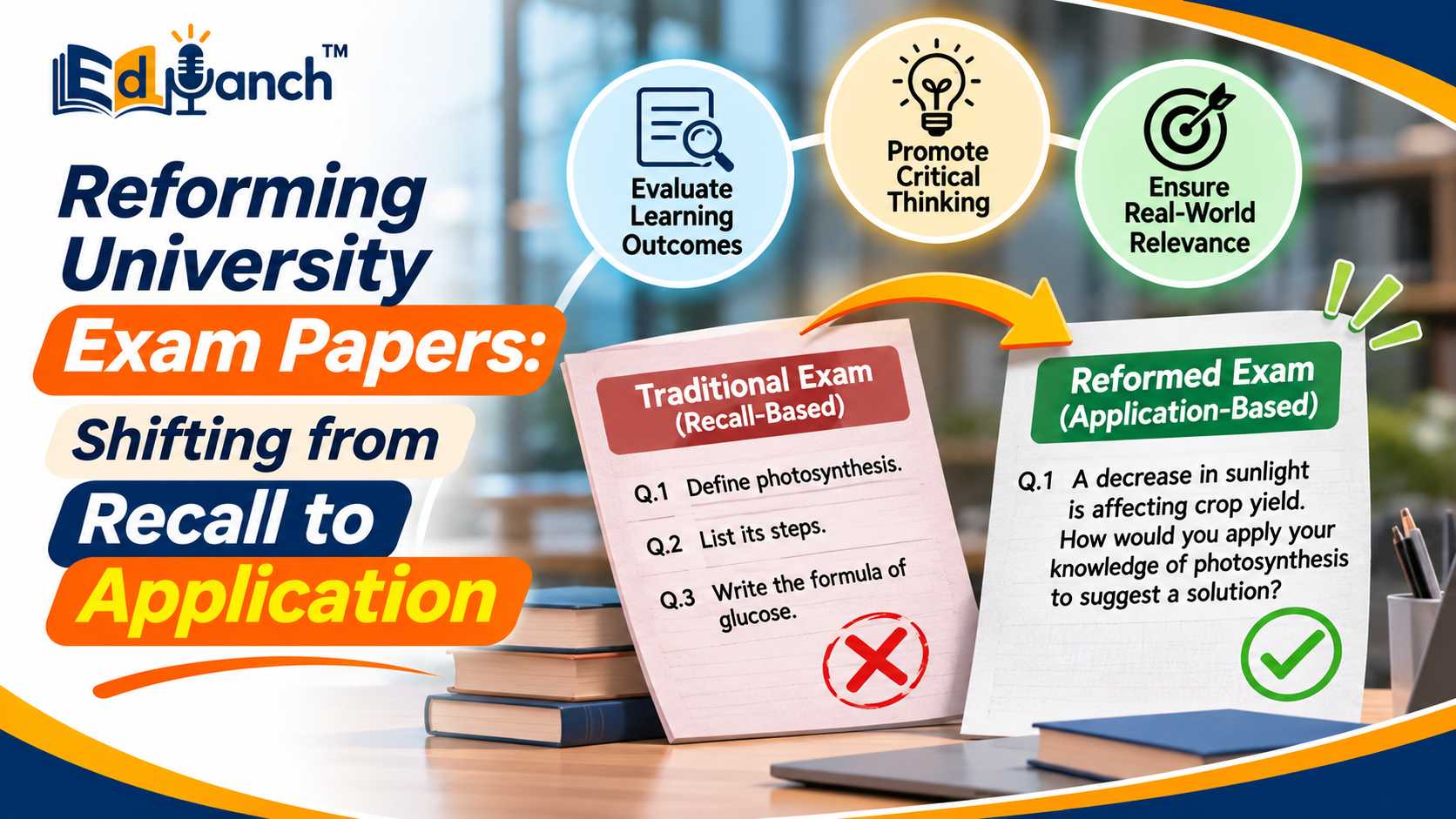
 Reforming university examinations from recall-based to application-based assessments encourages critical thinking, problem-solving, and practical understanding. This approach helps students apply their knowledge to real-world challenges and improves learning outcomes.





Executive Overview: The Rote-Memorization Dilemma in Higher Education
Higher education systems globally, and particularly within large-scale collegiate examination frameworks, face an acute assessment crisis. While universities publish ambitious graduate attributes emphasizing critical inquiry, complex problem-solving, cognitive agility, and analytical evaluation, their summative examination architectures remain tethered to low-level cognitive testing. Traditional end-semester university question papers frequently reward rote memorization, mechanical verbatim reproduction of lecture notes, and surface-level textbook recall.
Relying on recall-based examination models introduces critical educational and institutional failure modes:
- The Illusion of Mastery: Students who achieve top academic marks frequently demonstrate high mnemonic retention rather than deep conceptual understanding. When placed into unscripted workplace environments, clinical settings, or industrial laboratories, these graduates struggle to diagnose anomalies, interpret novel data arrays, or transfer theoretical models to operational problems.
- Curricular Washback and Distorted Pedagogical Drivers: The nature of summative examination dictates classroom instructional behavior. When faculty and students recognize that examination papers reuse predictable past-year prompts asking candidates to "define," "list," or "describe," teaching methodologies narrow into passive dictation, rote exam drills, and selective question banking.
- Erosion of Academic Credibility and Employability Deficits: Industry recruiters and graduate admission committees increasingly discount university grade point averages. When summative credentials fail to distinguish independent analytical reasoning from mechanical memorization, institutional degrees lose external labor-market signaling value.
Overcoming this structural deficit demands a fundamental overhaul of university examination paper design: moving decisively from fact-recall interrogations to Application-Oriented and Competency-Based Prompts.
Executing this examination reform requires an integrated operational framework:
- Anchoring item generation in Bloom's Revised Taxonomy (Higher-Order Cognitive Domains: Apply, Analyze, Evaluate, Create).
- Engineering contextualized, vignette-driven scenario prompts and authentic problem-solving stems.
- Establishing institutional Outcome-Based Education (OBE) course outcome mapping and item vetting committees.
- Replacing subjective, arbitrary scoring keys with calibrated, multi-tier analytic evaluation rubrics.
1. Pedagogical Foundations: Operationalizing Bloom's Revised Taxonomy in Item Writing
Shifting examination papers away from memorization requires university academic boards to replace generic question verbs with actionable, cognitively rigorous behavioral stems anchored in Bloom’s Revised Taxonomy.
The Lower-Order Trap (Remembering and Understanding)- Traditional question papers heavily concentrate cognitive weight in Level 1 (Remember) and Level 2 (Understand). Prompts beginning with "Define," "List," "State," "Enumerate," or "What is..." assess whether a student can retrieve static information from memory.
- While foundational vocabulary is necessary, devoting seventy to eighty percent of an undergraduate or postgraduate summative paper to lower-order recall incentivizes superficial cramming and short-term memorization cycles.
- These questions provide zero visibility into whether the candidate understands the functional constraints, contextual boundaries, or practical trade-offs of the theoretical concept being tested.
Modern examination design mandates that at least sixty to seventy percent of total examination marks target application, analysis, and evaluative judgment:
- Level 3 (Apply): Demands that the student execute a procedure or transfer an abstract conceptual rule to an unfamiliar operational scenario. Prompts utilize verbs such as "Calculate under condition X," "Implement," "Demonstrate how," "Construct," or "Adapt."
- Level 4 (Analyze): Requires breaking complex information into constituent elements, identifying hidden structural relationships, distinguishing cause from correlation, and spotting systemic inconsistencies. Prompts utilize verbs such as "Differentiate between operational effects," "Deconstruct," "Attribute," or "Diagnose."
- Level 5 (Evaluate): Demands making justified normative or technical judgments based on explicit criteria, empirical evidence, and operational standards. Prompts utilize verbs such as "Critique the efficacy of," "Appraise," "Justify the selection of X over Y," or "Determine which protocol fails."
- Level 6 (Create): Involves synthesizing disparate components into an integrated, novel structure or generating an alternative procedural plan. Prompts utilize verbs such as "Formulate an intervention strategy," "Propose a mitigation framework," or "Re-engineer."
2. Engineering the Application Prompt: Anatomy of Scenario-Based Question Design
Application-oriented prompts do not simply replace simple keywords with complex jargon; they restructure the prompt itself into an authentic problem-solving scenario.
The Three-Part Item ArchitectureA rigorous application-oriented question is built upon three distinct structural components:
- The Clinical or Industrial Vignette (The Context): A concise, realistic scenario providing concrete parameters, conflicting variables, real-world constraints, or anomalous data points. The scenario must be completely novel—not lifted verbatim from standard textbooks—to prevent candidates from reproducing memorized answers.
- The Stimulus Material (The Data Artifact): Empirical evidence embedded directly into the prompt: a clinical laboratory report, a segment of buggy software code, an architectural schematic, an extract from an ambiguous financial balance sheet, or an unedited legal statute.
- The Actionable Prompt Stem (The Cognitive Task): A targeted, unambiguous directive requiring the student to apply theoretical knowledge to the scenario, analyze the stimulus, make an evidence-based recommendation, and justify the trade-offs of their decision.
- Computer Science and Software Engineering:
- Recall-Based Prompt: "Explain the concept of race conditions in multithreaded programming and state three concurrency control mechanisms."
- Application-Oriented Prompt: "Analyze the provided 20-line concurrent banking transaction script. Identify the precise execution thread where a race condition occurs, predict the resulting ledger anomaly under a 500-millisecond network latency, and rewrite the transaction block using optimistic locking to prevent ledger inconsistency."
- Business Management and Corporate Finance:
- Recall-Based Prompt: "Define Working Capital Management and explain the formula for calculating the Current Ratio."
- Application-Oriented Prompt: "Review the provided financial statements of a mid-sized automotive parts supplier facing a 25% spike in raw material costs and a 60-day customer payment delay. Evaluate their current cash conversion cycle, identify two balance-sheet vulnerabilities that threaten immediate payroll obligations, and propose a working capital restructuring plan that stabilizes liquidity without raising external equity."
- Public Health and Medical Sciences:
- Recall-Based Prompt: "List the primary symptoms and diagnostic laboratory markers of acute myocardial infarction."
- Application-Oriented Prompt: "A 54-year-old diabetic patient presents to the emergency room with progressive epigastric burning, diaphoresis, normal sinus rhythm on standard 12-lead ECG, and borderline elevated serum troponin levels. Formulate an immediate diagnostic and pharmacological stabilization protocol, explain why atypical presentations occur in diabetic neuropathy, and justify whether fibrinolytic therapy or immediate percutaneous coronary intervention is indicated."
3. Institutional Governance: Moderation, Vetting, and Item Banking
Reforming question paper design cannot be achieved through administrative memos alone. It requires institutionalizing quality-control mechanisms that eliminate poor-quality, recall-heavy questions before examination papers reach the printing press.
The Board of Question Paper Setters (BQPS) and Vetting Panels- Decoupling Question Setting from Course Instruction: While individual faculty develop questions, final examination papers must be curated and vetted by an independent, interdisciplinary Question Paper Vetting Committee (QPVC).
- The Bloom’s Cognitive Taxonomy Audit: The vetting committee reviews every submitted prompt against an institutional taxonomy checklist. If more than thirty percent of an undergraduate paper’s marks are allocated to simple recall verbs (e.g., "Describe," "Define"), the vetting panel formally returns the paper to the setter for restructuring.
- Eliminating Ambiguity and "Trick" Questions: Vetting ensures that scenario prompts test deep conceptual application rather than linguistic trickery, verifying that all data parameters necessary to solve the problem are present within the vignette.
- Universities must transition from the hurried, seasonal drafting of complete papers by isolated professors toward continuous, institutional Digital Item Banking.
- Items are contributed throughout the academic semester, categorized by Course Outcome (CO), Program Outcome (PO), cognitive taxonomy level, estimated completion time, and discrimination index.
- Every vetted item undergoes pilot testing and statistical calibration (analyzing student response distributions) to ensure questions accurately differentiate high-competency candidates from surface memorizers.
4. Evaluative Integrity: Moving from Subjective Scoring to Analytic Rubrics
A sophisticated, application-oriented question paper becomes counterproductive if the grading process relies on subjective, uncalibrated examiner impressions. Application prompts have multiple defensible solution pathways, necessitating transparent, objective grading rubrics.
The Failure of the Traditional "Model Answer" Key- Traditional marking keys provide a rigid list of bullet points extracted directly from a prescribed textbook. Examiners assign marks by counting whether specific memorized sentences appear on the candidate’s script.
- This punitive marking approach penalizes students who propose creative, analytically sound alternative solutions that diverge from the textbook's phrasing.
Every application prompt must be accompanied by an Analytic Scoring Rubric distributed to all evaluators, grading performance across explicit performance dimensions:
- Problem Identification and Diagnostic Accuracy (Weighted 25%): Evaluates how accurately the candidate extracts critical variables, identifies underlying constraints, and isolates the core systemic failure within the scenario vignette.
- Theoretical Framework Integration (Weighted 30%): Evaluates whether the candidate correctly applies relevant theoretical laws, algorithms, physiological mechanisms, or regulatory statutes to the specific context.
- Quality of Justification and Trade-Off Analysis (Weighted 30%): Assesses the logical rigor of the candidate’s argument, their evaluation of competing alternatives, and their consideration of secondary real-world consequences (e.g., cost, safety, latency, ethical considerations).
- Communication Precision and Professional Coherence (Weighted 15%): Evaluates clarity, structured argumentation, precision in domain terminology, and the absence of superfluous narrative filler.
5. Structural Comparison: Traditional Recall-Centric Papers vs. Modernized Application-Oriented Papers
Evaluating traditional university examination architectures alongside an operationalized application-oriented assessment model illustrates systemic differences in cognitive demand, curriculum alignment, and graduate readiness:
Primary Cognitive Focus and Student Preparation Mode- Traditional Recall-Centric Examination: Concentrates heavily on Bloom's Levels 1 and 2 (Remember and Understand); incentivizes memorization, last-minute cramming, and reproduction of static lecture notes.
- Modernized Application-Oriented Examination: Concentrates primarily on Bloom's Levels 3, 4, and 5 (Apply, Analyze, and Evaluate); incentivizes year-long active problem-solving, critical case inquiry, and conceptual synthesis.
- Educational Impact: Shifts student study behavior away from passive textbook memorization toward active inquiry and analytical reasoning.
- Traditional Recall-Centric Examination: Direct, decontextualized prompts asking for generic definitions, lists, and summaries; highly predictable, allowing students to pass by studying past five-year question banks.
- Modernized Application-Oriented Examination: Unfamiliar scenario vignettes, empirical data stimulus sets, and real-world operational problems; unpredictable contexts requiring live diagnostic reasoning.
- Assessment Impact: Eliminates the efficacy of question-spotting and selective cramming, ensuring examination scores reflect genuine domain competence.
- Traditional Recall-Centric Examination: Relies on rigid, word-matching answer keys or subjective examiner impressions; marks fluctuate widely between different faculty evaluators.
- Modernized Application-Oriented Examination: Governed by standardized, multi-criteria analytic rubrics assessing diagnostic accuracy, theoretical application, and trade-off analysis.
- Scoring Impact: Maximizes inter-rater reliability, minimizes grading subjectivity, and provides legally defensible evaluation records during academic appeals.
- Traditional Recall-Centric Examination: Poor indicator of real-world capability; graduates frequently possess high grades but cannot solve complex, ambiguous problems in professional work environments.
- Modernized Application-Oriented Examination: High predictive validity for occupational and research performance; directly assesses the candidate's ability to operate under realistic industry constraints.
- Institutional Impact: Strengthens degree credibility, satisfies international professional accreditation standards, and improves graduate employment outcomes.
6. Phased Implementation Protocol: Institutionalizing Examination Reform
Transitioning a university examination system from legacy recall formats into an application-oriented assessment ecosystem requires an organized four-phase operational roadmap:
- Phase 1: Policy Governance, Taxonomy Auditing, and Baseline Benchmarking (Months 1 to 3):
- Adopt an official University Examination Reform Policy approved by the Academic Council, codifying that a minimum of sixty percent of marks on summative examinations must target Bloom's Taxonomy Levels 3 through 5.
- Execute a comprehensive diagnostic audit of the preceding three years of examination papers across engineering, sciences, humanities, and management faculties, categorizing historical questions by cognitive depth to establish baseline memorization indices.
- Mandate that all future syllabus documents explicitly link Course Outcomes (COs) to Bloom's taxonomy verbs, establishing the legal basis for rejecting purely recall-based exam items.
- Phase 2: Faculty Enablement, Item-Writing Workshops, and Rubric Design (Months 4 to 6):
- Launch mandatory, intensive Item-Writing Training Institutes for all instructional faculty: teaching professors how to write clinical, industrial, and social vignettes, extract data stimuli, and eliminate leading question stems.
- Train department heads and evaluation coordinators on authoring standardized, multi-criteria analytic scoring rubrics, running mock grading sessions to calibrate evaluator scoring consistency.
- Formalize and credential the Question Paper Vetting Committees (QPVC) across every academic faculty, equipping panels with standardized review checklists to audit cognitive-level balance and eliminate linguistic ambiguity before printing.
- Phase 3: Pilot Deployment, Digital Item Banking, and Retrospectives (Months 7 to 9):
- Pilot application-oriented formats across internal continuous assessments and mid-semester examinations in select benchmark departments (e.g., Computer Science, Mechanical Engineering, and Business Administration).
- Configure the university’s secure, enterprise digital item banking software: tagging questions by course outcome, cognitive level, marks, and estimated completion duration.
- Conduct post-pilot feedback sessions with students and faculty evaluators: reviewing completion times, analyzing candidate confusion over vignette terminology, and calibrating difficulty parameters.
- Phase 4: Full Enterprise Rollout and Continuous Psychometric Governance (Months 10 to 12):
- Scale application-oriented examination papers across all undergraduate and postgraduate academic programs university-wide.
- Deploy independent vetting panels to review 100% of final examination papers, granting vetting committees the absolute authority to reject papers that fail to meet cognitive application thresholds.
- Implement annual psychometric audits: analyzing item discrimination indices (how effectively application questions separate high-performing students from struggling students) and inter-rater reliability scores to ensure grading consistency and continuous assessment improvement.
Strategic Summary: Aligning Assessment with the Demands of a Knowledge Economy
A university’s ultimate academic integrity is reflected in its examination papers. If an institution teaches complex critical thinking during lectures but evaluates students through predictable, fact-recall questions on final examinations, students will naturally prioritize memorization over genuine intellectual growth. Relying on rote-recall testing alienates students, degrades faculty instructional ambition, and damages institutional academic reputation.
By anchoring examination architectures in higher-order cognitive domains (Bloom's Levels 3 through 5), engineering contextualized, real-world scenario vignettes, institutionalizing independent question vetting committees, and enforcing objective, analytic grading rubrics, universities reclaim the true evaluative purpose of higher education.
This operational transformation ensures that examination marks reflect authentic professional competency, analytical agility, and critical problem-solving capability—empowering graduates to thrive in an unpredictable, technologically advanced global economy.
10 Frequently Asked Questions (FAQs)
Q1. What is the fundamental difference between a recall-based exam question and an application-oriented question?A recall-based question asks candidates to retrieve memorized facts, definitions, or textbook explanations without modifying the context (e.g., "Define the principle of torque and write its formula").
An application-oriented question places the candidate in a realistic, novel problem scenario where they must use theoretical concepts to solve an anomaly, diagnose a failure, or make an evidence-based recommendation under operational constraints (e.g., "Given the structural specifications and wind shear data of the provided bridge design, calculate the torsion forces at Joint B and determine which beam requires reinforcement to prevent structural failure").
Q2. How does shifting to application-oriented exams discourage student cramming and question-spotting?Question-spotting works because traditional exams reuse identical, static textbook prompts year after year, allowing students to pass by memorizing past five-year question papers:
- Application-oriented examinations embed unique, scenario-specific vignettes and data sets that change in every examination cycle.
- Because the specific situation is novel, candidates cannot rely on pre-memorized textbook answers.
- To pass, students must deeply understand the underlying principles and understand how to adapt them to unfamiliar situations, making last-minute memorization ineffective.
Not if the transition is managed with proper pedagogical scaffolding:
- If a university suddenly introduces complex application examinations without changing classroom teaching methods, failure rates will rise because students were trained through passive memorization.
- Successful implementations introduce application formats gradually: incorporating scenario questions into continuous internal assessments, using case-based discussions during lectures, and providing students with sample rubrics and mock papers so they understand evaluation expectations before final examinations.
Application-oriented prompts in the humanities test interpretive, evaluative, and analytical reasoning rather than simple date or biographical recall:
- History: Instead of "List the causes of the French Revolution," an application prompt asks: "Analyze the provided 1789 grain price ledger and regional tax decree. Evaluate how localized bread inflation altered the political demands of urban artisans compared to rural peasants."
- Literature: Instead of "Summarize the plot of Hamlet," a prompt asks: "Evaluate the dramatic function of Hamlet's soliloquy in Act III using the provided feminist critique extract. Defend or refute whether Shakespeare constructs female agency exclusively through the male gaze."
Application-oriented questions have multiple valid analytical pathways, interpretations, and solution proposals:
- Relying on a traditional, rigid "model answer" key causes examiners to mark down students whose creative, mathematically sound approaches differ from the textbook author's phrasing.
- An analytic scoring rubric breaks down evaluation into objective performance dimensions: evaluating problem diagnosis, appropriate theoretical framework selection, logical trade-off analysis, and clarity of justification.
- This ensures consistent, fair, and legally defensible grading across hundreds of different faculty evaluators.
The QPVC serves as the institutional quality filter before examination papers are approved:
- Independent subject matter experts audit submitted papers against an explicit Bloom’s Taxonomy cognitive checklist.
- The committee verifies that questions are not copied from past papers, ensures scenario vignettes contain all necessary data variables, checks that prompts are linguistically unambiguous, and confirms that higher-order cognitive marks meet the mandatory university threshold (typically 60% or higher).
In an Outcome-Based Education (OBE) model, universities must empirically measure whether students achieve specific Course Outcomes (COs) and Program Outcomes (POs):
- Recall questions only demonstrate the achievement of basic knowledge acquisition.
- Application, analysis, and evaluative prompts provide direct, measurable evidence of higher-level outcomes (such as complex problem-solving, design-thinking, ethical reasoning, and modern tool usage).
- Reforming exam papers is essential for universities seeking national and international accreditation (such as NAAC, NBA, and Washington Accord compliance).
An Item Bank is a secure, encrypted digital repository containing hundreds of calibrated, peer-reviewed question items categorized by course outcome, cognitive level, and difficulty:
- Instead of hiring a single professor to draft an entire paper weeks before an exam—which creates a single point of failure for security leaks—the university’s automated examination software randomly selects calibrated items across predefined criteria on the day of the exam.
- This eliminates exam leakage risks, standardizes difficulty across examination sessions, and prevents single-faculty bias from skewing assessments.
Yes. Application-oriented testing is not limited to long, 15-mark essay questions:
- Multiple-choice questions (MCQs) can be written as scenario-based mini-cases: presenting an unscripted four-sentence problem, a small code snippet, or a clinical laboratory chart, requiring candidates to perform calculations or diagnose a fault before choosing the correct option.
- Two-mark or five-mark short questions can ask candidates to identify an error in a provided schematic, predict the immediate outcome of a changed parameter, or select the most cost-effective solution from two stated choices.
Track three prioritized, operational metrics:
- Bloom's Cognitive Distribution Index: The percentage of total marks across university question papers certified to assess Bloom's Levels 3, 4, and 5 (target: \ge 60\% across all faculties).
- Inter-Rater Grading Reliability Score: The statistical correlation of grades assigned to identical anonymized application scripts evaluated by different faculty members, verifying that analytic rubrics ensure objective, fair evaluation.
- Item Discrimination Index (IDI): Measuring the statistical ability of individual application prompts to distinguish between high-achieving analytical students and low-performing candidates across semester cohorts.