 Wednesday, November 25, 2026
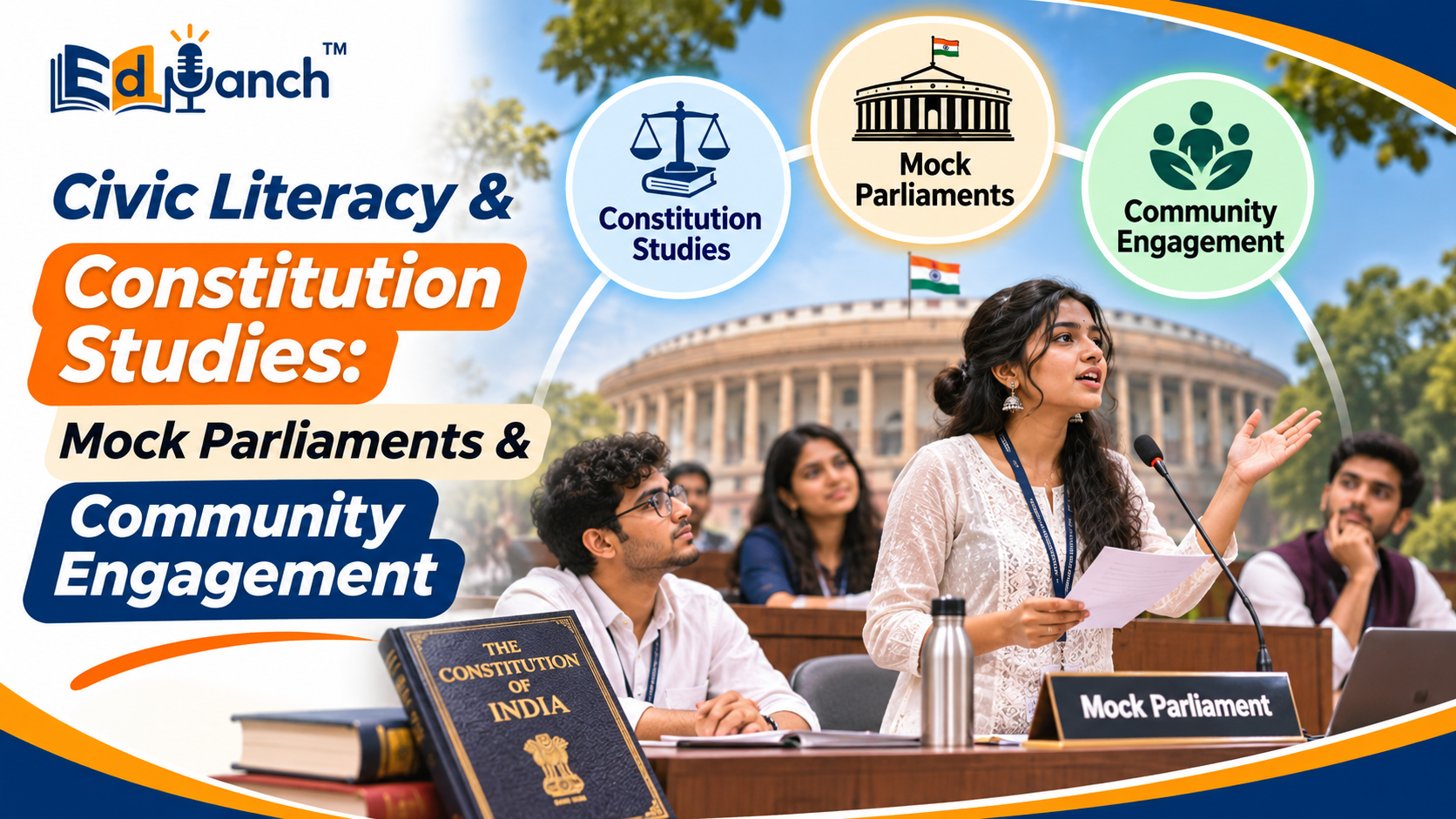
 Civic literacy and Constitution studies help students understand democratic values, rights, and responsibilities. Mock parliaments and community engagement encourage critical thinking, active citizenship, and leadership development.





Executive Overview: Bridging the Democratic Deficit in Civic Education
Constitutional democracies rely on an informed, critically engaged, and ethically literate citizenry. In an era marked by rapid digital polarization, algorithmic echo chambers, widespread voter apathy, and declining institutional trust, preparing youth for democratic participation is an urgent civic priority. Historically, civics and political science education within secondary schools, collegiate institutions, and community hubs has suffered from severe pedagogical limitations.
Traditional civic education typically exhibits three critical operational vulnerabilities:
- The Rote-Memorization Dilemma: Civic pedagogy has historically treated constitutional studies as a passive memorization exercise. Students memorize constitutional articles, fundamental rights lists, and legislative organ structures for examination recall without internalizing constitutional morality, civil liberties, or the institutional checks and balances underpinning democratic governance.
- The "Spectator Democracy" Delusion: Abstract textbook teaching presents legislative and judicial mechanisms as distant, ceremonial state rituals rather than dynamic, deliberative arenas. Youth are conditioned to view citizenship as a passive identity exercised exclusively at the voting booth once every five years, rather than an active, everyday discipline of deliberation, inquiry, and communal accountability.
- Disconnection from Localized Realities: Traditional curricula discuss governance at the highest federal tiers while ignoring decentralized local self-governance institutions (such as Gram Panchayats, Ward Committees, and municipal corporations). Consequently, young citizens fail to grasp how public policy, budget allocation, and administrative accountability affect daily community realities.
Transforming civic literacy from an academic exercise into an active democratic capability requires an Experiential Civic and Constitutional Engagement Architecture.
This operational model rests on four foundational pillars:
- Structuring immersive, role-delineated Youth Mock Parliaments and Constituent Assembly Simulations.
- Embedding school- and college-based Constitutional Literacy Labs that deconstruct constitutional morality, fundamental rights, and civil duties through real-world case law.
- Deploying Local Governance Community Immersions that connect youth directly to municipal planning, grassroots public hearings (Jan Sunwai), and social audits.
- Institutionalizing clear governance metrics to evaluate deliberative competence, empathy, and active community participation.
1. Experiential Parliamentary Simulations: The Anatomy of a High-Yield Mock Parliament
Passive lectures cannot replicate the emotional and intellectual stakes of legislative negotiation. Experiential Mock Parliaments (Youth Parliaments) place students inside the procedural mechanics of parliamentary democracy, transforming abstract procedural rules into tangible civic exercises.
Procedural Modeling: The Three Core ChambersTo ensure participants experience the full spectrum of legislative governance, simulations must be organized across distinct parliamentary arenas:
- The Question Hour (Executive Accountability): Simulating the foundational instrument of executive oversight. Student legislators draft starred and unstarred questions targeting simulated ministries (e.g., Environment, Public Health, Education, Finance). Government representatives must defend ministry actions, justify public expenditures, and respond to spontaneous supplementary questions without scripted evasion, illustrating how elected officials remain accountable to the public.
- The Legislative Bill Deliberation (Substantive Compromise): Moving through the three formal readings of a proposed bill: introduction, clause-by-clause scrutiny, and final passage. Student participants review legislative drafts, introduce amendments, articulate cross-party trade-offs, and defend civil liberties against excessive state power.
- The Zero Hour and Calling Attention Notices (Urgent Public Interest): A rapid-response parliamentary segment where student representatives raise sudden, unscripted national or regional crises (e.g., localized drought, public health outbreaks, cyber privacy violations), compelling the simulated executive to commit to immediate relief actions on the record.
Mock parliaments often fail when they mimic sensationalized media debates. Rigorous simulations assign diverse constitutional roles to teach nuanced institutional behavior:
- The Non-Partisan Speaker and Secretariat: Enforcing standing orders, ruling on points of order, ensuring proportional speaking allocations for minority caucuses, and maintaining parliamentary decorum.
- The Parliamentary Standing Committees: Small, cross-party working groups that meet behind closed doors to review technical legislation, examine budget estimates, interview expert witnesses, and author bipartisan consensus reports away from floor cameras.
- The Marshals and Parliamentary Reporting Cadre: Documenting verbatim proceedings, tracking voting divisions, and managing formal procedural petitions.
2. Constitutional Literacy Labs: Internalizing Constitutional Morality
Understanding the mechanics of voting is insufficient if citizens do not grasp the ethical principles governing constitutional democracy. Constitutional Literacy Labs deconstruct the living text of the Constitution, shifting the focus from static legal articles to active moral reasoning.
The Preamble as an Operational Decision Framework- Rather than treating the Preamble as a text to be memorized, labs use its foundational principles—Justice, Liberty, Equality, and Fraternity—as analytical lenses to evaluate modern public policies.
- Students analyze proposed municipal bylaws, zoning laws, or public health policies through these lenses, debating whether an administrative action that promotes economic utility violates fundamental equality or human dignity.
Constitutional literacy is best cultivated through the analysis of landmark judicial decisions where fundamental rights collide with state interests or competing individual claims:
- Privacy vs. State Security: Dissecting the boundaries of personal autonomy, biometric data collection, and state surveillance under constitutional protections of life and personal liberty.
- Freedom of Speech vs. Public Order: Debating real-world dilemmas where expressive liberties conflict with hate-speech protections, social harmony, and communal peace.
- Affirmative Action and Substantive Equality: Exploring the tension between formal equality of opportunity and substantive remedial justice for historically marginalized communities.
- The Classroom Supreme Court Simulation: Students act as petitioner counsels, state advocates, and a multi-judge constitutional bench, authoring reasoned majority judgments and dissenting opinions anchored in constitutional jurisprudence.
3. Grassroots Community Engagements: Connecting Youth to Local Self-Governance
Civic capability remains theoretical if it is confined to school auditoriums. Experiential civic learning requires structured field immersion within local self-governance institutions.
Deconstructing the Third Tier of Governance- While national elections dominate media coverage, local governments (Panchayati Raj Institutions and Urban Local Bodies) directly shape everyday life: drinking water access, waste processing, primary health centers, rural roads, and local schools.
- Programs partner with local Gram Panchayats and Municipal Ward Committees to bring students into real-world local administration.
- Gram Sabha and Ward Committee Observation: Students attend scheduled public village assemblies or municipal ward meetings as accredited non-voting observers. They witness how citizens raise localized grievances, observe how public funds are debated, and note how women and marginalized groups navigate patriarchal or socio-economic power dynamics.
- The Participatory Youth Social Audit: Working alongside civil society organizations and community elders, students conduct small-scale social audits of public services. They inspect mid-day meal quality in primary schools, evaluate public sanitation infrastructure, cross-reference public works muster rolls, and present factual audit scorecards to local administrative officers.
- Community Problem-Mapping and Deputation: Student cohorts select a hyper-local civic issue (e.g., an unlit pedestrian crossing, open garbage dumping, or inadequate clean drinking water in a neighborhood). They interview residents, compile photographic evidence, identify the specific municipal department holding statutory jurisdiction, draft a formal administrative petition, and track its resolution through citizen grievance portals.
4. Structural Comparison: Pedagogical Models in Civic and Constitutional Learning
Evaluating conventional, textbook-bound civic instruction alongside an experiential civic engagement ecosystem highlights fundamental differences in student agency, critical inquiry, and democratic capability:
Primary Learning Objective and Knowledge Retention- Conventional Civics Curriculum: Focuses on factual memorization of institutional structures, electoral rules, and statutory articles for end-of-term examinations; knowledge fades rapidly post-testing.
- Experiential Civic Ecosystem: Focuses on developing deliberative capability, constitutional moral reasoning, policy evaluation skills, and grassroots problem-solving.
- Educational Impact: Transforms passive facts into active critical thinking, building lifelong civic understanding and participation habits.
- Conventional Civics Curriculum: Passive and receptive; students listen to lectures, read textbooks, and answer predictable multiple-choice questions.
- Experiential Civic Ecosystem: Active and participatory; students step into the roles of legislators, cabinet ministers, judicial advocates, ward councilors, and social auditors.
- Agency Impact: Builds agency, public speaking confidence, empathetic listening skills, and the capacity to negotiate constructive compromise across ideological divides.
- Conventional Civics Curriculum: Distant and centralized; focuses almost exclusively on national and state executive offices, ignoring municipal councils and rural local bodies.
- Experiential Civic Ecosystem: Multi-tiered and local; balances parliamentary simulations with direct field visits to Gram Sabhas, municipal ward hearings, and neighborhood public service audits.
- Community Impact: Demystifies local bureaucracy and empowers youth to view grassroots administration as accessible, responsive, and accountable.
- Conventional Civics Curriculum: Theoretical and evasive; avoids discussing real-world political polarization, ideological friction, and contentious public debates.
- Experiential Civic Ecosystem: Deliberative and pluralistic; exposes students to structured parliamentary debates and constitutional dilemmas with divergent, defensible viewpoints.
- Social Impact: Teaches civil disagreement, dismantles echo-chamber dogmatism, and reinforces constitutional fraternity across diverse communities.
5. Phased Implementation Protocol: Institutionalizing Civic Literacy Initiatives
Transitioning an educational institution or youth organization from lecture-based civics into an experiential civic learning ecosystem requires an organized four-phase operational roadmap:
- Review existing academic curricula to integrate experiential civic modules seamlessly into secondary and undergraduate humanities, legal studies, and social science programs.
- Secure formal institutional partnerships with district legal services authorities, municipal ward secretariats, and rural local bodies to grant student cohorts observer access to official proceedings.
- Form the Institutional Civic Council and deliver practical facilitation training to educators, teaching them how to moderate polarized debates neutrally without imposing personal ideological views.
- Launch weekly, 90-minute Constitutional Literacy Lab sessions analyzing real-world ethical dilemmas through the foundational values of the Preamble.
- Execute structured moot court trials: assign student legal teams to argue historical and contemporary civil liberties cases using constitutional law precedents.
- Publish the official Mock Parliament Docket: provide students with standardized legislative bill templates, model standing orders, and briefing books on simulated national policy challenges.
- Convene a comprehensive, multi-day Youth Mock Parliament: orchestrating formal Question Hour sessions, legislative bill debates, and closed-door Standing Committee markups.
- Enforce parliamentary rules of order: require student legislators to support factual assertions with verified data, record legislative compromises, and register formal voting divisions.
- Invite active public servants—such as local legislators, civil magistrates, and public ombudspersons—to observe floor proceedings, offering real-world feedback on deliberative conduct and legislative precision.
- Dispatch student cohorts into community field tracks: observing live Gram Sabha meetings, auditing local municipal service delivery, and mapping hyper-local infrastructure bottlenecks.
- Guide student teams in authoring actionable Citizen Grievance Petitions, submitting them through official government administrative portals and tracking bureaucratic responses.
- Conduct annual program evaluations: administer validated civic literacy and engagement surveys to measure gains in constitutional understanding, collaborative compromise, and community involvement.
Strategic Summary: Cultivating Resilient Democratic Leadership
Democratic governance is not self-sustaining; its survival requires every generation to learn the habits of critical inquiry, respectful deliberation, and civic responsibility. Leaving constitutional education to passive textbook memorization creates disengaged populations vulnerable to polarization, misinformation, and authoritarian rhetoric.
By implementing immersive, procedural Mock Parliaments, establishing case-driven Constitutional Literacy Labs, and connecting young citizens directly to local governance and community social audits, educational institutions revitalize civic education.
This experiential framework replaces passive political spectatorship with informed, active democratic practice. It equips young citizens with the courage, empathy, and intellectual rigor required to safeguard constitutional morality, hold public institutions accountable, and lead their communities with integrity.
10 Frequently Asked Questions (FAQs)
Q1. What is the primary pedagogical benefit of a Youth Mock Parliament over a traditional debate competition?Traditional debate competitions reward adversarial rhetoric, binary arguments, and aggressive persuasion:
- One side must "win" while the other "loses," which often encourages polarization.
- A Youth Mock Parliament models legislative governance:
- It prioritizes procedural rules, cross-party negotiation, committee scrutiny, and legislative compromise.
- Participants must balance diverse constituency interests, amend bill language collaboratively, and build consensus to pass legislation.
- This teaches students that democratic politics is an exercise in coalition-building and public stewardship rather than personal rhetorical triumph.
Preventing partisan vitriol requires clear procedural design:
- Use Fictionalized Parties and Coalitions: Avoid using real-world political party names, slogans, or symbols. Instead, establish policy-aligned coalitions (e.g., "The Conservation Alliance," "The Economic Modernization Party," "The Agrarian Union").
- Focus on Policy Issues, Not Personalities: Ground parliamentary dockets in technical, structural challenges (such as data privacy regulations, urban water management, or renewable energy transitions) rather than identity politics.
- Enforce Parliamentary Rules of Decorum: The Speaker must strictly penalize personal attacks, unparliamentary language, and procedural disruptions, reinforcing that elected representatives must debate ideas with evidence and mutual respect.
Constitutional morality, as articulated by visionary jurists including Dr. B.R. Ambedkar, means commitment to constitutional values over popular whims or administrative convenience:
- It recognizes that holding elections is not enough; governance must always respect the rule of law, individual dignity, minority rights, and institutional checks and balances.
- Teaching constitutional morality ensures young citizens understand that a democratic majority cannot use its power to override fundamental human rights, promoting social fraternity and mutual respect across diverse communities.
Yes, when concepts are adapted to appropriate developmental stages:
- For primary students (Ages 6 to 10), constitutional studies focus on foundational values: fairness, turn-taking, active listening, and resolving classroom disagreements through shared rules.
- For middle school students (Ages 11 to 13), programs use story-based scenarios and classroom constitutions: students collectively draft, debate, and vote on classroom rules, learning how laws are made, why they must be enforced fairly, and what happens when rules are broken.
The Question Hour is the premier exercise in executive accountability:
- Student legislators submit structured, factual inquiries concerning public spending, policy outcomes, and administrative lapses to student cabinet ministers.
- Ministers must answer using verified briefing data, defending their actions under questioning without deflecting or obfuscating.
- This exercise teaches students that executive power is not absolute and that public officials must account transparently for public funds and public trust.
Social audits bring textbook civic concepts into direct contact with real community life:
- When students evaluate public services—such as auditing rural school meal programs, testing municipal water quality, or checking road repairs against public budgets—they see the practical impact of administrative integrity.
- Students discover that public policy failures often stem from budget leakage, bureaucratic neglect, or poor community participation rather than bad legislative intentions, inspiring them to become active local watchdogs.
Experiential civic education teaches youth how government institutions, public records, and official data actually work:
- When students act as legislative researchers or committee members, they must corroborate claims using primary sources, budget books, and verified reports rather than social media hearsay.
- Understanding how policies are formulated and where official information lives helps students spot sensationalized falsehoods, clickbait political propaganda, and manipulated video clips, making them resilient to digital polarization.
Constitutional Literacy Labs do not require expensive technology or specialized infrastructure:
- A successful lab requires copies of the national Constitution, curated collections of simplified landmark legal judgments, and open classroom space for deliberative circles.
- Schools can leverage free open-access legal databases, educational case-study briefs produced by legal aid non-profits, and invite volunteer lawyers or law students from nearby universities to serve as guest judicial moderators.
Assessment shifts away from written recall exams toward authentic, performance-based rubrics:
- Evaluate students on deliberative research quality: how effectively they cite constitutional principles, statutory precedents, and verifiable empirical evidence during debates.
- Assess collaborative problem-solving: measuring a student's ability to negotiate amendments, incorporate opposing viewpoints, and build consensus in committee work.
- Evaluate real-world civic action: grading completed community problem-mapping portfolios, citizen petitions, and reflective essays on local governance observations.
Track three prioritized, operational metrics:
- Deliberative Participation and Inclusivity Rate: The percentage of enrolled students who actively prepare, speak, and sponsor legislative clauses or mock judicial petitions, ensuring diverse representation across gender and academic backgrounds.
- Civic Reasoning and Critical Thinking Gain: Measuring measurable improvements on pre- and post-program evaluations assessing students' ability to identify constitutional issues, analyze conflicting rights, and propose balanced policy solutions.
- Community Engagement and Resolution Velocity: The volume and completion quality of student-led community social audits and citizen petitions submitted to local municipal or panchayat bodies, measuring real-world civic impact.