 Wednesday, November 25, 2026
 Accreditation verification is essential before college admission in India. This guide explains how to check NAAC, UGC, AICTE, and NBA status to avoid fake institutions and secure your academic future.





Introduction
Choosing the right college is one of the most consequential decisions in a student's life, and in a country as educationally diverse as India, it is also one of the most complicated. With thousands of universities, colleges, deemed institutions, and private institutes operating across the country, the risk of enrolling in an unrecognized or low-quality institution is real and serious. A degree from such an institution can close doors rather than open them, affecting employment prospects, eligibility for government examinations, and even the ability to pursue postgraduate education.
Accreditation status is the clearest, most objective signal of an institution's legitimacy and quality. Yet most students and parents do not know how to verify it, or even that they should. This guide explains what college accreditation means in India, which bodies are responsible for granting it, and exactly how to check whether the college a student is considering is properly recognized and accredited before admission.
Understanding College Accreditation in India
Accreditation is an official process through which a recognized body evaluates an educational institution against defined quality and academic standards. In India, this process is not uniform across all types of institutions. Different regulatory bodies are responsible for different types of colleges, programs, and disciplines.
The two concepts that students must distinguish at the outset are recognition and accreditation. Recognition refers to legal authorization, meaning whether an institution or its degree-granting authority is legally valid under Indian law. Accreditation refers to quality certification, meaning whether the institution meets established academic, infrastructural, and governance benchmarks.
Both matter, but they are separate. A college can be recognized without being accredited. And an accreditation certificate from an unofficial or fake body is itself worthless. Understanding this distinction is the first step toward making an informed decision.
Key Accreditation and Recognition Bodies in India
India has several official bodies responsible for regulating and accrediting higher education institutions. Each has a distinct scope, and students need to know which one applies to the type of institution they are evaluating.
University Grants Commission (UGC): The UGC is the primary statutory body governing university education in India. Under the UGC Act of 1956, only universities recognized by the UGC are authorized to award valid degrees. The UGC website maintains a publicly accessible list of recognized universities and also publishes a regularly updated list of fake universities operating in the country.
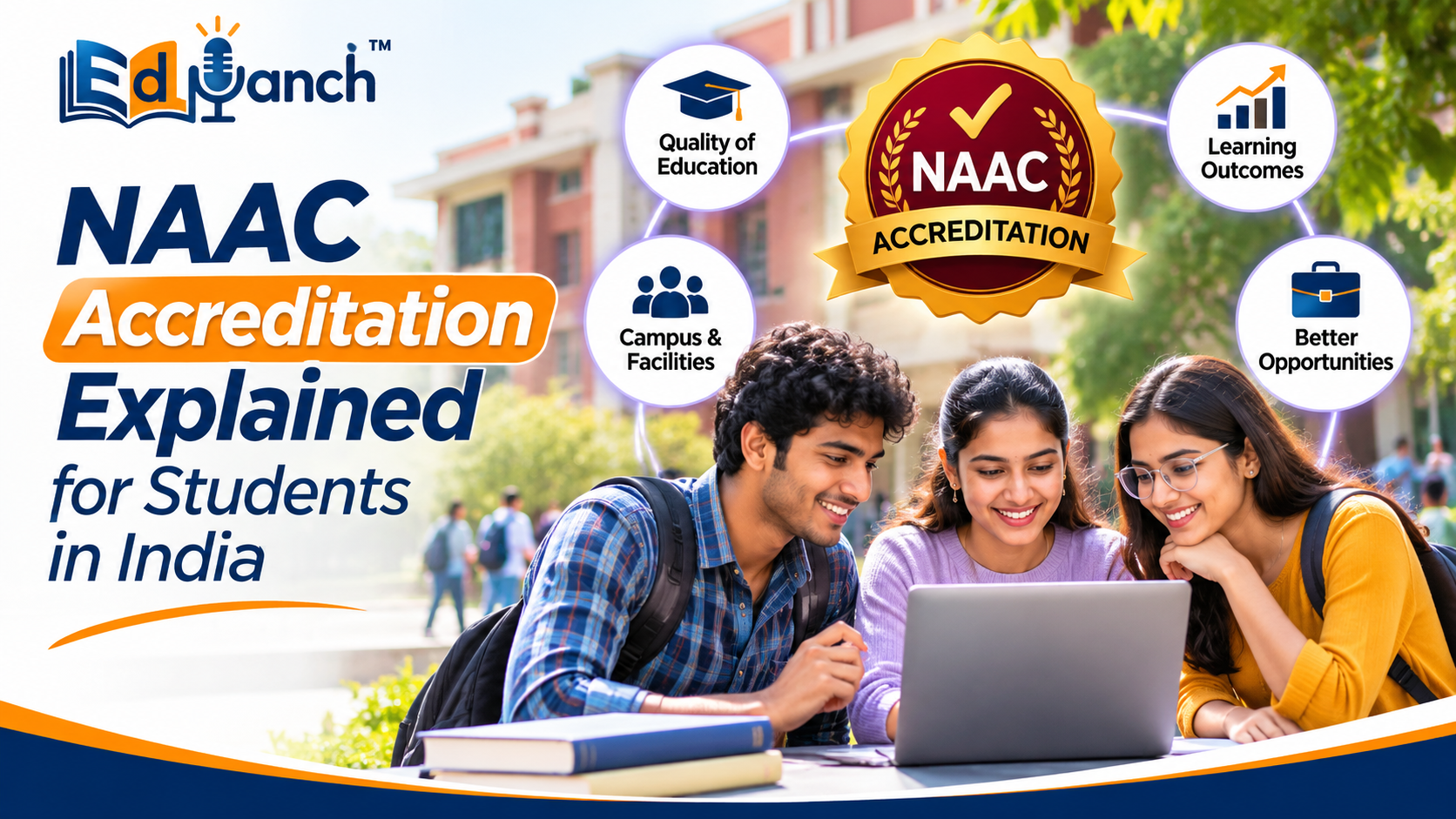
National Assessment and Accreditation Council (NAAC): NAAC is the premier body for quality accreditation of colleges and universities in India. Institutions that voluntarily submit to NAAC assessment receive a grade from A++ to C, based on criteria such as teaching quality, research output, infrastructure, governance, and student outcomes. A NAAC grade gives students a reliable quality benchmark.
All India Council for Technical Education (AICTE): AICTE governs technical and management education institutions in India, including engineering colleges, polytechnics, MBA programs, and architecture schools. Any institution offering AICTE-regulated programs must have AICTE approval, and this can be verified through the AICTE approval portal.
National Board of Accreditation (NBA): NBA accredits specific programs within technical institutions rather than entire institutions. If a student is evaluating an engineering or technology program in particular, NBA accreditation of that program is an important quality marker.
Medical Council of India and Its Successor, NMC: Medical colleges in India are regulated by the National Medical Commission (NMC), which replaced the Medical Council of India. Recognition from NMC is mandatory for any college offering MBBS and other medical degrees.
Bar Council of India (BCI) and Dental Council of India (DCI): Law colleges must be recognized by the BCI, while dental colleges require approval from the DCI. Similar statutory councils exist for pharmacy, nursing, and other professional education streams.
How to Check Accreditation Status: Step-by-Step for Each Portal
Verifying accreditation is not complicated if one knows where to look. Here is how to check status across the most important portals.
Checking NAAC AccreditationNAAC maintains an online database of all accredited institutions at its official website, naac.gov.in. Students can navigate to the section titled "Accredited Institutions" and search by institution name, state, or institution type. The result will show the NAAC grade awarded, the cycle of accreditation (first, second, or third), and the validity period of the accreditation.
It is important to check the validity date carefully. NAAC accreditation is granted for a period of five years. If the validity has lapsed and the institution has not been re-accredited, the grade shown may no longer be current.
Checking UGC RecognitionThe UGC maintains a searchable list of recognized universities on its website, ugc.ac.in. Under the "University" section, students can search for any institution to verify whether it has UGC recognition. The same website also provides a regularly updated list of fake universities, which students and parents should cross-reference before finalizing admission to any private or deemed institution.
Checking AICTE ApprovalFor technical and management programs, students should visit the AICTE approval portal at aicte-india.org and use the search interface to look up the institution. The portal displays the institution's approval status, the programs it is approved to offer, its annual intake capacity, and the approval year. This is especially useful for engineering colleges and MBA programs.
Checking NBA Program AccreditationNBA accreditation details are available at nbaind.org. Students can search for accredited programs by institution name or discipline. This is particularly relevant for students considering engineering programs who want to verify program-level quality, not just institutional approval.
Checking Medical and Professional Education ApprovalsFor medical colleges, the NMC website at nmc.org.in provides a list of recognized medical institutions and their permitted intake. For pharmacy, nursing, law, and dental education, students should visit the respective statutory council websites, which include the Pharmacy Council of India, the Indian Nursing Council, the Bar Council of India, and the Dental Council of India.
Red Flags: Signs That a College May Not Be Legitimate
Beyond checking official portals, students and parents should be alert to certain warning signs that may indicate an institution is operating outside the bounds of legitimate accreditation.
- The institution claims accreditation from a body that does not appear in any government registry or official list.
- The college promises degrees in unusually short durations that do not align with UGC-prescribed course structures.
- No physical address, faculty list, or verifiable infrastructure is visible on the college website.
- The admission process bypasses standard procedures, relies entirely on agents, and demands unusually large cash payments.
- The institution is not listed on the UGC, AICTE, or any relevant council portal despite claiming to offer recognized programs.
India has a documented problem with fake universities. As of recent UGC disclosures, over 20 institutions have been identified as fake universities operating in states including Uttar Pradesh, Delhi, West Bengal, and Karnataka. This is not a theoretical concern, and the risk is real for students in Tier 2 and Tier 3 cities where information access may be limited.
Why Accreditation Matters for Indian Students
Accreditation has practical consequences that extend far beyond the admission decision. Here is why it deserves serious attention.
Government job eligibility: Most central and state government recruitment processes, including those through UPSC, SSC, and state public service commissions, require degrees from UGC-recognized institutions. A degree from an unrecognized college will typically disqualify a candidate regardless of their academic performance.
Higher education and study abroad: Indian universities and foreign universities both require proof that a candidate's undergraduate degree is from a recognized institution. NAAC accreditation, in particular, is increasingly used as a quality benchmark for admission to competitive postgraduate programs.
Scholarship access: Government scholarships, including those under the National Scholarship Portal (NSP) and state scholarship schemes, often require that the institution be recognized and accredited. Students in unrecognized colleges may be ineligible for financial support.
Professional licensing: For disciplines like engineering, medicine, law, pharmacy, and architecture, the degree-granting institution must be recognized by the relevant statutory council. Without this, the graduate cannot obtain the professional license needed to practice.
How Edumanch Helps Students Navigate These Decisions
Edumanch exists to make education information simple, accessible, and useful for students and parents across India, particularly those navigating these decisions for the first time. The platform covers accreditation updates, institution profiles, education policy changes, and admission guidance in a clear and student-friendly format.
For students in smaller cities and towns who may not have access to education counselors or institutional advisors, resources like Edumanch serve as a reliable digital reference point for understanding which institutions meet quality standards and what the implications of those standards are for their future.
Frequently Asked Questions
Q1: How can I check if a college is accredited by NAAC?
Visit the official NAAC website at naac.gov.in and use the "Accredited Institutions" search tool. Enter the college name or state to view its accreditation grade and validity period.
Q2: Is UGC recognition the same as NAAC accreditation?
No. UGC recognition confirms that a university is legally empowered to award degrees. NAAC accreditation is a quality assessment process. A college must have UGC recognition, but NAAC accreditation is a separate and additional quality marker.
Q3: What happens if I study at a fake or unrecognized college?
Degrees from fake or unrecognized colleges have no legal or academic value. They will not be accepted for government jobs, higher education, or professional licensing. UGC publishes a list of fake universities on its official website.
Q4: Can a college lose its accreditation?
Yes. Accreditation is granted for a fixed cycle, usually five years. If a college does not maintain quality standards or fails to apply for renewal, its accreditation status may lapse or be revoked.
Q5: Which portal should I use to check engineering college accreditation in India?
For engineering and technical programs, use the AICTE approval portal at aicte-india.org. For institution-level quality accreditation, cross-check with NAAC and NBA at nbaind.org.
Resources
- University Grants Commission (UGC): Official list of recognized universities and fake university disclosures at ugc.ac.in
- National Assessment and Accreditation Council (NAAC): Searchable database of accredited institutions and grades at naac.gov.in
- All India Council for Technical Education (AICTE): Approval status and program details for technical institutions at aicte-india.org
- National Board of Accreditation (NBA): Program-level accreditation details for technical and professional programs at nbaind.org
- National Medical Commission (NMC): Recognition list for medical colleges in India at nmc.org.in
Interlinking Keywords
College accreditation India, NAAC grade check, UGC recognized universities, fake university list India, AICTE approved colleges, NBA accreditation engineering, how to verify college recognition, college admission India guidance, UGC recognition check, deemed university India
Last reviewed by:
Dr. Manthan Tripathi, Edumanch Editorial and Education Guidance Team on November 20, 2026.
Disclaimer
This article is intended for general informational and educational purposes only. While every effort has been made to ensure accuracy, readers are advised to verify current accreditation and recognition status directly through the official portals of UGC, NAAC, AICTE, NBA, NMC, and other relevant statutory bodies before making any admission decisions. Accreditation status is subject to change. Edumanch does not take responsibility for any decisions made solely on the basis of this content.