 Monday, November 16, 2026
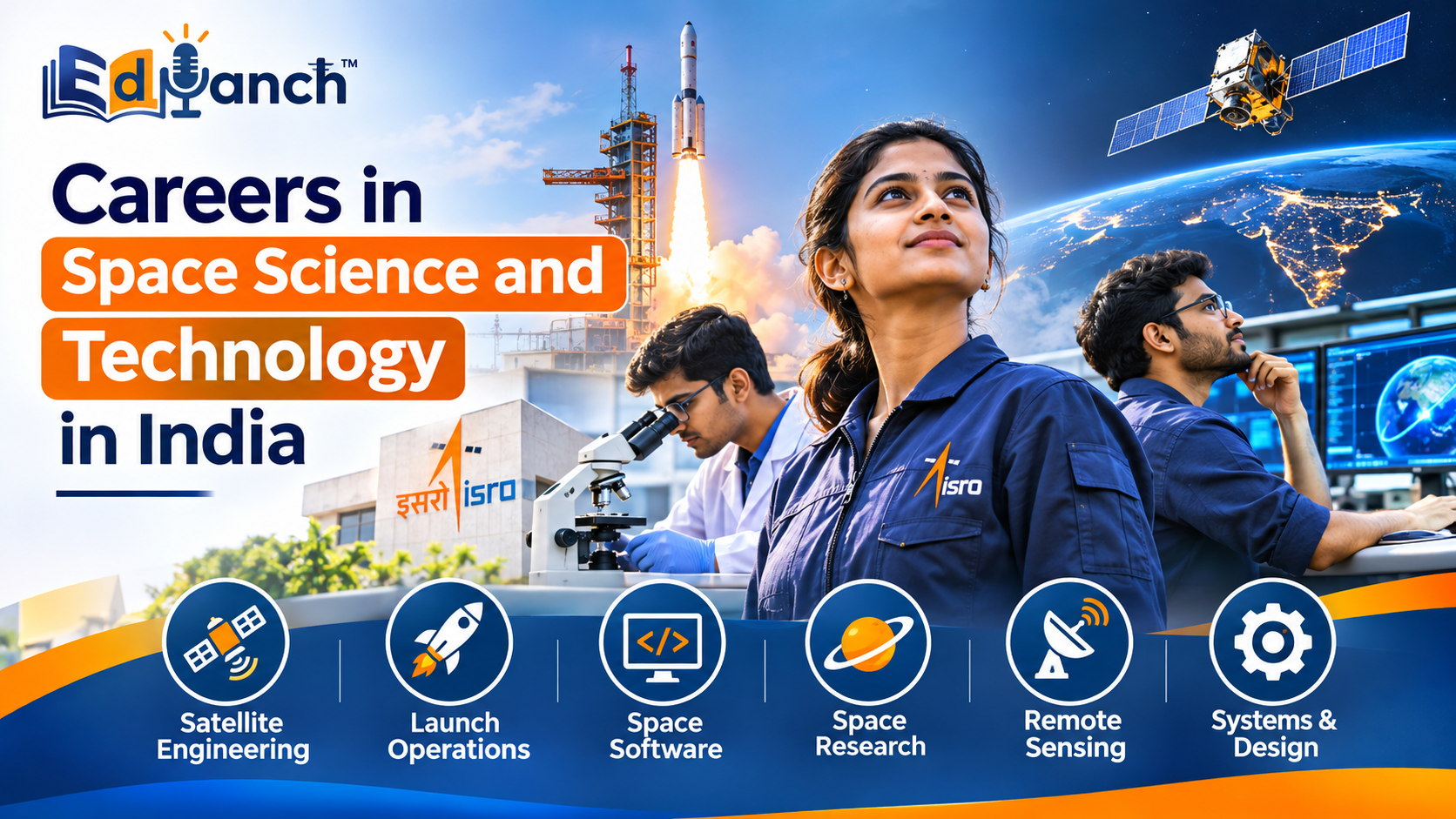
 Careers in space science and technology in India span engineering, research, data science, and private sector roles, offering Indian students diverse, future-ready pathways supported by ISRO and a growing commercial space ecosystem.





Introduction
India's space programme is no longer just a source of national pride. It is fast becoming one of the most exciting career destinations for young professionals in science, engineering, and technology. The successful landing of Chandrayaan-3 near the lunar south pole, the launch of Aditya-L1 to study the Sun, and the growing pipeline of missions from the Indian Space Research Organisation (ISRO) have placed India firmly among the world's most capable space-faring nations.
For students exploring career options today, space science and technology represents a field where ambition, rigorous education, and national purpose intersect. India is investing significantly in space infrastructure, satellite communication, earth observation, and deep space exploration. At the same time, a growing private space industry is opening doors that simply did not exist a decade ago.
This guide is designed to give students, parents, and career counsellors a clear and practical understanding of what a career in space science and technology looks like in India, what educational paths lead there, which organisations are hiring, and what the future holds for professionals in this field.
Understanding Space Science and Technology as a Career Field
Space science and technology is a broad and interdisciplinary domain. It is not limited to astronauts or rocket scientists, although those roles are part of it. The field encompasses a wide range of professional streams, each requiring a different combination of knowledge and skills.
At its core, space science is the study of the universe, celestial bodies, and the physical phenomena that occur beyond Earth's atmosphere. It includes planetary science, astrophysics, solar physics, and space biology. Space technology, on the other hand, refers to the engineering and systems knowledge needed to design, build, launch, and operate spacecraft, satellites, and related ground infrastructure.
What makes this field particularly exciting for Indian students is its interdisciplinary nature. Contributions come from professionals with backgrounds in:
- Physics and mathematics
- Aerospace and mechanical engineering
- Electronics and communication engineering
- Computer science and data analytics
- Chemistry and materials science
- Life sciences and astrobiology
- Geography and remote sensing
A student does not need to come from a single narrow academic background to find a meaningful role in this field. What is required is a strong foundation in science or engineering, a problem-solving mindset, and a willingness to pursue specialised education at the undergraduate or postgraduate level.
Educational Pathways and Qualifications Required
The entry point for most space science and technology careers in India begins at Class 11 and 12 with Physics, Chemistry, and Mathematics as core subjects. Beyond this foundation, the pathway branches depending on whether a student is interested in the science side or the engineering and technology side of the field.
For the engineering and technology track, the most relevant undergraduate degree is a Bachelor of Technology (B.Tech) or Bachelor of Engineering (B.E.) in one of the following disciplines:
- Aerospace Engineering
- Mechanical Engineering
- Electronics and Communication Engineering
- Electrical Engineering
- Computer Science Engineering
Institutions offering B.Tech in Aerospace Engineering include the Indian Institute of Technology (IIT) Bombay, IIT Madras, IIT Kharagpur, Madras Institute of Technology, and PEC University of Technology in Chandigarh.
For the pure science track, students can pursue a Bachelor of Science (B.Sc.) in Physics, Mathematics, or Applied Sciences, followed by a Master of Science (M.Sc.) in Astrophysics, Space Physics, or related fields. The Indian Institute of Science (IISc) in Bengaluru, the National Institute of Science Education and Research (NISER), and the Indian Institutes of Science Education and Research (IISERs) are among the most respected institutions for this pathway.
ISRO itself runs the ISRO Centralised Recruitment Board (ICRB), which conducts recruitment for Scientist or Engineer positions. These positions are open to candidates with a first-class degree in engineering or a Master's degree in science. ISRO also offers the Junior Research Fellowship (JRF) programme and the ISRO Engage initiative, which allows students to participate in live projects.
For those seeking advanced research careers, a PhD in fields such as astrophysics, remote sensing, aerospace systems, or atmospheric sciences opens pathways at ISRO, the Physical Research Laboratory (PRL), the National Atmospheric Research Laboratory (NARL), and Indian universities.
Career Roles and Specialisations in Space Science and Technology
One of the most common misconceptions about space careers is that the only roles available are those of scientists and engineers at ISRO. The reality is significantly more expansive, particularly now that India's private space sector is growing rapidly.
Scientist and Researcher RolesScientists at institutions such as ISRO, PRL, NARL, and the Indian Institute of Astrophysics conduct fundamental and applied research on topics ranging from solar-terrestrial physics to planetary geology. These roles require strong academic credentials and research experience, typically at the postgraduate level or above.
Aerospace and Systems EngineersEngineers play a critical role in the design, development, testing, and operations of spacecraft, launch vehicles, and associated ground systems. Roles include propulsion engineer, structures engineer, guidance and navigation engineer, thermal engineer, and systems integration engineer. ISRO employs a large workforce of engineers across its numerous centres, including the Vikram Sarabhai Space Centre (VSSC) in Thiruvananthapuram, the ISRO Satellite Centre (URSC) in Bengaluru, and the Space Applications Centre (SAC) in Ahmedabad.
Remote Sensing and GIS ProfessionalsIndia's earth observation satellites generate enormous volumes of data used in agriculture, disaster management, urban planning, water resource management, and defence. Professionals trained in remote sensing and Geographic Information Systems (GIS) are in high demand both within ISRO and in government departments, research institutions, and private companies that use satellite data.
Data Scientists and AI/ML EngineersModern space missions generate vast amounts of data. Professionals with expertise in data science, machine learning, and artificial intelligence are increasingly valuable to organisations analysing satellite imagery, modelling space weather, or processing signals from deep space probes.
Private Sector and StartupsThe Indian National Space Promotion and Authorisation Centre (IN-SPACe), established in 2020, has opened the space sector to private players. Companies such as Skyroot Aerospace, Agnikul Cosmos, Bellatrix Aerospace, and Pixxel are building rockets, satellite platforms, and earth observation services. These startups are actively hiring engineers, project managers, software developers, and business professionals who want to contribute to space from outside the government system.
Top Organisations Hiring in India's Space Sector
Understanding where opportunities exist is as important as knowing what qualifications to pursue. The major employers in India's space sector include the following:
- ISRO (Indian Space Research Organisation): The primary government body for space research and operations in India.
- DRDO (Defence Research and Development Organisation): Involved in defence-related aerospace and satellite applications.
- NRSC (National Remote Sensing Centre): A unit of ISRO focused on earth observation and satellite data services.
- Physical Research Laboratory (PRL): A Department of Space institute conducting research in astronomy, astrophysics, and planetary sciences.
- NARL (National Atmospheric Research Laboratory): Focused on atmospheric and space weather research.
- Private aerospace startups: A rapidly expanding cluster of companies under the IN-SPACe framework.
Multinational corporations such as Boeing, Airbus, Honeywell, Thales, and L3Harris also have operations in India and recruit aerospace professionals from Indian universities and institutions.
Salary Expectations and Career Growth
A career in space science and technology in India offers competitive compensation, particularly for those who join ISRO or private sector companies at the engineer or scientist level.
ISRO recruits Scientists or Engineers in Grade SC, with an entry-level pay in the range of approximately Rs 56,100 to Rs 1,77,500 per month under the 7th Central Pay Commission pay matrix. With experience, professionals can progress to higher grades such as SD, SE, SF, and SG, with corresponding increases in responsibility and remuneration.
In the private sector, salaries vary depending on the company, the specific role, and the candidate's experience. Aerospace startups in India typically offer competitive packages to attract talent, particularly in engineering, data science, and product development roles.
For those pursuing academic and research careers, positions at IITs, IISc, and national research laboratories come with structured pay scales, research grants, and opportunities for international collaboration.
Career growth in this field is driven by a combination of technical depth, project contributions, publications, and the ability to work across multidisciplinary teams. Professionals who combine strong domain knowledge with communication skills and project management capabilities tend to advance rapidly.
How Indian Students Can Prepare for a Space Career
Preparing for a career in space science and technology requires deliberate academic planning from an early stage. Students in Class 11 and 12 should focus on building a strong conceptual foundation in Physics and Mathematics. Participating in Olympiads such as the Indian National Astronomy Olympiad (INAO) or the Indian National Physics Olympiad (INPhO) can provide significant academic and competitive advantages.
At the undergraduate level, students should actively seek research internships, participate in student satellite projects, and engage with organisations such as the Student Satellite Programme at IITs or the YUVIKA programme offered by ISRO for school students.
Joining the right postgraduate or doctoral programme, ideally at an institution with active space research collaborations, is a critical next step for those aiming at research careers. Platforms such as Edumanch can help students stay updated on admission cycles, scholarship opportunities, new course launches, and career guidance across India's evolving education landscape.
Conclusion
India's space sector is undergoing a transformation that few could have anticipated even a decade ago. With ISRO achieving milestones that have earned global recognition, and a growing private space industry expanding the ecosystem of opportunities, careers in space science and technology are no longer reserved for a narrow set of elite professionals. They are becoming accessible to students from diverse academic backgrounds who are willing to invest in the right education, build practical skills, and pursue their passion for understanding the universe.
For students in India today, the opportunity to contribute to the country's space ambitions is real, tangible, and growing. The path requires commitment, rigorous preparation, and the right information at the right time. That is precisely the kind of guidance Edumanch is built to provide.
Frequently Asked Questions
Q1: What is the minimum qualification to apply for ISRO?
Candidates must hold a first-class Bachelor's degree in Engineering or Technology, or a Master's degree in Science with Physics or Mathematics as a specialisation. ISRO specifies minimum aggregate marks, typically 65 percent or a CGPA of 6.84 on a 10-point scale, depending on the recruitment notification.
Q2: Can a Biology student build a career in space science?
Yes. Students with a background in life sciences can pursue specialisations such as astrobiology, space medicine, and bioastronautics. These fields study how living organisms survive in space environments and are becoming increasingly relevant as human spaceflight missions are being planned globally and in India.
Q3: Which are the best colleges in India for Aerospace Engineering?
The leading institutions offering Aerospace Engineering programmes in India include IIT Bombay, IIT Madras, IIT Kharagpur, Madras Institute of Technology (MIT Chennai), PEC University of Technology, Manipal Institute of Technology, and Amrita School of Engineering. IISc Bengaluru is the preferred destination for research-focused aerospace careers.
Q4: Is the private space sector in India growing enough to offer stable careers?
India's private space sector has grown considerably since the establishment of IN-SPACe in 2020. Companies such as Skyroot Aerospace, Agnikul Cosmos, and Pixxel have raised significant funding and are progressing toward commercial launches and satellite operations. While the sector is still maturing, the trajectory strongly suggests continued growth in employment opportunities.
Q5: What are the best online resources for students interested in space science careers in India?
Students can explore the ISRO official website for recruitment notifications and educational programmes, the Physical Research Laboratory website for research fellowships, and national education platforms for course guidance and admission updates. Edumanch regularly covers education and career developments in emerging fields including space science, helping students stay informed about opportunities as they arise.
Resources
- Indian Space Research Organisation (ISRO): Official government body for space research in India, providing recruitment, mission updates, and educational programme information.
- IN-SPACe (Indian National Space Promotion and Authorisation Centre): The regulatory and promotional body overseeing private sector participation in India's space activities.
- Physical Research Laboratory (PRL): A Department of Space institution offering research fellowships and postgraduate programmes in space and atmospheric sciences.
- University Grants Commission (UGC): Provides information on approved universities and postgraduate programmes relevant to space science education in India.
- National Remote Sensing Centre (NRSC): Offers data, training programmes, and career pathways in earth observation and satellite-based applications.
Interlinking Keywords
Careers in space science India, ISRO recruitment, aerospace engineering colleges India, space technology courses, remote sensing careers, IN-SPACe private sector, astrophysics programmes India, student satellite projects, space science after 12th, ISRO Scientist Engineer
Last reviewed by:
Dr. Manthan Tripathi, Edumanch Editorial and Education Guidance Team on November 12, 2026.
Disclaimer
The information provided in this article is intended for general educational and career guidance purposes only. It does not constitute professional academic counselling, official recruitment advice, or any form of institutional endorsement. Salary figures, qualification criteria, and organisational details are based on publicly available information at the time of writing and may change over time. Readers are advised to verify all details directly from official sources such as the ISRO website, university prospectuses, and relevant government portals before making any academic or career decisions. Edumanch does not take responsibility for decisions made solely on the basis of this content.