 Monday, November 16, 2026
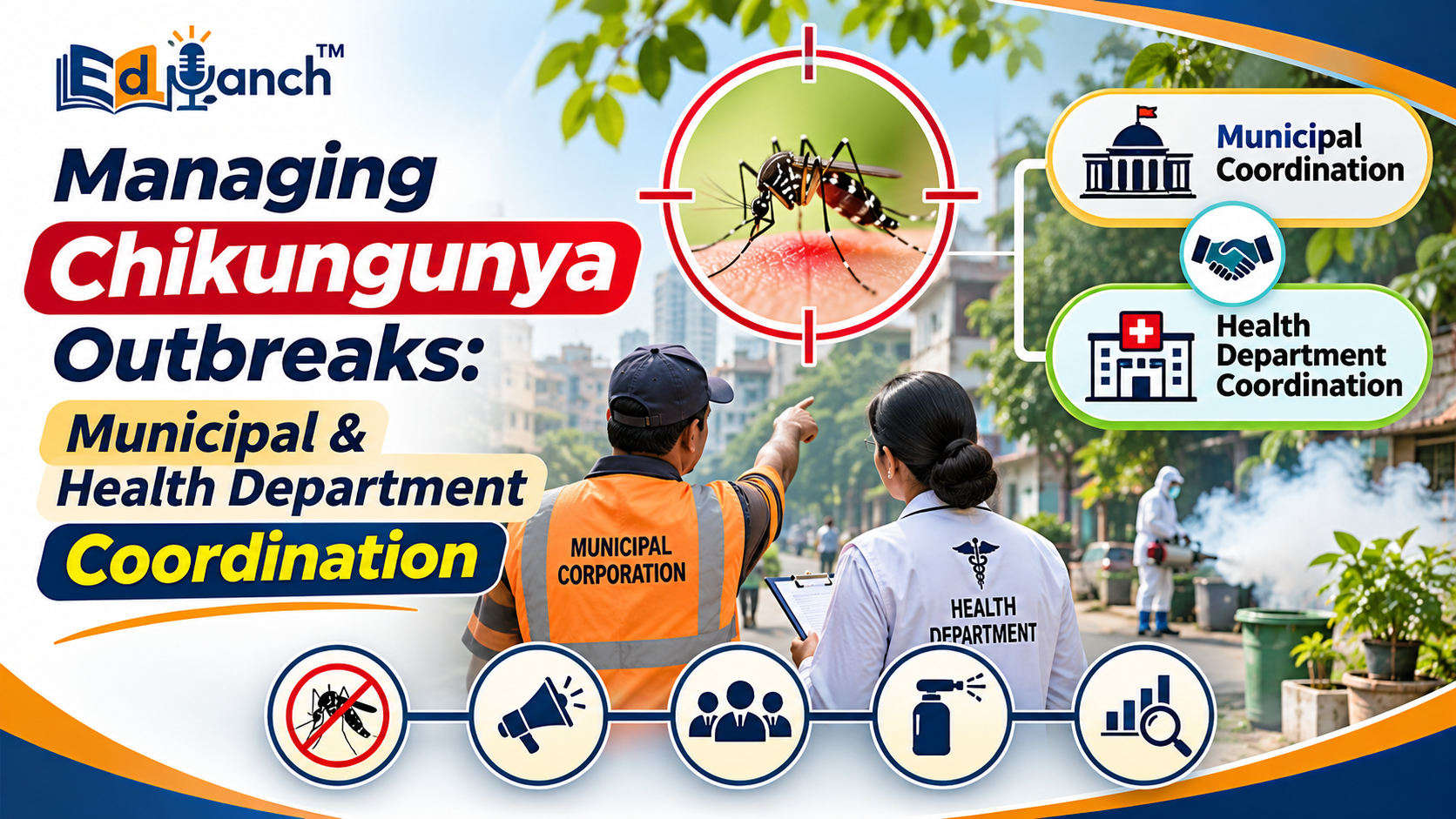
 Managing chikungunya outbreaks requires effective coordination between municipal authorities and health departments. Joint efforts in mosquito control, public awareness, sanitation, and disease monitoring help prevent the spread of infection.





Executive Overview: The Urban Vector Challenge and Institutional Fragmentation
Chikungunya is a debilitating, mosquito-borne viral illness caused by an alphavirus of the family Togaviridae, primarily transmitted to humans through the bites of infected female Aedes mosquitoes (Aedes aegypti and Aedes albopictus). Unlike malaria vectors that typically breed in rural or semi-natural water bodies and feed nocturnally, Aedes mosquitoes are urbanized, daylight-feeding anthropophilic vectors that breed prolifically in artificial, man-made domestic and peri-domestic water collections.
During an outbreak, the clinical presentation is marked by abrupt high fevers, severe polyarthralgias, incapacitating joint swelling, tenosynovitis, and maculopapular exanthem. While mortality is relatively low compared to severe dengue, the secondary economic impact, loss of workforce productivity, and long-term morbidity from chronic, persistent post-chikungunya arthritis are severe.
The fundamental barrier to managing urban Chikungunya outbreaks is institutional fragmentation:
- The Public Health vs. Municipal Divide: Public Health Departments track epidemiological data, manage hospital bed capacity, conduct laboratory diagnostics (RT-PCR and IgM ELISA), and treat patients. However, health departments possess zero authority over municipal solid waste collection, storm-water drainage maintenance, construction-site licensing, or urban water distribution.
- The Municipal Enforcement Deficit: Municipal Corporations, urban local bodies (ULBs), and civil engineering departments control sanitation, water logistics, building code enforcement, and public works. Yet, municipal authorities frequently lack epidemiological intelligence, operating vector control reactively—such as conducting indiscriminate thermal fogging only after community outrage—rather than deploying data-driven, preemptive larval source reduction.
- The Inter-Sectoral Breakdown: When health departments identify clustering cases but fail to transmit geographic coordinates instantly to municipal engineering teams, the clinical window for localized vector containment closes. Aedes mosquito lifecycles accelerate in tropical ambient temperatures (egg-to-adult transition in 7 to 10 days), allowing transmission chains to outrun slow inter-agency paperwork.
Controlling Chikungunya demands an institutionalized, inter-sectoral command model:
- Establishing real-time epidemiological and entomological data-sharing pipelines between hospital surveillance systems and municipal sanitation teams.
- Deploying targeted Integrated Vector Management (IVM) that balances source reduction, biological controls, and judicious chemical adulticiding.
- Engineering municipal infrastructure to resolve chronic urban water storage dependencies and unmanaged stormwater accumulation.
- Institutionalizing legal frameworks that empower municipal sanitary inspectors to penalize mosquito breeding violations on private, commercial, and construction properties.
1. Entomological Dynamics and Environmental Drivers of Aedes Proliferation
Designing an operational coordination framework requires understanding the biological characteristics and micro-environmental preferences of the vector:
Bionomics of Aedes aegypti and Aedes albopictus- Daytime Biting Rhythm: Aedes mosquitoes exhibit bimodal diurnal biting peaks—predominantly early morning (just after dawn) and late afternoon (before dusk). Interventions focused on nocturnal bed nets, while effective for malaria, offer limited protection against Chikungunya; vector control must focus on daytime exposure zones (schools, offices, construction zones, and day-care facilities).
- Container-Breeding Ecology: Aedes does not breed in open sewage drains or polluted rivers. They require clean or lightly turbid non-flowing water. Preferred micro-habitats include discarded automotive tires, plastic containers, overhead water tanks with broken lids, desert air coolers, flower vase saucers, elevator construction shafts, and unsealed rainwater catchment cisterns.
- Desiccation-Resistant Eggs: Aedes eggs possess extreme chorionic desiccation resistance. Female mosquitoes deposit eggs on the inner damp walls of containers just above the waterline. These eggs can remain viable in completely dry conditions for up to six to nine months, hatching within hours once reflooded by monsoon rains or domestic refilling. This biological trait creates explosive seasonal post-monsoon outbreaks.
- Intermittent Municipal Water Supply: When municipalities deliver piped water for only two to three hours every couple of days, residents are forced to store water in large plastic drums, metal containers, and concrete cisterns. If left uncovered or covered with porous cloth, these domestic storage units become permanent, indoor mosquito breeding nurseries.
- Solid Waste Disposal Deficits: Inadequate municipal plastic waste collection leaves non-biodegradable single-use plastics, discarded coconut shells, and construction debris across vacant urban plots, creating thousands of micro-breeding sites during rain events.
2. Structural Architecture: Joint Inter-Sectoral Coordination Protocols
Effective epidemic response requires formal administrative alignment that bridges the gap between public health surveillance and municipal engineering operations.
The Joint Epidemic Control Command (JECC)Municipalities and health departments must merge their authority under a unified operational room:
- Leadership Structure: The Municipal Commissioner and the Chief District Medical Officer (CDMO) serve as joint directors, supported by the Municipal Health Officer, City Chief Engineer, Head of Public Works, and lead Vector-Borne Disease Officers.
- Daily Incident Action Cadence: During active outbreak phases (defined by localized clusters of acute febrile polyarthralgia), the JECC convenes daily operational briefings to review new clinical admissions, laboratory confirmations, Breteau Indices, and localized fogging coverage, directing resources within twenty-four hours.
- Case-Based Geotagging: Government clinics, tertiary medical colleges, private hospitals, and commercial diagnostic laboratories must be mandated under public health acts to report every suspected and confirmed Chikungunya case within twelve hours of clinical presentation via an integrated digital disease surveillance portal.
- The 100-Meter Rapid Response Radius: The effective flight range of Aedes aegypti is short, rarely exceeding 50 to 100 meters from its larval emergence site. When a cluster of two or more cases is confirmed, the system immediately generates an automated 100-Meter Containment Zone around the patient's residence.
- Automated Dispatch to Municipal Ward Teams: The digital alert routes directly to the specific Municipal Ward Sanitation Inspector, triggering an immediate deployment of a combined vector containment squad within the 100-meter zone within twenty-four hours.
3. Integrated Vector Management (IVM): Operationalizing Field Control
Vector control cannot rely on single, reactive interventions. Integrated Vector Management coordinates physical, biological, and chemical methodologies across distinct life stages of the mosquito:
1. Source Reduction and Environmental Management (The Primary Pillar)Environmental management removes vector breeding habitats permanently:
- The "Dry Day" Institutionalization: Municipalities and public health teams enforce a mandatory weekly "Dry Day" across all public offices, schools, colleges, and commercial establishments. On this designated day, all desert air coolers, overhead cisterns, decorative fountains, and secondary storage containers must be drained, scrubbed to dislodge desiccation-resistant eggs, and left dry for twenty-four hours.
- Construction Site Compliance: Unfinished basements, elevator shafts, and curing tanks on active construction sites represent massive commercial breeding grounds. Municipal engineering departments must mandate weekly application of chemical larvicides or de-watering pumping on all active sites, enforcing stop-work notices against non-compliant builders.
When water containers cannot be drained or scrubbed:
- Chemical Larvicides: Applying granular formulations of organophosphates (such as Temephos 1% SG at a concentration of 1 mg/L) or Insect Growth Regulators (such as Diflubenzuron or Pyriproxyfen) to non-potable static water collections, blocking larval development and adult emergence.
- Biological Control via Larvivorous Fish: Municipal hatcheries breed and distribute larvivorous fish species (Gambusia affinis and Poecilia reticulata / Guppies) to rural and urban water bodies, ornamental ponds, and large institutional storage sumps.
- Biolarvicides (Bacillus thuringiensis israelensis - Bti): Applying formulations of Bti to domestic water containers and sensitive environmental zones. The delta-endotoxin synthesized by Bti specifically targets the gut epithelium of mosquito larvae upon ingestion without causing chemical toxicity to humans, birds, or aquatic ecosystems.
- The Misconception of Routine Fogging: Thermal fogging (using pyrethroids such as Malathion, Deltamethrin, or Cyphenothrin) kills only adult mosquitoes resting in the immediate air path at the moment of application. It has zero residual killing efficacy against larvae or protected resting adults.
- Clinical Protocol for Fogging: Outdoor thermal fogging should be restricted to acute, emergency containment within the 100-meter radius of confirmed clinical clusters, timed precisely to match peak Aedes biting activity (early morning or late afternoon). Indiscriminate night-time fogging wastes public resources and breeds false public security while missing daylight-active Aedes vectors.
- Targeted Indoor Space Spraying: Where permitted, deploying cold-aerosol Ultra-Low Volume (ULV) formulations inside houses within high-density transmission clusters to neutralize infected adult female mosquitoes resting in dark indoor closets, under furniture, and behind drapes.
4. Structural Comparison: Reactive Public Health vs. Integrated Municipal Coordination
Evaluating conventional, siloed health responses alongside an integrated municipal-health operational model illustrates how structural design reshapes epidemic curves:
Surveillance Velocity and Case Reporting- Siloed Public Health Model: Relies on slow, manual paper records and weekly district health reports; cases from private clinics and private laboratories are largely unrecorded; response begins weeks after transmission has generalized.
- Integrated Municipal-Health Model: Mandates automated, digital, case-based geotagging across both public and private health networks within 12 hours; triggers instant automated municipal containment workflows within a 100-meter radius.
- Epidemiological Outcome: Eliminates blind spots; isolates localized transmission chains before the virus expands across adjacent municipal wards.
- Siloed Public Health Model: Relies on reactive, highly visible outdoor thermal fogging conducted along main roadways after public complaints, with minimal larvicide application.
- Integrated Municipal-Health Model: Deploys stratified Integrated Vector Management: continuous physical source reduction, systematic chemical/biological larviciding, and targeted indoor/outdoor ULV adulticiding locked to transmission clusters.
- Epidemiological Outcome: Neutralizes the reproductive engine of the mosquito population rather than merely killing a small fraction of flying adults.
- Siloed Public Health Model: Health departments distribute leaflets instructing citizens to cover water, with zero authority over municipal water delivery schedules, drainage clearing, or construction licensing.
- Integrated Municipal-Health Model: Municipal public works departments re-engineer water supply schedules to minimize domestic storage, clear solid plastic waste from open drainage networks, and enforce strict vector sanitation mandates on construction licenses.
- Epidemiological Outcome: Eliminates the underlying environmental conditions that fuel recurrent urban vector proliferation.
- Siloed Public Health Model: Public health advisories are voluntary; health inspectors possess limited legal authority to inspect private residential premises or issue binding monetary fines.
- Integrated Municipal-Health Model: Municipal sanitary inspectors exercise statutory authority under municipal corporation acts and epidemic regulations, issuing formal notices, levying escalating fines, and sealing non-compliant commercial sites.
- Epidemiological Outcome: Enforces widespread community and commercial compliance across gated communities, housing societies, and industrial sectors.
5. Community Mobilization, Legal Enforcement, and Behavioral Change
Vector control fails if treated purely as an administrative exercise. Domestic breeding occurs inside private homes, requiring civic participation reinforced by statutory authority.
The Institutional "Asha-Anganwadi-Sanitary" Triad- Community Health Workers (ASHAs), Anganwadi workers, and municipal sanitary personnel operate as integrated house-to-house inspection teams.
- Teams execute weekly physical inspections: checking indoor desert coolers, refrigerator defrost trays, overhead water tanks, and discarded terrace clutter.
- Inspection teams calculate the Breteau Index (number of positive containers per 100 houses) and House Index (percentage of houses with positive breeding), feeding raw entomological telemetry directly into the municipal GIS dashboard.
- Municipal Notices and Fines: Under the Epidemic Diseases Acts and Municipal Corporation bylaws, municipal sanitary officers must be authorized to issue immediate legal notices to property owners, residential housing societies, and commercial developers harboring active mosquito breeding.
- Graduated Penalty Scales: Instituting escalating structural fines: nominal citations for initial residential offenses, escalating to heavy commercial fines and temporary revocation of building construction permits for persistent industrial breeding sites.
6. Phased Implementation Protocol: The 4-Phase Outbreak Management Roadmap
Transitioning municipal and health administrative bodies into a synchronized outbreak containment engine requires an organized four-phase operational strategy:
- Phase 1: Pre-Monsoon Preparedness and Infrastructure Hardening (Months 1 to 2):
- Establish the Joint Epidemic Control Command (JECC) co-chaired by the Municipal Commissioner and Chief District Medical Officer.
- Audit and clean urban stormwater drains, clearing silt and non-biodegradable plastic debris before seasonal rains begin.
- Introduce larvivorous fish into all perennial public water bodies, community tanks, and institutional ponds.
- Stockpile essential diagnostic reagents (RT-PCR and IgM ELISA kits) across district health laboratories, alongside adequate municipal reserves of Temephos, Bti, and pyrethroid adulticides.
- Phase 2: Active Transmission Surveillance and Cluster Interception (Months 3 to 4):
- Activate mandatory real-time digital case reporting across all public clinics, private hospitals, and diagnostic pathology centers.
- Launch house-to-house larval surveillance, calculating Ward-level Breteau Indices weekly to identify high-risk urban hot-spots.
- Execute targeted indoor and outdoor space spraying within 100 meters of any confirmed Chikungunya cluster within twenty-four hours of clinical notification.
- Enforce the mandatory weekly institutional "Dry Day" across all schools, government complexes, commercial offices, and transit hubs.
- Phase 3: Peak-Outbreak Surge Stabilization and Emergency Containment (Months 5 to 6):
- Convene daily JECC operational briefings to coordinate hospital bed capacity, dedicated orthopedic and fever triage clinics, and non-steroidal anti-inflammatory drug (NSAID) availability.
- Deploy mobile municipal vector containment units equipped with vehicle-mounted cold aerosol ULV machines across high-incidence wards.
- Deploy joint municipal-police enforcement squads to conduct unscheduled inspections of construction sites, bus depots, and scrap-tire yards, levying immediate administrative fines for breeding violations.
- Phase 4: Post-Outbreak Evaluation and Long-Term Infrastructure Engineering (Months 7 to 8):
- Transition clinical facilities into chronic post-chikungunya rheumatological support tracks, managing long-term arthralgias and joint inflammation.
- Execute a comprehensive post-epidemic audit: reviewing case mapping against municipal water supply schedules and drainage bottlenecks to isolate root infrastructure failures.
- Amend urban town planning bylaws to mandate that all new residential and commercial building plans feature screened overhead tanks, subterranean drainage systems, and insect-screened ventilation shafts.
Strategic Summary: The Unified Urban Defense Blueprint
Chikungunya is fundamentally an environmental and governance challenge manifesting as a clinical pathology. Relying exclusively on hospital beds, oral analgesics, or reactive roadside thermal fogging guarantees seasonal epidemics.
By replacing fragmented departmental operations with a Joint Epidemic Control Command, integrating real-time GIS case surveillance with automated 100-meter containment dispatches, deploying disciplined Integrated Vector Management focused on larval source reduction, and leveraging municipal regulatory authority to enforce civic compliance, urban administrations can dismantle the transmission machinery of Aedes mosquitoes.
This multi-sectoral approach safeguards public health, protects workforce productivity, and builds resilient urban infrastructure capable of withstanding vector-borne disease threats across generations.
10 Frequently Asked Questions (FAQs)
Q1. What is the fundamental difference between the mosquitoes that spread Malaria and those that spread Chikungunya?Malaria is transmitted by Anopheles mosquitoes, which are nocturnal biters (biting predominantly from dusk to dawn) that breed in natural, clean, rural or semi-urban ground pools.
Chikungunya is transmitted by Aedes mosquitoes (Aedes aegypti and Aedes albopictus), which are daylight biters (with peak biting activity shortly after sunrise and before sunset) that breed in artificial, man-made domestic containers (plastic buckets, discarded tires, desert air coolers, and overhead tanks) in urban environments.
Q2. Why is thermal fogging along city streets often ineffective at stopping a Chikungunya outbreak?Thermal fogging along public roadways kills only the adult flying mosquitoes that happen to be directly exposed to the chemical cloud at that specific moment:
- It has zero residual killing effect and does not kill eggs, larvae, or pupae.
- Aedes aegypti rests primarily indoors in dark closets, behind furniture, and inside bedrooms, completely sheltered from street-level fogging trucks.
- Unless paired with aggressive indoor physical source reduction and larviciding to destroy the breeding sites, new adult mosquitoes will emerge within 48 to 72 hours, continuing transmission.
Because Aedes aegypti mosquitoes have weak flight capability and rarely travel more than 50 to 100 meters from where they hatch:
- The appearance of a Chikungunya case indicates that the infected mosquito emerged within that immediate neighborhood.
- A 100-meter containment protocol immediately establishes a geographic zone around the patient's home where combined municipal and health teams inspect every residence, eliminate all standing water collections, apply larvicides, and perform localized indoor and outdoor space spraying within twenty-four hours.
Female Aedes mosquitoes lay their eggs on the damp inner walls of domestic containers above the waterline.
These eggs can dry out completely and remain dormant and viable for six to nine months:
- When seasonal monsoon rains arrive or dry containers are refilled with municipal water, these dormant eggs rehydrate and hatch within hours.
- This results in an immediate, explosive surge of adult mosquitoes across a city, even in areas that had been dry for months.
When municipalities provide piped water for only an hour or two every few days:
- Residents are forced to store water in large drums, buckets, plastic containers, and underground cisterns.
- Because these domestic containers are often improperly sealed or left open, they become perfect artificial breeding sites for Aedes mosquitoes inside homes, directly driving outbreaks.
The Breteau Index (BI) is an entomological metric calculating the number of positive mosquito-breeding containers per 100 inspected houses:
- If municipal surveillance records a Breteau Index above 20 in a specific ward, it indicates a high density of vector breeding and an elevated risk of explosive viral transmission.
- This automated data signal directs vector control teams to flood that specific ward with intensive source reduction and larviciding before clinical hospital cases spike.
Bti is a naturally occurring soil bacterium that produces specific crystalline protein toxins (delta-endotoxins):
- When mosquito larvae ingest Bti in standing water, their alkaline gut digestive enzymes activate the toxin, destroying the larval stomach lining and killing them within hours.
- Bti is non-toxic to humans, mammals, fish, and beneficial aquatic life, making it an ideal biological larvicide for domestic and environmental water treatment.
Under statutory Municipal Corporation Acts and Public Health/Epidemic Regulations:
- Municipal sanitary inspectors and designated health officers possess the legal authority to enter private commercial properties, residential compounds, and construction yards during reasonable hours to inspect for public health nuisances.
- If active mosquito breeding is documented, inspectors can issue legally binding notices, levy escalating financial fines, and, in severe cases of commercial negligence, issue stop-work orders or temporarily suspend operating business licenses.
In the early acute febrile phase, the clinical symptoms of Chikungunya overlap significantly with Dengue fever:
- If a patient actually has Dengue, taking aspirin, ibuprofen, or other NSAIDs impairs platelet aggregation and can trigger severe internal hemorrhage or gastrointestinal bleeding.
- Patients presenting with acute fever and joint pain should be managed exclusively with paracetamol (acetaminophen) and aggressive oral hydration until Dengue is definitively ruled out by laboratory diagnostics.
Take three prioritized, collaborative actions:
- Activate the Joint Incident Command: Form a single command room co-chaired by the Municipal Commissioner and Chief District Medical Officer to direct public health and sanitation teams under one unified operational plan.
- Launch Real-Time Digital Case Geotagging: Mandate that all private and public clinics report suspected Chikungunya cases digitally within 12 hours, automatically generating 100-meter containment zones on a shared municipal GIS map.
- Deploy Joint Larval Interception Squads: Dispatch combined municipal sanitation workers and community health workers to inspect homes, destroy breeding containers, and apply Bti/Temephos larvicides within the identified 100-meter cluster radius within 24 hours of notification.