 Monday, November 16, 2026
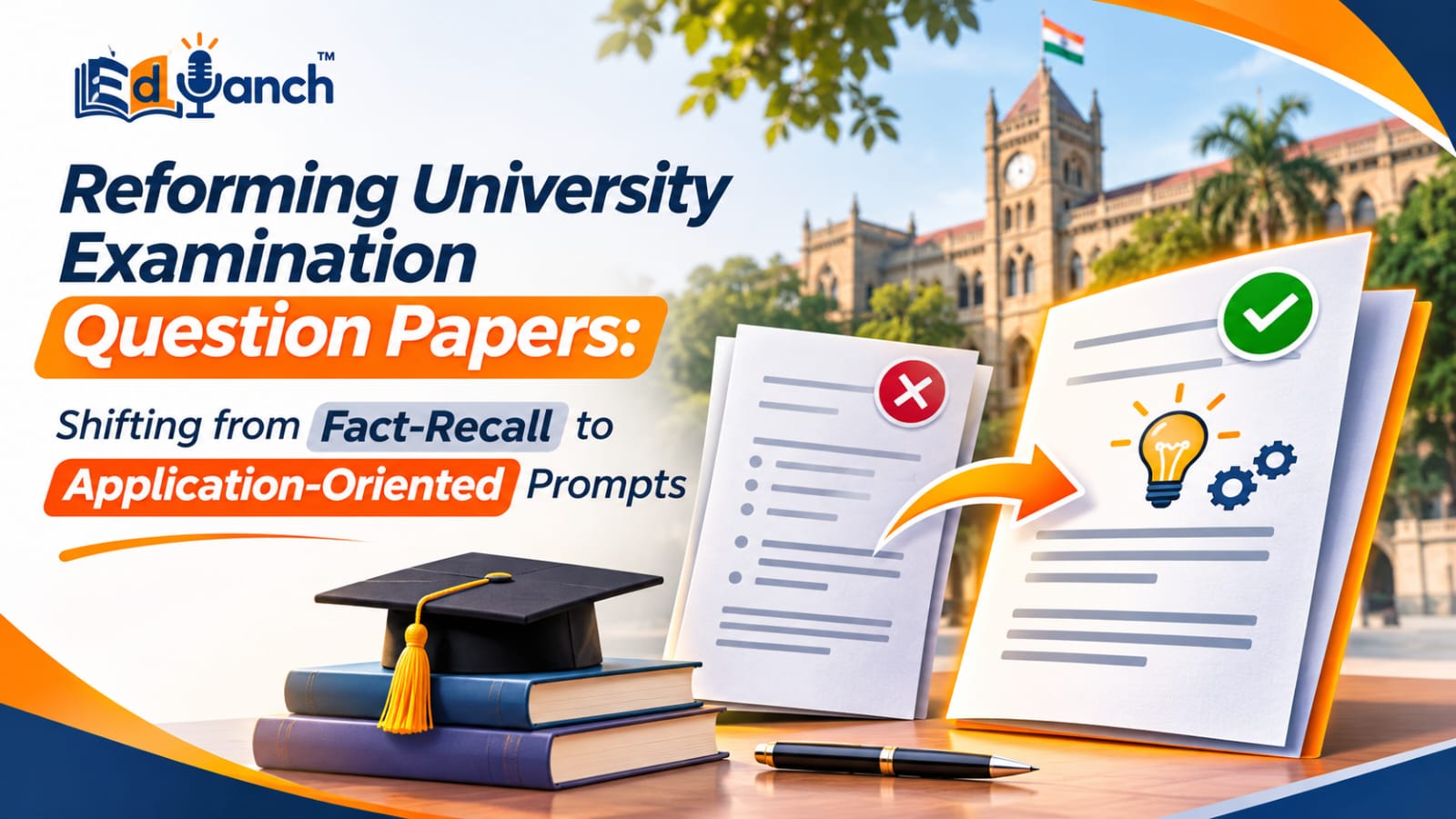
 University examination reforms focus on moving beyond memorization towards application-based learning. Practical and analytical questions encourage students to develop critical thinking and real-world problem-solving skills.





Executive Overview: The Legacy Assessment Trap in Higher Education
Higher education systems globally face a critical pedagogical misalignment: while university curricula claim to prepare graduates for complex, ambiguous, and rapidly evolving professional landscapes, summative examination papers overwhelmingly test lower-order cognitive retention. Decades of institutional inertia have preserved an assessment culture dominated by factual regurgitation, definition recitation, and algorithmic repetition.
Students are routinely prompted to "State," "Define," "List," or "Describe," rewarding rote memorization over conceptual transference, critical synthesis, and real-world problem-solving.
This reliance on fact-recall assessments produces severe systemic dysfunctions:
- The "Surface Learning" Incentive: When terminal examinations reward the verbatim reproduction of lecture notes or textbook chapters, students adopt surface-level cramming techniques. Information is temporarily stored in short-term working memory to pass the examination, only to undergo rapid cognitive decay immediately post-assessment.
- The Artificial Intelligence Vulnerability: Large language models and automated technical solvers can generate instant, flawless answers to standard fact-recall and textbook-derivative questions. Examinations that fail to evaluate contextual judgment, nuanced trade-off analysis, or multi-layered application are rendered obsolete in the era of generative computational tools.
- The Employability Disconnect: Industry stakeholders consistently report that graduates possess theoretical domain familiarity but cannot troubleshoot non-standard operational failures, analyze ambiguous datasets, or cross-apply foundational theories to real-world workplace scenarios.
Reforming university examination papers requires moving beyond incremental adjustments.
It demands an integrated, evidence-based overhaul of question architecture:
- Anchoring assessment design in revised cognitive taxonomies to eliminate lower-order rote prompts.
- Mastering the engineering of authentic, scenario-driven, and vignette-based application prompts.
- Modernizing grading architecture through standardized, competency-based analytic rubrics.
- Aligning examination reform with institutional accreditation benchmarks, Outcome-Based Education (OBE) frameworks, and national educational policies.
1. Cognitive Taxonomy Alignment: Deconstructing the Rote Examination Culture
To systematically overhaul examination papers, academic boards and examination committees must understand how traditional prompts fail to engage higher-order cognitive processing.
Bloom's Revised Taxonomy and Cognitive HierarchyThe cognitive framework developed by Anderson, Krathwohl, and colleagues categorizes cognitive processes across six distinct ascending levels:
- Level 1 (Remembering): Retrieving, recognizing, and recalling relevant factual knowledge from long-term memory.
- Level 2 (Understanding): Constructing meaning from instructional messages through interpreting, exemplifying, classifying, summarizing, inferring, comparing, and explaining.
- Level 3 (Applying): Carrying out or executing a procedure, formula, or theoretical construct in a given, novel situation.
- Level 4 (Analyzing): Breaking material into constituent parts, determining how the parts relate to one another and to an overall structure or purpose.
- Level 5 (Evaluating): Making judgments based on explicit criteria, empirical evidence, and professional standards.
- Level 6 (Creating): Putting elements together to form a coherent or functional whole; reorganizing elements into a novel pattern, prototype, or structure.
In conventional university examinations, up to seventy to eighty percent of allocated marks assess Levels 1 and 2.
Exam papers ask students to reproduce standard proofs, recite historical treaties, list biological classifications, or state economic laws.
A reformed examination architecture inverts this balance: mandating that at least sixty to seventy percent of aggregate paper marks assess Level 3 (Applying), Level 4 (Analyzing), and Level 5 (Evaluating), restricting basic recall to low-stakes continuous assessments.
2. Engineering the Application-Oriented Prompt: Operational Design Principles
Transforming a question from a memory check into an intellectual simulation requires specific instructional engineering techniques. The goal is to evaluate whether a student can wield knowledge as an operational tool rather than an abstract museum piece.
The Scenario-Based Vignette FrameworkApplication prompts must present an authentic, contextual narrative containing relevant operational parameters, conflicting priorities, and realistic constraints:
- The Context Anchor: Establish a realistic scenario involving an engineering failure, a clinical presentation, a corporate balance sheet anomaly, or a public policy dilemma.
- The Data Injection: Provide authentic artifacts: raw diagnostic telemetry, contradictory witness testimonies, excerpts from corporate contracts, or non-linear experimental datasets.
- The Controlled Noise Factor: Include a minor amount of authentic, irrelevant data (noise) to test whether the student can identify, filter, and extract salient variables rather than plugging every supplied number into a memorized formula.
- The Divergent Action Directive: Direct the student to diagnose the root cause, evaluate competing solutions, calculate optimized resource allocations, or draft an actionable mitigation strategy under stated physical, financial, or ethical constraints.
- Engineering Example:
- Legacy Rote Prompt: "Explain the working principle of a four-stroke internal combustion engine and list its four thermodynamic cycles."
- Reformed Application Prompt: "A commercial delivery fleet operating in an arid environment reports persistent engine overheating and knocking under peak cargo loads. Analyze the provided cylinder pressure-volume telemetry curves, determine the primary operational failure point across the thermodynamic cycle, and recommend two engineering design modifications to mitigate knocking without reducing fuel efficiency."
- Business and Economics Example:
- Legacy Rote Prompt: "Define Price Elasticity of Demand and explain the differences between elastic and inelastic goods."
- Reformed Application Prompt: "A municipal public transit authority faces an operating budget deficit of fifteen percent. The director proposes a twenty-five percent fare hike across all routes. Utilizing the supplied commuter demographic data, route utilization tables, and local fuel pricing indices, evaluate the projected fiscal outcome of this policy, identify secondary economic consequences on low-income suburban corridors, and propose an alternative price discrimination structure."
- Biomedical Sciences Example:
- Legacy Rote Prompt: "Describe the pharmacological mechanism of action of Angiotensin-Converting Enzyme (ACE) Inhibitors."
- Reformed Application Prompt: "A 62-year-old patient with type 2 diabetes and stage 3 chronic kidney disease presents with persistent hypertension (160/95 mm Hg) and new-onset bilateral ankle edema. Contrast the physiological trade-offs of initiating an ACE inhibitor versus a dihydropyridine calcium channel blocker in this patient, evaluate the risk of acute hyperkalemia, and outline the mandatory biochemical monitoring parameters required within fourteen days of initiation."
3. Structural Comparison: Fact-Recall vs. Application-Oriented Examination Architectures
Evaluating traditional examination papers alongside modernized application-oriented frameworks illustrates how structural design reshapes cognitive engagement and academic integrity:
Cognitive Focus and Intellectual Demand- Traditional Fact-Recall Papers: Focuses on passive retrieval; evaluates short-term memory capacity, handwriting transcription speed, and textbook verbatim replication.
- Reformed Application Papers: Focuses on active synthesis; evaluates conceptual transference, data interpretation, diagnostic reasoning, and multi-variable problem-solving under constraints.
- Student Preparation Impact: Traditional models incentivize cramming and question-bank memorization; reformed models incentivize deep understanding, peer collaboration, and continuous conceptual application.
- Traditional Fact-Recall Papers: Extremely high vulnerability; AI tools can generate complete, top-percentile answers to memorization questions within seconds.
- Reformed Application Papers: Highly resilient; contextual vignettes with specific, proprietary data parameters require human judgment, critique of contradictory evidence, and nuanced contextual synthesis.
- Academic Integrity Impact: Eliminates the value of illicit electronic lookup; prompts evaluate the reasoning process rather than the final raw fact.
- Traditional Fact-Recall Papers: Binary and rigid; answers are either right or wrong according to a standardized lecture key; rewards compliance over intellectual bravery.
- Reformed Application Papers: Evaluates reasoned defense; accepts multiple divergent technical pathways provided the student justifies their methodology using empirical evidence and sound theory.
- Professional Competency Impact: Mirrors real-world workplace environments where problems rarely have a single, clean, pre-determined textbook solution.
- Traditional Fact-Recall Papers: Fast, mechanical grading; evaluators can scan for specific keywords or memorized paragraphs with minimal cognitive effort.
- Reformed Application Papers: Requires trained academic evaluators utilizing standardized, multi-criteria analytic rubrics; demands higher cognitive engagement from the faculty grader.
- Institutional Resource Impact: Requires investments in faculty grading calibration, sample moderation sessions, and explicit rubric development.
4. The Grading Infrastructure: Standardized Analytic Rubrics
A significant barrier to reforming examination papers is the fear of subjective grading. When questions move away from memorized textbook answers, grading cannot depend on an evaluator's passing mood.
Universities must replace vague answer keys with Standardized Competency-Based Analytic Rubrics.
The Anatomy of an Application Scoring RubricEvery application-oriented question must be paired with an explicit rubric published to evaluators prior to grading:
- Criterion 1: Problem Diagnosis and Variable Identification (25%): Did the candidate accurately identify the core operational issue and isolate the relevant physical, financial, or clinical variables from the scenario background?
- Criterion 2: Methodological Application and Theoretical Rigor (35%): Did the candidate apply the appropriate formulas, theoretical frameworks, or legal doctrines correctly, demonstrating mathematical and conceptual precision?
- Criterion 3: Critical Analysis of Trade-offs and Constraints (25%): Did the candidate evaluate the real-world consequences, limitations, failure points, and ethical dimensions of their proposed solution?
- Criterion 4: Coherence and Technical Justification (15%): Is the argument structured logically, supported by clear mathematical derivations or evidence-based prose, and communicated with appropriate technical vocabulary?
To ensure absolute grading parity across large university student cohorts:
- The "Blind Benchmark" Calibration: Before general grading commences, the head examiner and course instructors collectively evaluate five anonymized student scripts using the analytic rubric, resolving scoring discrepancies and anchoring the grading baseline.
- Double-Blind Sample Moderation: Ten percent of all graded scripts are routed to a secondary evaluator without visible previous marks; if score variances exceed ten percent, the script is submitted to a departmental moderation panel for final adjudication.
5. Phased Institutional Roadmap: Scaling Examination Reform
Transitioning a university department, faculty senate, or collegiate system from legacy recall tests into an accredited application-oriented examination ecosystem requires an organized four-phase operational strategy:
The institutional rollout follows four sequential, compounding phases:
- Phase 1: Institutional Auditing and Blueprint Formulation (Months 1 to 3):
- Audit historical examination papers to classify questions across Bloom's Taxonomy.
- Formulate the Institutional Examination Blueprint, mandating that 60% or more of marks target higher-order levels.
- Establish Departmental Assessment Steering Committees across all academic faculties.
- Phase 2: Faculty Upskilling and Question-Bank Engineering (Months 4 to 6):
- Conduct faculty workshops on scenario-based vignette design and case drafting.
- Author new, peer-vetted application-oriented question repositories paired with analytic rubrics.
- Run student orientation workshops demystifying application question formats and grading criteria.
- Phase 3: Pilot Deployment and Moderation Run (Months 7 to 9):
- Deploy reformed question papers across twenty-five percent of gateway undergraduate core courses.
- Permit curated open-book reference aids, formula sheets, or approved digital databases during exams.
- Execute double-blind grading calibrations and collect faculty-student sentiment metrics.
- Phase 4: Full Institutionalization and National Grid Alignment (Months 10 to 12):
- Scale application-oriented examination models across one hundred percent of academic programs.
- Align assessment data with Outcome-Based Education (OBE) course attainment frameworks.
- Bind verified higher-order competency records to national digital student registries.
- The Historical Paper Audit: The university academic council reviews the preceding three years of examination papers across all degree programs, classifying every question into Bloom’s taxonomy tiers to establish the baseline percentage of rote memorization.
- Publishing the Mandatory Blueprint: The university formally codifies an institutional policy: no end-semester examination paper may contain more than thirty percent of total marks allocated to direct fact-recall prompts.
- Establishing Course Outcome (CO) Mapping: Every question on an examination paper must be formally mapped to an explicit Course Outcome (CO) and Program Outcome (PO) under international Outcome-Based Education (OBE) standards.
- Mandatory Paper-Setting Coaching: Faculty complete clinical workshops on writing vignette-based questions, constructing scenario noise, and developing analytic rubrics.
- Peer-Vetted Question Banks: Departments decommission outdated, static question banks; interdisciplinary faculty committees author new, peer-reviewed application repositories that are refreshed annually.
- Student Orientation: Academic departments run mock application workshops, providing students with sample scenario questions and scoring rubrics to dismantle exam anxiety and calibrate study habits.
- Targeted Pilot Rollout: Deploy reformed examination papers across gateway undergraduate courses in engineering, business, and natural sciences.
- Permitting Reference Aids: Eliminate the artificial burden of memorizing long mathematical constants or minor legal statutes: provide official reference formula sheets, case compendiums, or curated digital databases during the examination, forcing the student to focus on application rather than retention.
- Executing Double-Blind Moderation: Implement the benchmark calibration protocol across all pilot courses, evaluating score distributions and monitoring faculty grading reliability.
- Universal University Adoption: Mandate application-oriented formats across one hundred percent of undergraduate and postgraduate courses.
- Integration with National Digital Academic Registries:
- In India, aligning course outcome attainment data directly with the National Education Policy (NEP 2020) mandates, recording verified higher-order competencies into the student's Academic Bank of Credits (ABC) via their unique Automated Permanent Academic Account Registry (APAAR ID).
- Internationally, providing accredited engineering (ABET), business (AACSB), and medical licensing boards with transparent, rubric-validated competency portfolios rather than un-calibrated letter grades.
Strategic Summary: Transforming Examinations into Intellectual Instruments
The examination paper is the most powerful behavioral steering wheel in higher education. What an institution tests signals to students what it truly values.
If a university tests definitions and verbatim derivations, students will memorize textbooks; if a university tests application, critical diagnosis, and reasoned synthesis, students will master the craft of authentic intellectual inquiry.
Reforming examination papers is not a matter of making tests unnecessarily punishing or mathematically obscure.
It is the deliberate application of pedagogical science: replacing sterile prompts with authentic scenario vignettes, substituting subjective grading keys with competency-based analytic rubrics, and shifting institutional priorities from passive memorization to dynamic real-world execution.
By transforming examinations into rigorous, application-oriented instruments, universities fulfill their foundational mission: graduating empathetic, agile, and brilliant problem-solvers equipped to navigate and lead an increasingly complex world.
10 Frequently Asked Questions (FAQs)
Q1. What is the fundamental difference between a fact-recall question and an application-oriented question?A fact-recall question tests whether a student can retrieve stored information from memory (such as reciting a formula, stating a law, or naming the anatomical parts of an organ).
An application-oriented question presents an unfamiliar, real-world scenario or dataset, requiring the student to select the appropriate theoretical principle, adapt it to the constraints of the situation, and justify their solution using empirical evidence.
Q2. Does shifting to application-oriented exams make tests unfairly difficult for average students?No, provided instruction is aligned with assessment:
- If a professor lectures via rote recitation and then gives an application exam, students will struggle because of instructional misalignment.
- When classroom teaching incorporates active problem-solving, case studies, and worked examples, application exams feel natural and engaging.
- Furthermore, application questions award partial credit for sound reasoning and clear methodology, whereas a forgotten memorized step on a traditional test results in zero marks.
Generative AI tools excel at answering direct factual prompts (such as "Summarize the causes of the 1929 market crash").
However, when presented with a scenario involving proprietary datasets, localized institutional variables, and conflicting ethical constraints, AI tools often generate generic, un-calibrated responses.
Application prompts evaluate the human evaluator's ability to filter noise, question premises, and make contextual trade-offs that generic AI models cannot replicate.
Q4. Why should universities provide formula sheets or reference guides during application exams?In the modern workplace, professionals are never forbidden from looking up a mathematical constant, a chemical molecular weight, or a legal statute:
- Forcing students to memorize dozens of arbitrary formulas tests memory capacity rather than engineering or analytical competence.
- Providing official reference sheets liberates cognitive working memory, allowing students to focus entirely on higher-order tasks: selecting the correct formula, interpreting variables, and diagnosing complex failures.
Subjective grading is eliminated through Standardized Analytic Rubrics and Calibration Protocols:
- The answer key is replaced by a rubric that explicitly defines point allocations across specific criteria: problem diagnosis, theoretical accuracy, evaluation of trade-offs, and communication clarity.
- Conducting pre-grading calibration sessions where faculty grade sample scripts together ensures that all evaluators apply identical evaluation standards across large cohorts.
Yes, exceptionally well:
- Instead of asking a history student to "List the events leading to the signing of the Treaty of Versailles," an application prompt presents an excerpt from an un-translated primary source letter from 1919, asking the student to analyze the author's underlying economic motivations and evaluate how those assumptions led to geopolitical destabilization in the subsequent decade.
NEP 2020 explicitly directs higher education institutions to move away from the culture of rote memorization:
- It mandates that assessments must test higher-order capacities: critical thinking, conceptual clarity, and analytical reasoning.
- Reformed application papers directly operationalize these mandates, generating verifiable student competency data that maps into the PARAKH holistic assessment framework and the Academic Bank of Credits (ABC) via the student's APAAR ID.
The biggest obstacle is time and instructional inertia:
- Writing a rote question takes ten seconds; engineering a high-quality scenario vignette complete with realistic data, controlled noise, and a balanced analytic rubric takes several hours of careful drafting and peer review.
- Universities must support faculty by providing dedicated course release time, professional development workshops, and institutional recognition for assessment design.
No. MCQs do not have to be limited to basic recall:
- A well-engineered Scenario-Based MCQ presents a clinical vignette, a snippet of faulty computer code, or an economic graph, asking the student to diagnose the error or select the optimal intervention among four plausible, highly calibrated distractors.
- Application MCQs provide rapid, automated, and objective assessment of higher-order analytical reasoning.
Take three prioritized operational actions:
- Audit the Next Examination Paper: Review the upcoming draft examination paper and flag every question that begins with "Define," "List," "State," or "Describe," requiring professors to replace them with "Analyze," "Evaluate," or "Design."
- Mandate Scenario Anchors: Require that at least fifty percent of questions on the upcoming test begin with a concrete, three-to-five-sentence case scenario or data artifact.
- Draft Analytic Rubrics Before Administering the Exam: Require faculty to submit a four-tier analytic rubric alongside their draft examination paper before the paper is approved by the departmental board of studies.