 Wednesday, November 25, 2026
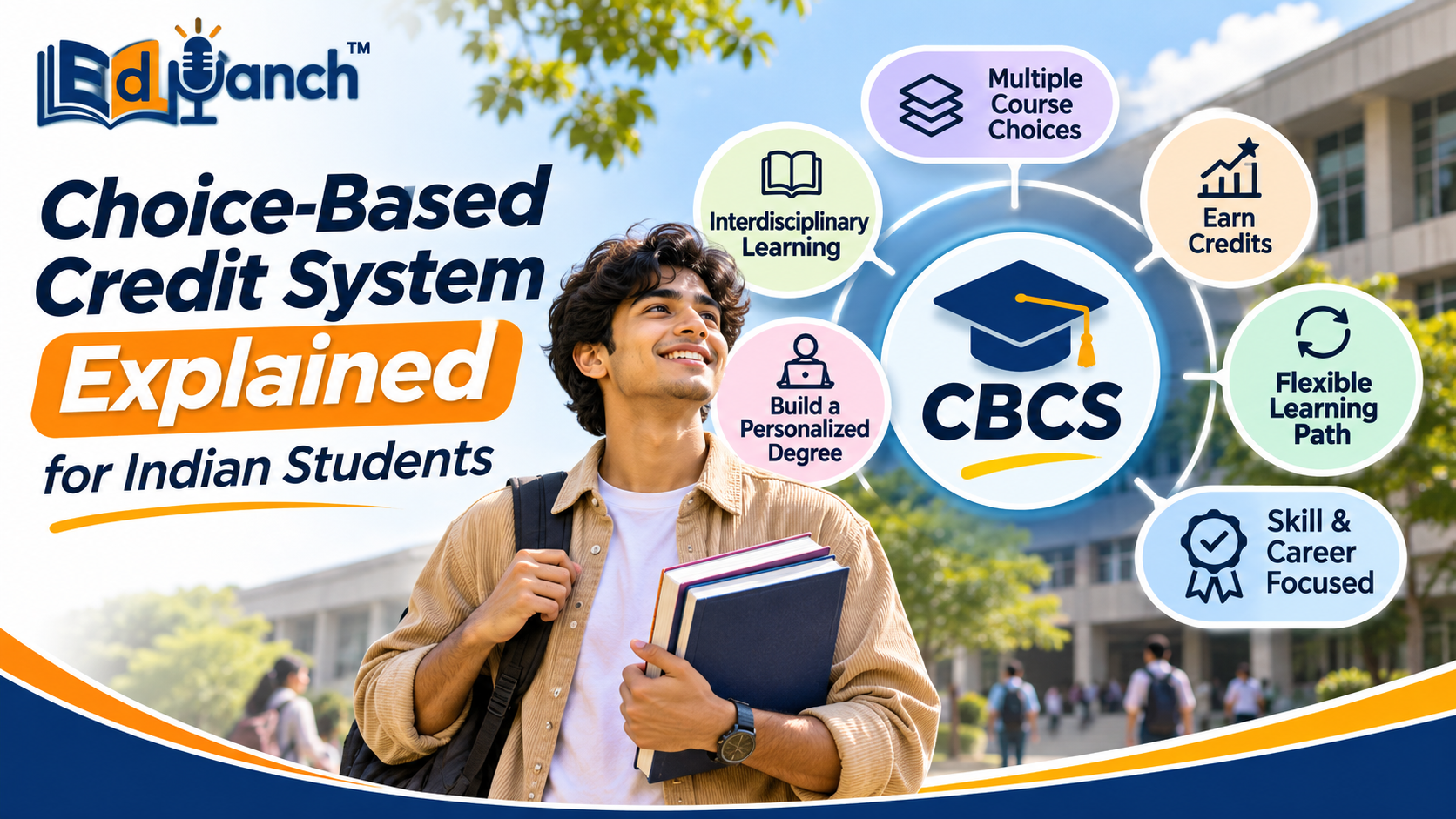
 The Choice-Based Credit System gives Indian college students flexible course choices, credit-based progression, and skill development pathways, making higher education more multidisciplinary and aligned with NEP 2020 goals.





Introduction
Higher education in India is going through one of its most significant transformations in decades. At the heart of this transformation is a system that many students encounter the moment they step into college, yet few fully understand before making their course choices. The Choice-Based Credit System, commonly known as CBCS, is a flexible academic framework that has fundamentally changed how undergraduate and postgraduate education is structured across Indian universities and colleges.
Introduced formally by the University Grants Commission (UGC) in 2015 and further reinforced through the National Education Policy 2020, CBCS moves away from rigid, year-based learning and replaces it with a credit-based model. Students are no longer locked into a fixed set of subjects determined entirely by their department. Instead, they have the freedom to shape their own academic journey by choosing from a range of core subjects, elective courses, and skill development options.
For Indian students who have grown up navigating a highly structured school curriculum, this shift can feel both liberating and confusing. This article explains what CBCS is, how it works, why it was introduced, what it means for academic progression, and what students and parents need to understand before entering a CBCS-enabled college.
Understanding the Choice-Based Credit System
At its core, CBCS is a system that assigns a numerical value, called a credit, to each course a student completes. The number of credits reflects the total time and effort a course requires. A student earns those credits by attending classes, completing assignments, and passing assessments. Progress in a programme is measured by how many credits a student has accumulated, rather than simply by the number of years they have spent in college.
Under this system, courses are broadly divided into three categories. Core courses are the compulsory subjects that form the backbone of a student's chosen discipline. A student studying economics, for example, will have core courses in macroeconomics, microeconomics, and statistics that are non-negotiable. Elective courses offer flexibility and fall into two types: discipline-specific electives, which are advanced or specialised subjects within the same field, and generic electives, which allow students to study subjects from entirely different departments.
The third category consists of Ability Enhancement Courses and Skill Enhancement Courses. These are designed to develop communication skills, environmental awareness, digital literacy, and other practical competencies that are relevant regardless of a student's main subject area.
The grading system under CBCS uses a ten-point scale to calculate a student's Cumulative Grade Point Average, or CGPA. This replaces the older percentage-based marking system in most institutions, making it easier to compare academic performance across different universities.
Why India Introduced CBCS: The Policy Background
Before CBCS, Indian higher education followed a largely uniform and inflexible structure. Students enrolled in a programme had little say in what they studied beyond their prescribed syllabus. There was minimal room for interdisciplinary learning, and the system did not encourage the development of soft skills or vocational competencies alongside academic knowledge.
The UGC introduced CBCS with the explicit goal of bringing Indian higher education in line with global standards. Many of the world's leading university systems, including those in the United States, United Kingdom, and Australia, already operate on credit-based frameworks. The intent was to allow Indian students to study abroad, transfer credits internationally, and have their qualifications recognised more easily by foreign institutions.
Domestically, CBCS addressed a critical gap. India's employment market was signalling that graduates lacked the multidisciplinary thinking and practical skills that modern workplaces demand. CBCS was designed to bridge this gap by encouraging students to study beyond the boundaries of their primary discipline.
The National Education Policy 2020 took these principles considerably further. Under NEP 2020, the undergraduate programme has been restructured into a four-year framework with multiple entry and exit points. A student who studies for one year receives a certificate. Two years earns a diploma. Three years results in a bachelor's degree. Completing four years earns an Honours or Research degree. This flexibility means that students who need to pause their education for financial, personal, or health reasons are not forced to forfeit all academic progress. They can exit with a recognised qualification and return later to continue.
The Academic Bank of Credits, or ABC, is one of the most forward-looking elements of NEP 2020's implementation of the credit system. This is a national digital repository where students can deposit credits earned from any registered higher education institution across India. If a student completes certain courses at one university and wishes to transfer to another, those credits travel with them. This prevents the loss of academic work and encourages greater mobility within India's higher education landscape.
How CBCS Works in Practice: A Student's Experience
When a student joins an undergraduate programme under CBCS, they typically receive a semester-wise credit framework at the start of their course. Each semester has a specified number of credits they are expected to complete. The total credits required to complete the degree, usually around 120 to 140 for a three-year programme, are distributed across the semesters.
At the beginning of each semester, students are presented with a list of available courses. Core courses are mandatory and have no substitutes. For electives, students can choose from several options offered by their own department or from a list of generic electives offered by other departments. The number of elective slots varies by institution and by the stage of the programme.
Assessments under CBCS are typically continuous, with a portion of marks assigned for internal work such as assignments, presentations, mid-semester tests, and attendance, and the remainder for end-semester examinations. The exact internal-to-external ratio varies, but most UGC-aligned institutions follow a 25:75 or 40:60 split.
A student's performance is recorded semester-wise in the form of a grade card, which lists all courses attempted, grades received, and credits earned. At the end of the programme, the total credits earned and the CGPA across all semesters form the basis of the final degree transcript.
Benefits of CBCS for Students in India
The advantages of CBCS, when implemented well, are substantial.
Flexibility in course selection allows students to explore subjects outside their primary discipline. A science student can study economics or communication. An arts student can take introductory data science or environmental studies. This interdisciplinary exposure broadens a student's perspective and often opens up career paths that a traditional programme would not have made visible.
Credit transferability is particularly valuable for students who wish to study at multiple institutions during their undergraduate years, or who participate in exchange programmes. With the Academic Bank of Credits now operational, this mobility is becoming increasingly practical within India.
The grading system under CBCS is designed to reduce the pressure of a single high-stakes annual examination. Continuous internal assessment spreads the evaluation process across the semester, which benefits students who perform better through regular work rather than through single examination performance.
Skill-based courses build practical competencies that employers look for. Many students who graduate with degrees in pure disciplines find that they are better prepared for the job market because they also completed communication, digital skills, or entrepreneurship courses alongside their core studies.
Challenges and Criticisms: What Still Needs Improvement
CBCS has not been without its difficulties, and it is important for students and parents to understand the gaps that still exist in the system.
Implementation has been highly uneven across India. Premier central universities and well-resourced autonomous colleges in Tier 1 cities have been able to offer a wide range of elective courses with dedicated faculty and proper infrastructure. However, many colleges in Tier 2 and Tier 3 cities, particularly those affiliated with large state universities, have struggled. The number of elective courses on paper often exceeds what is actually available to students, because there are not enough faculty members or classrooms to support them.
Grading standardisation remains a concern. Since CGPA is calculated differently at different institutions, a student with a 8.5 CGPA from one university may not have learned the same amount as a student with the same CGPA from another university. This creates complications when students apply for postgraduate programmes or competitive jobs where GPAs are compared without adequate context.
The transition from percentage to CGPA has also caused confusion among parents and employers who are more accustomed to interpreting marks in percentage terms. Many universities now provide a grade conversion table, but the absence of a fully standardised national conversion formula continues to create ambiguity.
For students in financially constrained circumstances, the multiple exit option under NEP 2020 is empowering on paper but raises real concerns in practice. Exiting after one or two years still carries a social and professional stigma in many Indian communities, particularly in regions where any degree less than a full bachelor's is not widely accepted by employers or families.
CBCS and Career Readiness: What Employers Are Saying
Employers across sectors, from information technology to banking to public health, have noted that CBCS graduates who made thoughtful course choices tend to demonstrate more versatile skill sets than those who passed through rigid, single-discipline programmes. The ability to study data interpretation alongside journalism, or marketing alongside environmental science, produces graduates who can think across domains.
Skill Enhancement Courses and vocational electives within CBCS have been particularly well-received in sectors that require both subject knowledge and communication or digital fluency. Campus recruiters from several industries have pointed out that students who actively used their elective slots to build complementary skills rather than simply taking the easiest available option showed measurably stronger interview performance.
However, the full potential of CBCS for career readiness depends on the quality and relevance of the courses an institution offers, and the guidance available to students as they make their selections.
Guidance for Students Making CBCS Course Choices
Choosing electives wisely is one of the most underrated decisions a student makes during their college years. A few practical principles are worth keeping in mind.
- Think about where the core degree is heading and choose electives that either deepen that direction or deliberately broaden it in a useful way.
- Review the actual syllabi of elective courses before choosing, not just the course names.
- Speak with seniors who have already completed the course to understand the actual workload and assessment pattern.
- Use skill-based elective slots to build digital, communication, or entrepreneurship competencies that are transferable across industries.
- Understand the credit requirements for each semester before the course registration window closes, to avoid shortfalls in total credits at the time of degree completion.
Edumanch provides updated information on CBCS frameworks across Indian universities, NEP 2020 implementation updates, and guidance on elective course categories, which can help students navigate these choices with better clarity.
Frequently Asked Questions
Q1: What is the Choice-Based Credit System in India?
The Choice-Based Credit System is a flexible academic framework introduced by the UGC that allows students to choose from core, elective, and skill-based courses, earning credits for each. Progress toward a degree is measured by total credits accumulated rather than years of study.
Q2: Is CBCS part of NEP 2020?
Yes. The National Education Policy 2020 incorporates and significantly expands upon CBCS by introducing a four-year undergraduate programme with multiple entry and exit options, the Academic Bank of Credits, and a stronger emphasis on multidisciplinary and vocational learning.
Q3: What is the difference between core courses and elective courses under CBCS?
Core courses are compulsory subjects directly tied to a student's major discipline. Elective courses include discipline-specific electives for advanced study within the same field, and generic electives that allow students to study subjects from other departments.
Q4: What is the Academic Bank of Credits?
The Academic Bank of Credits is a national digital platform introduced under NEP 2020 where students can store, transfer, and redeem credits earned from registered higher education institutions across India, enabling greater academic mobility.
Q5: What are the main challenges of CBCS for students in India?
The key challenges include uneven implementation across institutions, limited availability of elective courses in smaller colleges, faculty shortages, inconsistent grading standards between universities, and the ongoing social stigma around early exit qualifications in several communities.
Resources
- University Grants Commission (UGC): Official guidelines and circulars on CBCS implementation across Indian universities
- Ministry of Education, Government of India: National Education Policy 2020 full document and implementation updates
- Academic Bank of Credits (ABC): Official portal for credit registration, transfer, and redemption for students across Indian higher education institutions
- National Institute of Educational Planning and Administration (NIEPA): Research and policy analysis on higher education reforms in India
- NCERT and UGC Joint Resource Portals: Curriculum frameworks and credit structure references for undergraduate programmes under NEP 2020
Interlinking Keywords
Choice-Based Credit System India, CBCS explained, NEP 2020 undergraduate programme, Academic Bank of Credits, UGC credit system, elective courses in college, CGPA grading system India, four-year undergraduate programme, multiple exit options NEP, skill enhancement courses India
Last reviewed by:
Dr. Manthan Tripathi, Edumanch Editorial and Education Guidance Team on November 19, 2026.
Disclaimer
The information provided in this article is intended for general educational awareness and informational purposes only. While every effort has been made to ensure accuracy at the time of publication, education policies, credit frameworks, and institutional guidelines are subject to change. Students and parents are advised to verify the specific CBCS structure, credit requirements, and elective availability directly with their respective colleges or universities before making academic decisions. Edumanch does not guarantee outcomes related to course selection, credit transfer, or degree completion based on the information presented here.