 Monday, November 16, 2026
 Scholarship applications in India are commonly rejected due to incomplete documents, missed deadlines, eligibility mismatches, and weak personal statements. Early preparation and attention to detail can significantly improve outcomes.





Introduction
Every year, thousands of deserving students across India apply for scholarships with genuine need, strong academic records, and high hopes. Yet a significant number of those applications never make it past the review stage. The reason is not always a lack of merit. In many cases, entirely avoidable mistakes lead to rejection before the application even receives serious consideration.
Understanding what causes scholarship applications to fail is just as important as knowing how to apply. Whether a student is applying for a central government scheme under the National Scholarship Portal, a state-level financial aid programme, or a private foundation grant, the evaluation process is structured and unforgiving of errors. A single missing document or an incorrect declaration can result in disqualification.
This guide covers the most common and critical reasons why scholarship applications get rejected in India, with practical guidance on how students and parents can avoid these pitfalls and present the strongest possible application.
Understanding How Scholarship Applications Are Evaluated in India
Before examining the reasons for rejection, it helps to understand how scholarship applications are typically reviewed. Most scholarship bodies in India, including those operating under government portals and private foundations, use a multi-stage evaluation process.
At the first stage, applications are screened for completeness and eligibility. This is where a large volume of rejections happen. At the second stage, shortlisted applications are reviewed on merit, which includes academic performance, financial need, and in some cases, extracurricular achievements or personal statements. Final selections are then made based on a combination of these factors, available funds, and the specific objectives of the scholarship.
The majority of students who get rejected are eliminated at the very first stage, often for reasons that had nothing to do with their academic ability or financial need.
Incomplete or Incorrect Documentation
The single most common reason scholarship applications are rejected in India is incomplete or incorrectly submitted documentation. Every scholarship has a defined list of required documents, and reviewers do not have the discretion to overlook missing materials.
Commonly required documents that students frequently fail to submit correctly include:
- Income certificate issued by a competent authority, within the validity period
- Domicile certificate to prove state residency
- Bonafide student certificate from the current institution
- Mark sheets from the previous qualifying examination
- Caste or category certificate for reserved category applicants
- Bank account details linked to Aadhaar for direct benefit transfer
- Passport-sized photographs in the specified format and file size
Students often upload blurry scans, documents in unsupported file formats, or certificates that have expired. In some cases, the name on one document does not match the name on another, which creates verification issues that can lead to rejection.
The solution is straightforward. Before submitting, students must create a checklist of every required document, verify each document for accuracy and validity, and ensure all scanned copies are clear, legible, and within the size limits specified by the scholarship portal.
Failure to Meet Eligibility Criteria
Every scholarship is designed for a specific profile of students. Applying without carefully reading and verifying the eligibility criteria is one of the most damaging mistakes an applicant can make.
Eligibility criteria typically include a minimum percentage in the qualifying examination, a family income limit, enrollment in a specific type of institution or course, category requirements such as SC, ST, OBC, or EWS, and sometimes residency in a particular state or district.
When students apply for scholarships they are not eligible for, the application is rejected at the screening stage itself. This wastes time, effort, and sometimes application fees.
Students must read the eligibility section of every scholarship they consider applying for, not just the scholarship name or the amount offered. If there is any doubt about eligibility, they should check directly with the scholarship provider or their institution's scholarship coordinator before investing time in the application.
Missing Application Deadlines
Scholarship portals in India, particularly government portals like the National Scholarship Portal, have strict submission windows. An application submitted even a single day after the deadline is typically rejected outright, with no exceptions.
Many students delay applications because they are waiting for a particular document, underestimate how long the online submission process takes, or are simply unaware of the deadline until it is too late.
It is important to note that deadlines in the scholarship world are different from exam admit card dates or college fee payment timelines, where extensions are sometimes granted. Scholarship deadlines are usually fixed and non-negotiable.
The simplest way to avoid this is to treat the scholarship deadline as if it is at least one week earlier than the official date. Starting the application process immediately after a scholarship is announced gives students time to gather documents, get the application reviewed by a teacher or parent, and handle any technical issues that may arise on the portal.
Poor or Weak Personal Statement
For scholarships that require a personal statement, statement of purpose, or essay, the quality of the written response plays a significant role in selection. A weak personal statement is often the reason a technically eligible application fails to advance past the merit review stage.
Common problems in scholarship personal statements include vague language, a lack of clarity about academic goals, generic statements that could apply to any student, grammatical errors, and failure to explain how the scholarship would specifically help the applicant.
A strong personal statement should explain the student's background honestly, describe their academic and career goals clearly, mention any challenges they have overcome, and demonstrate why they are a suitable candidate for that specific scholarship. It should be original, personal, and specific rather than a templated response that reads like it was written for any scholarship in general.
Students applying for scholarships that require a written component should draft their personal statement early, seek feedback from a teacher or mentor, and revise it at least twice before submission.
Academic Performance Below the Required Threshold
Most scholarships in India require a minimum academic performance as a condition of eligibility. For many government scholarships, this threshold is set at 50 percent, 60 percent, or even higher, depending on the level of study and the awarding body.
Students who fall short of the required academic percentage at the qualifying examination are disqualified regardless of their financial need or other strengths. Similarly, students who have a gap year without valid reasons, or whose academic history shows an unusual dip, may find their applications facing additional scrutiny.
Consistent academic performance is not just a metric for scholarships but a signal of a student's commitment to their education. Students who are planning to apply for scholarships should be mindful of minimum academic requirements from the beginning of their academic year and seek academic support if they are at risk of falling below the threshold.
Errors in the Application Form
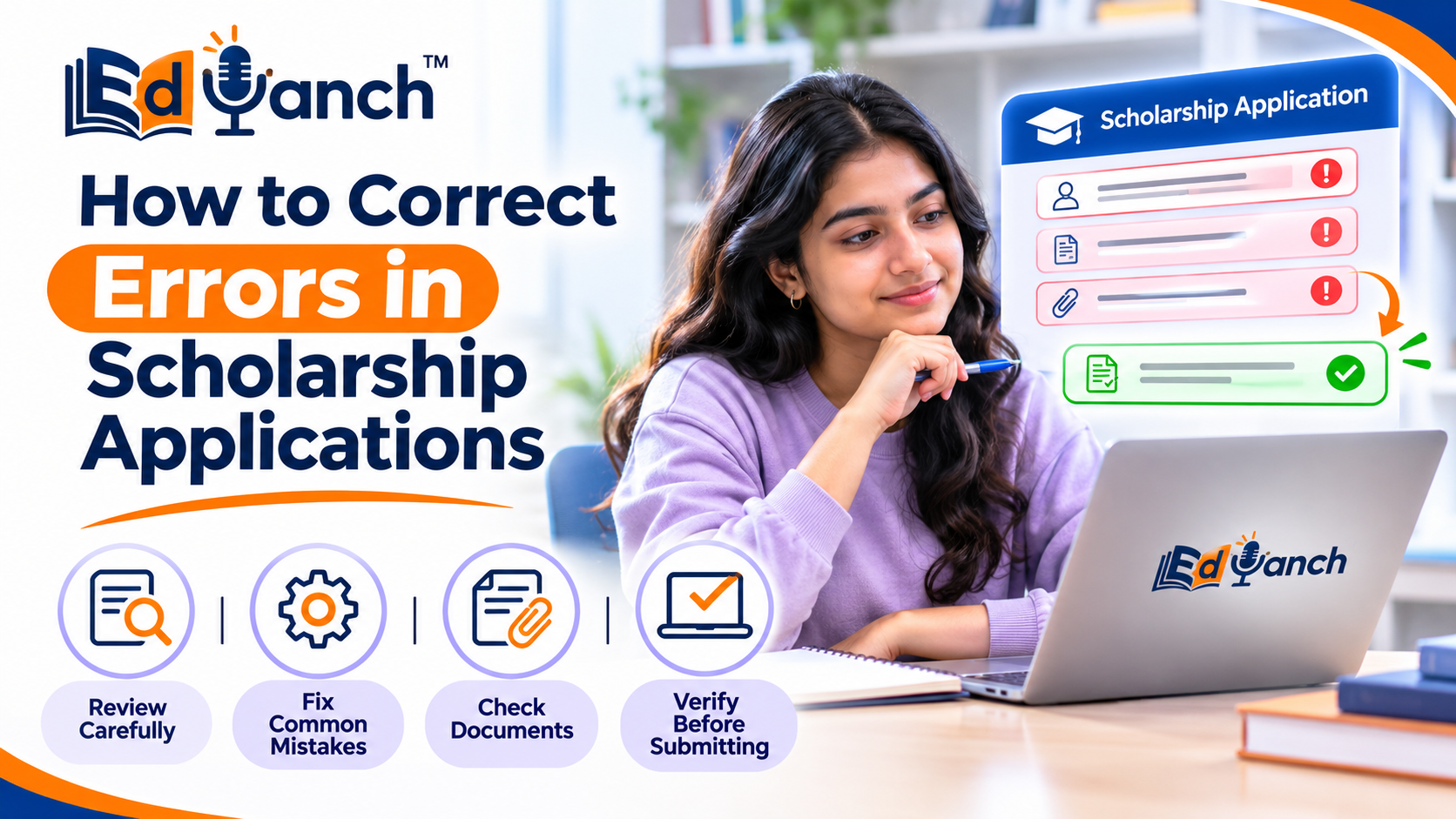
Mistakes made while filling out the online or offline application form are another major cause of rejection. These errors include entering incorrect dates of birth, wrong course codes, incorrect income figures, or mismatched information between the form and the supporting documents.
On portals like the National Scholarship Portal, the Aadhaar number, bank account number, and student name must match exactly. Even a minor discrepancy, such as a middle name included in one field but not another, can cause the application to be flagged or rejected during verification.
Students should take their time when completing the application form, review every field before final submission, and never rush through the process. If a portal allows form preview before submission, this feature should always be used.
Applying to the Wrong Scholarship Category
India has a large number of scholarships across different categories, including merit-based, need-based, category-specific, community-specific, course-specific, and institution-specific scholarships. Students sometimes apply under the wrong category, either because they misread the scholarship name or because they assumed they qualified based on partial information.
For example, a scholarship meant exclusively for students pursuing undergraduate science courses at central universities would not be open to students enrolled in private universities or students pursuing arts courses, regardless of their merit or financial background.
This type of rejection is particularly frustrating because the student may have been entirely eligible for a different scholarship but wasted the application window on one they could not qualify for. Careful research before applying is the only way to avoid this situation.
Inadequate Financial Documentation
For need-based scholarships, the income certificate and financial documentation submitted by the applicant must clearly reflect the family's economic situation within the defined income limits. If the income certificate is issued by an authority that is not recognized by the scholarship body, or if it exceeds the income cap specified in the eligibility criteria, the application will be rejected.
Some students also make the mistake of not disclosing all sources of family income, which can create inconsistencies that are caught during verification. Financial documentation must be honest, accurate, current, and issued by a competent government authority such as a tehsildar, revenue officer, or designated district authority.
Institutional Non-Verification or Delay
In India, many scholarship applications, especially those processed through the National Scholarship Portal, require institutional verification before the application is forwarded to the scholarship authority. If the student's college or university does not verify the application within the given timeframe, the application is treated as incomplete and may be rejected.
This is a procedural issue that is out of the student's direct control, but it is the student's responsibility to follow up with their institution. Students should submit applications early enough to give the institution adequate time to complete verification, and they should regularly check the verification status on the portal.
How Students Can Strengthen Their Scholarship Applications
Avoiding rejection is largely a matter of preparation, attention to detail, and timely action. Here are the key practices that separate successful applicants from those who get rejected:
- Research every scholarship thoroughly before applying, including eligibility, documents, deadlines, and the application process
- Build a complete scholarship document folder at the beginning of the academic year so materials are ready when applications open
- Follow up with the institution's scholarship coordinator to ensure timely verification
- Read the application guidelines at least twice before starting the form
- Have a trusted adult, teacher, or mentor review the completed application before submission
- Track multiple scholarship deadlines using a calendar or planner
Platforms like Edumanch publish regular updates on scholarship opportunities, deadlines, and guidance articles specifically designed to help Indian students navigate the scholarship landscape more confidently.
Frequently Asked Questions
Q1: Why do most scholarship applications in India get rejected?
Most scholarship applications in India are rejected due to incomplete documentation, failure to meet eligibility criteria, incorrect information in the application form, missed deadlines, or weak personal statements. A large number of rejections happen at the initial screening stage for entirely avoidable reasons.
Q2: What documents are commonly required for scholarship applications?
Commonly required documents include income certificates, mark sheets, caste or category certificates, bonafide student certificates, bank account details linked to Aadhaar, domicile certificate, and passport-sized photographs. Requirements vary by scholarship, so applicants must always check the specific list.
Q3: How can students avoid getting their scholarship rejected?
Students can avoid rejection by reading eligibility criteria carefully, submitting all required documents before deadlines, filling out application forms accurately, writing a clear and genuine personal statement, and following up with their institution for timely verification.
Q4: Can a student reapply after a scholarship rejection?
Yes, in most cases, students can reapply in the next application cycle. It is advisable to identify the specific reason for the rejection, address the shortcomings, gather updated documentation, and submit a stronger application in the next available cycle.
Q5: Does academic performance affect scholarship eligibility in India?
Yes, most scholarships in India have a minimum academic performance requirement. Falling below the required percentage or grade point average can lead to immediate disqualification, regardless of financial need or other qualifications.
Resources
- National Scholarship Portal (NSP): The official government portal for applying to central and state scholarship schemes for students across India, accessible at scholarships.gov.in.
- University Grants Commission (UGC): Provides information on merit-based and need-based scholarships for higher education students in India, accessible at ugc.ac.in.
- Ministry of Education, Government of India: Publishes updates on national scholarship programmes, educational policies, and student support schemes, accessible at education.gov.in.
- NCERT: Offers information on merit scholarships for school students and guidance on academic excellence programmes, accessible at ncert.nic.in.
- Buddy4Study: A widely used scholarship aggregator platform in India that lists active scholarship opportunities across government and private sources, accessible at buddy4study.com.
Interlinking Keywords
scholarship application mistakes India, scholarship rejection reasons, how to apply for scholarship in India, NSP scholarship tips, scholarship documents required, scholarship eligibility criteria India, how to write scholarship personal statement, national scholarship portal India, scholarship for students India, need-based scholarship India
Last reviewed by:
Dr. Manthan Tripathi, Edumanch Editorial and Education Guidance Team on November 2, 2026.
Disclaimer
This article is intended for informational and educational purposes only. Scholarship eligibility criteria, documentation requirements, and application processes vary across schemes and are subject to change. Students are advised to verify all scholarship details directly from the official scholarship portal or the respective awarding authority before applying. Edumanch does not guarantee selection or approval for any scholarship programme.