 Monday, November 16, 2026
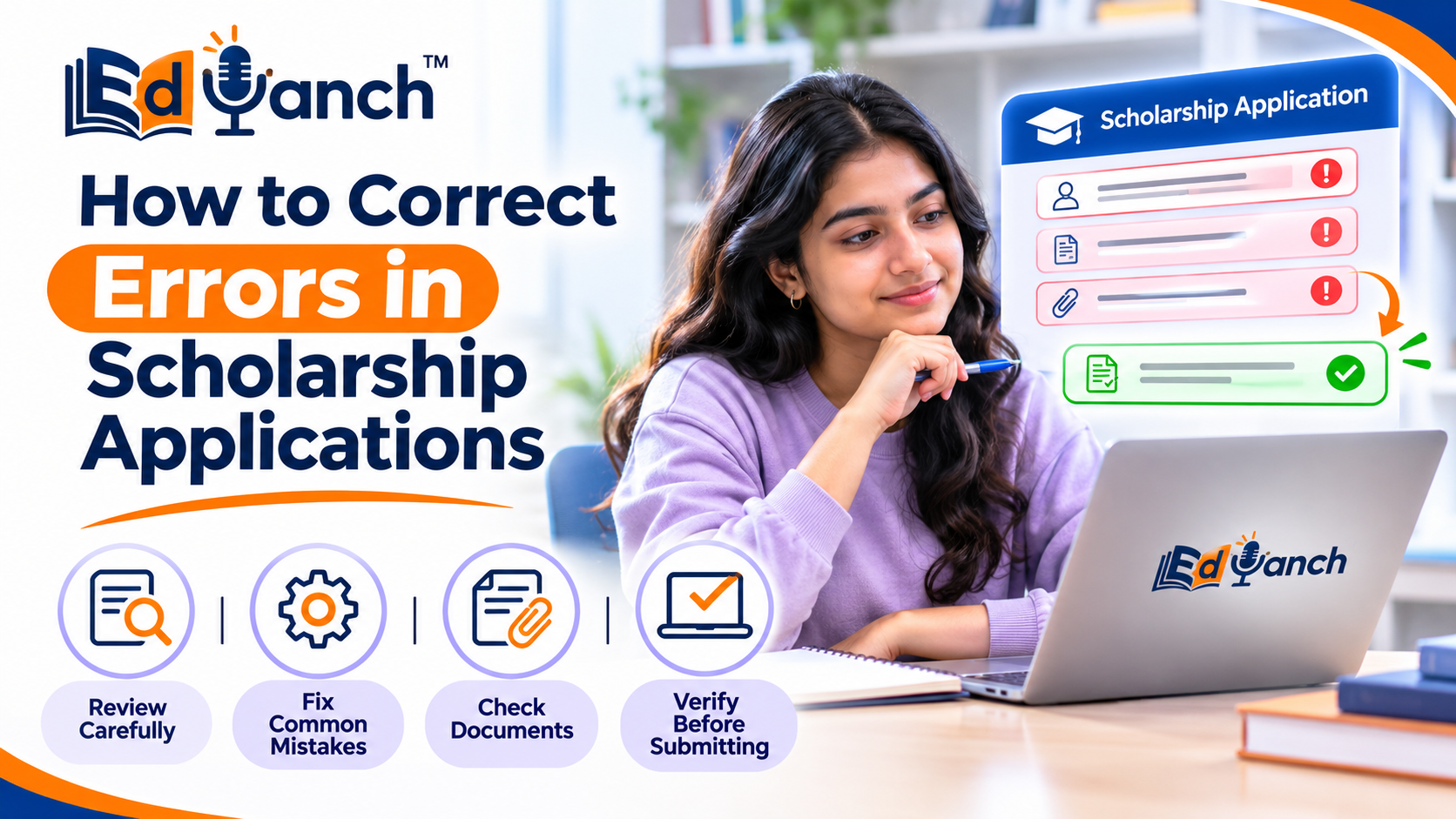
 Scholarship application errors in India can be corrected through portal correction windows, nodal officers, and official helpdesks. Early identification, proper documentation, and timely action protect student scholarship eligibility.





Introduction
Scholarship applications in India open doors to education for millions of students every year. From the National Scholarship Portal to state government schemes and institutional fellowships, these programs play a critical role in making higher education accessible and affordable. However, filling out a scholarship application is not always a smooth process. Mistakes happen. A wrong digit in a bank account number, a name spelled differently from an official document, an Aadhaar number entered incorrectly, or an academic detail left incomplete can quietly become a major obstacle in receiving funds that a student genuinely deserves.
The important thing to understand is that an error in a scholarship application does not automatically mean disqualification. Most scholarship programs, including those on the National Scholarship Portal (NSP) operated by the Ministry of Education, provide correction windows and grievance mechanisms specifically for this purpose. The key is to identify the mistake early, understand the right process to address it, and act before deadlines close.
This guide is written to help Indian students, parents, and educators understand how scholarship application errors can be corrected, what types of errors are most commonly encountered, and how to approach the entire process with confidence and clarity.
Understanding Common Errors in Scholarship Applications
Before exploring how to correct errors, it is useful to understand what kinds of mistakes most frequently appear in scholarship applications in India. These errors broadly fall into a few categories.
Personal information errors are among the most common. This includes misspelled names, incorrect dates of birth, mismatched gender information, or Aadhaar numbers entered with a wrong digit. Since scholarship portals like NSP link application data directly to Aadhaar, even a single character error in the Aadhaar number can cause the entire application to fail verification.
Bank account and payment errors are another significant category. Many scholarship payments in India are routed directly to student bank accounts through direct benefit transfer (DBT). An incorrect account number, a wrong IFSC code, an account that is not linked to Aadhaar, or a bank account belonging to someone other than the student are errors that can completely block scholarship disbursement.
Academic and institutional errors include incorrect course names, wrong percentage or CGPA entries, mismatched details between what is entered on the portal and what appears on official marksheets, or selecting the wrong academic year. These errors can trigger rejection during the verification stage conducted by institutions and nodal officers.
Document-related errors occur when uploaded documents are blurred, incorrectly labeled, expired, or do not match the information filled in the application form. For example, uploading a previous year's income certificate when the current year's certificate is required is a common issue.
Understanding these categories helps a student or parent approach the correction process in a focused and organized manner.
How to Identify Errors Before and After Submission
The best time to catch an error is before submitting the application. However, since many students apply under time pressure or at the last moment, errors often go unnoticed until after submission or even until a rejection or pending status appears on the portal.
Before submission, students should follow a thorough review process. After filling in all the details, the application should be checked against original documents side by side. The name as it appears on the scholarship form should match the name on the Aadhaar card exactly. The bank account details should be verified directly from the passbook or a bank statement. Income certificate details, caste certificate validity, and academic year information should all be cross-verified with physical copies before clicking submit.
After submission, errors can be identified in a few ways:
- Checking the application status on the portal regularly to see if it shows a deficiency or rejection notice
- Receiving an SMS or email alert from the scholarship portal about a mismatch or incomplete detail
- Getting a notification from the institution's nodal officer asking the student to correct specific information
- Noticing a discrepancy during the institution verification stage
Once an error is identified, the next step is to understand the correction mechanism available.
Step-by-Step Process to Correct Errors in Scholarship Applications
Step 1: Log in to the Official Scholarship PortalThe first step is to access the official portal where the application was submitted. For central government scholarships, this is the National Scholarship Portal at scholarships.gov.in. For state scholarships, it could be the respective state's scholarship management portal. Students should log in using their registered mobile number and credentials.
Step 2: Check Whether a Correction Window Is OpenMost scholarship portals provide a correction or edit window for a limited period after the application submission phase. During this window, applicants can update specific fields in their application. Students should navigate to their application and check whether an edit option or correction button is available.
If the correction window is active, students should carefully update the incorrect information, re-upload any corrected documents, and save the changes. It is important not to change any information that is correct, as unnecessary edits can sometimes cause new discrepancies.
Step 3: Contact the Nodal Officer If the Window Is ClosedIf the correction window on the portal has closed, students should not panic. The correct course of action is to immediately contact the nodal officer at their school or college. Nodal officers are administrative representatives who have elevated access on scholarship portals and are authorized to process correction requests on behalf of students.
When approaching the nodal officer, the student should bring:
- A written request clearly stating the error and the correct information
- Original documents supporting the correction
- A printout or screenshot of the current application showing the error
- Any portal reference number or application ID
The nodal officer can then initiate the correction at the institutional level or escalate it to the district or state helpdesk if needed.
Step 4: Use the Grievance or Helpdesk MechanismFor errors that cannot be resolved through the nodal officer channel or when the application has already been rejected due to the error, students can file a formal grievance through the portal's helpdesk system. The National Scholarship Portal has a dedicated help section where queries can be submitted along with supporting documents.
State scholarship portals often have similar grievance mechanisms. Some portals also provide helpline numbers where students can speak directly to support representatives.
When submitting a grievance, the student should provide a clear description of the error, the correct information, proof of the correct information such as a scanned Aadhaar card or bank passbook, and the application reference number.
Step 5: Track the Correction StatusAfter submitting a correction request either through the portal or through the nodal officer, the student must track the application status regularly. Most portals update the application status within a few working days of a correction being processed. Students should check for status changes and ensure the correction has been reflected accurately.
If the status does not change within a reasonable period, the student should follow up with the nodal officer or the helpdesk again.
Special Situations: Aadhaar and Bank Account Corrections
Two areas that often require particular attention are Aadhaar-related corrections and bank account corrections. These are sensitive fields because scholarship disbursement in India is closely linked to both.
If the Aadhaar number entered is incorrect, the student must first ensure that the correct Aadhaar number is updated on the portal. Additionally, the bank account must be seeded with the Aadhaar number through the student's bank branch. Without Aadhaar-bank seeding, DBT payments will fail regardless of other corrections.
For bank account corrections, students should verify with their bank that the account is active, that the IFSC code is current, and that the account is in the student's own name. Some scholarship schemes specifically require that the bank account belong to the student and not to a parent or guardian.
Role of Institutions and Parents in the Correction Process
Educational institutions play an important role in scholarship error correction. The school or college's scholarship coordinator or nodal officer is often the first point of contact for students facing difficulties. Institutions are responsible for verifying applications, flagging errors during the institution verification stage, and communicating discrepancies back to students in time for correction.
Parents can support the process by keeping all original documents organized, ensuring the student's bank account is properly set up, and helping the student track deadlines and follow up on pending corrections.
In Tier 2 and Tier 3 cities and in rural areas, many students rely heavily on their institution's guidance for the scholarship process. This makes it especially important for schools and colleges to proactively educate students about error correction procedures at the time of application.
Preventing Errors in Future Applications
While correcting errors is possible, prevention is always a better approach. Students applying for scholarships can significantly reduce the chance of errors by following a few disciplined practices.
Starting the application well before the deadline gives adequate time for review and correction. Keeping all required documents ready before beginning the form avoids rushed entries. Reading the eligibility criteria and instructions carefully before filling in any field prevents incorrect selections. Saving application drafts and reviewing them against original documents before final submission adds an extra layer of accuracy.
Edumanch regularly publishes guidance on scholarship schemes, portal updates, eligibility changes, and application timelines to help students and parents stay informed and prepared.
Conclusion
Errors in scholarship applications are more common than most students realize, but they are rarely the end of the road. India's scholarship infrastructure, particularly the National Scholarship Portal and state-level systems, has built-in mechanisms to support error correction. What matters most is acting quickly, understanding the right process, and working through the proper channels, whether that is the correction window on the portal, the institution's nodal officer, or the official helpdesk.
Students who approach the correction process systematically, with proper documentation and clear communication, stand a strong chance of resolving errors in time to receive the scholarship they have worked hard to earn. Staying informed, staying organized, and reaching out for help when needed are the qualities that make the difference.
Frequently Asked Questions
Q1: Can I correct my scholarship application after it has been submitted?
Yes. Most scholarship portals, including the National Scholarship Portal, provide a correction window after the submission phase during which students can edit specific fields. If the correction window has closed, the student should contact the nodal officer at their institution, who can process correction requests at the institutional level or escalate them to higher authorities.
Q2: What types of errors can be corrected in a scholarship application?
Common correctable errors include misspelled names, incorrect Aadhaar numbers, wrong bank account details or IFSC codes, mismatched academic information, incorrectly uploaded documents, and incomplete income or caste certificate details. The correction window typically allows updates to most fields, while some sensitive fields may require nodal officer intervention.
Q3: What happens if the errors in my scholarship application are not corrected?
Uncorrected errors can result in several consequences, including application rejection during the verification stage, failure of DBT payment due to wrong bank details, Aadhaar mismatch causing disqualification, or the scholarship being marked as incomplete and not disbursed. This is why early identification and correction of errors is essential.
Q4: How do I correct my bank account details in my NSP scholarship application?
Log in to the National Scholarship Portal at scholarships.gov.in using your registered credentials. If the correction window is active, navigate to your application and update the bank account number and IFSC code. Ensure the updated account is in your own name and is seeded with your Aadhaar number. If the correction window is closed, contact your institution's nodal officer with your bank passbook as supporting proof.
Q5: Who is the nodal officer and how do I contact them for a scholarship correction?
The nodal officer is a designated administrative staff member at your school or college who is responsible for managing scholarship portal activities, including verifying applications and processing student correction requests. Students should visit their institution's administrative office, identify the scholarship coordinator or nodal officer, and submit a written correction request along with original supporting documents.
Resources
- National Scholarship Portal (NSP): Official portal for central government scholarship schemes in India, managed by the Ministry of Electronics and Information Technology
- Ministry of Education, Government of India: Policy and program information related to scholarships and student support under the education ministry
- University Grants Commission (UGC): Information on UGC fellowships, scholarships, and financial support schemes for higher education students
- Aadhaar Services, UIDAI: Guidance on Aadhaar correction, bank seeding, and identity verification relevant to scholarship eligibility
Interlinking Keywords
National Scholarship Portal, scholarship application process, scholarship eligibility India, NSP portal login, scholarship for students in India, government scholarship schemes, scholarship correction window, nodal officer scholarship, DBT scholarship payment, Aadhaar bank seeding
Last reviewed by:
Dr. Manthan Tripathi, Edumanch Editorial and Education Guidance Team on November 7, 2026.
Disclaimer
The information provided in this article is intended for general guidance and educational purposes only. Scholarship rules, portal features, correction windows, and eligibility criteria are subject to change based on official notifications from the respective scholarship authorities. Students and parents are advised to refer to the official scholarship portals and contact their institution's nodal officer for the most current and accurate information specific to their application. Edumanch does not guarantee the outcome of any scholarship application or correction request.