 Monday, November 16, 2026
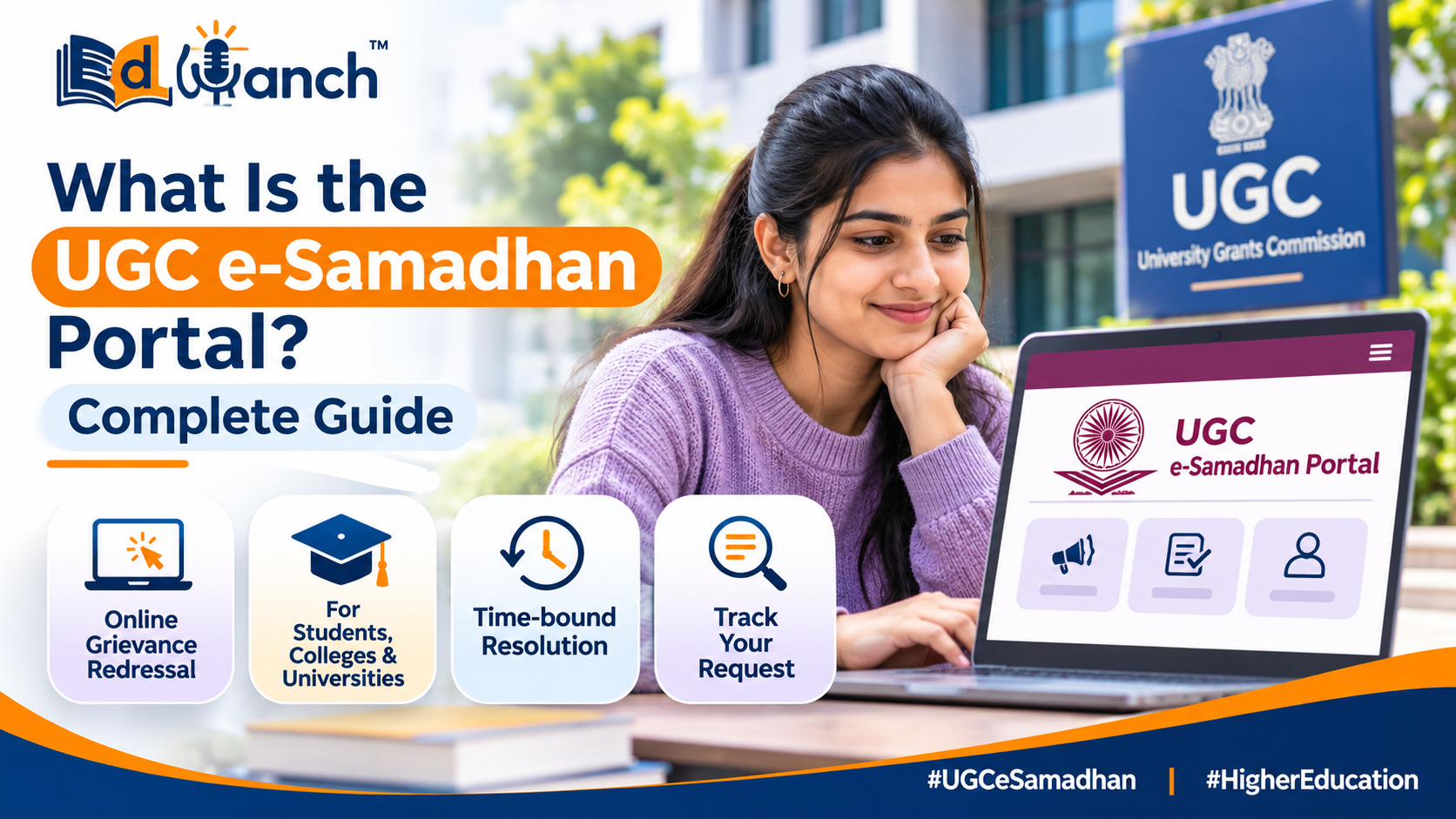
 The UGC e-Samadhan Portal is a centralized digital platform that enables students, faculty, and institutions to register and track higher education grievances in a time-bound manner.





Introduction
Higher education in India serves crores of students every year across thousands of universities, colleges, and institutions. Within this vast system, problems are inevitable. A student may face an unjustified fee deduction, a delayed result, a denial of merit-based admission, or even harassment on campus. For years, students and educators had limited, fragmented, and often frustratingly slow channels to raise these concerns formally.
The University Grants Commission, the apex regulatory body for higher education in India, recognized this gap and responded with a decisive step. It launched the UGC e-Samadhan Portal, a centralized, digital grievance redressal system designed to bring accountability, speed, and transparency to the way education-related complaints are handled across the country. For students in Tier 1 cities navigating competitive private universities as well as students in Tier 2 and Tier 3 cities dealing with state institutions, this portal represents a meaningful shift in how grievances are heard and resolved.
Understanding the UGC e-Samadhan Portal
The name "e-Samadhan" comes from the Hindi word meaning "solution" or "resolution." The UGC e-Samadhan Portal is an online grievance registration and monitoring system developed by the University Grants Commission to serve as a single-window platform for all higher education stakeholders to lodge complaints, submit feedback, and seek resolutions to their concerns.
The portal is accessible at samadhaan.ugc.ac.in and is available around the clock, 24 hours a day, seven days a week. It is also supported by a toll-free helpline number, 1800-111-656, for those who prefer to register complaints by phone.
Before the launch of this portal, the UGC operated several separate portals and complaint-handling mechanisms for different types of grievances. These fragmented systems created confusion among students who were unsure where to direct their complaints. The UGC addressed this by merging all its existing portals and helplines into the single e-Samadhan platform. The only exception is the anti-ragging helpline, which continues to function independently given its specialized and time-sensitive nature.
The portal was designed with a clear mandate: to bring structure, monitoring, and accountability to the grievance redressal process in Indian higher education. It reflects the broader national push toward digital governance and transparent institutional management.
Who Can Use the UGC e-Samadhan Portal?
One of the most important features of UGC e-Samadhan is that it is not limited to students alone. The portal serves a broad range of stakeholders within the higher education ecosystem.
Students who face problems related to admissions, examination delays, fee disputes, certificate withholding, or violations of UGC guidelines can file their complaints through this platform. Teaching and non-teaching staff members who face professional or institutional grievances also have access to this portal. Universities, colleges, and other institutions can use it to submit feedback or raise concerns related to regulatory matters.
This inclusive design ensures that the system addresses the needs of the entire academic community rather than focusing only on one group.
Types of Grievances Covered
The UGC e-Samadhan Portal covers a wide spectrum of education-related complaints. Understanding what falls under its scope helps stakeholders know when and how to use it effectively. The portal handles grievances related to:
- Non-refund or arbitrary deduction of fees by colleges or universities
- Admission based on factors other than merit or contrary to stated admission policies
- Delay or refusal in issuing mark sheets, degrees, or other academic certificates
- Non-compliance with UGC guidelines and regulations by institutions
- Scholarship-related issues including delays in disbursement or denial of eligible scholarships
- Examination irregularities or unjustified evaluation concerns
- Harassment complaints, including gender-related issues
It is worth noting that the portal specifically addresses situations where the institutional grievance redressal mechanisms have already been approached but have not provided adequate resolution. Students are generally expected to first raise their concerns at the institution level before approaching UGC e-Samadhan. This ensures that the portal handles escalated matters with higher complexity rather than being burdened by issues that institutions themselves are equipped to resolve.
How to Register a Grievance on UGC e-Samadhan
The process of registering a grievance on the portal is straightforward and has been designed to be accessible even for first-time users. The steps are as follows:
- Visit the official portal at samadhaan.ugc.ac.in or call the toll-free number 1800-111-656
- Create an account or log in using a registered email ID
- Select the relevant grievance category from the available options
- Fill in the required details including personal information, institution details, and a description of the complaint
- Attach any supporting documents or evidence relevant to the grievance
- Submit the complaint and note the unique docket number allotted by the system
The docket number is important. Once a complaint is registered, this number is automatically reflected in the concerned bureau head's account within the UGC system. The complainant can use this docket number to track the real-time status of their complaint and follow up if required.
Time-Bound Grievance Resolution
A key distinction of the UGC e-Samadhan Portal from earlier complaint mechanisms is its commitment to time-bound resolution. The UGC has established specific timelines for different types of grievances:
- Student-related matters must be addressed within 10 working days
- Teaching and non-teaching staff issues are to be resolved within 15 days
- University, college, and other institutional matters have a resolution timeline of 20 days
- Ragging and gender-related issues are handled as per existing norms, given their sensitive and urgent nature
The system also includes an automatic escalation mechanism. If a complaint is not resolved within the stipulated timeframe, it is automatically escalated to a higher authority within the UGC system. This prevents complaints from being ignored or indefinitely delayed at the institution level.
This structured approach is a significant improvement over earlier processes where students often had no clarity on when or whether their complaints would be addressed.
The Fee Nivaran Cell and Its Impact
One of the most consequential outcomes of the UGC e-Samadhan platform has been the work of the Fee Nivaran Cell, which operates under it. This specialized cell addresses complaints related to arbitrary or excessive fee collection by universities and colleges. Private universities in India have consistently accounted for the highest number of fee-related complaints, and the Fee Nivaran Cell has emerged as an important instrument of consumer protection in the education sector.
The UGC has publicly reported that the Fee Nivaran Cell resolved over 4,250 complaints and facilitated refunds of more than Rs 25.51 crore to students. This outcome is not just a statistic. It represents thousands of families who recovered money that was wrongfully withheld by institutions. The portal's reach has extended to central universities, state universities, private universities, deemed universities, and institutes of national importance, reflecting its applicability across the full range of higher education institutions in India.
Why This Portal Matters for Indian Students
India's higher education system is one of the largest in the world, with millions of students enrolled in undergraduate, postgraduate, and doctoral programs across the country. The diversity of this system, while a strength, also creates significant variability in institutional quality and accountability.
Students from economically weaker sections, students who are the first in their families to attend college, and students in states with weaker institutional oversight are often the most vulnerable to unfair practices. The UGC e-Samadhan Portal provides these students with a formal, government-backed channel to assert their rights without needing legal resources or institutional connections.
For students in Tier 2 and Tier 3 cities, where local redressal mechanisms may be less effective, the digital nature of the portal means that geography is no longer a barrier to accessing justice. The 24x7 availability and the toll-free helpline further reduce the access barriers that might otherwise prevent students from filing complaints.
Role of Institutions in the e-Samadhan Framework
The portal does not operate in isolation. Universities and colleges are expected to appoint Nodal Officers who serve as the designated point of contact between the institution and the UGC grievance system. These officers are responsible for receiving forwarded complaints from the portal, coordinating with the relevant internal departments, and ensuring timely responses are submitted back to the UGC system.
The presence of a Nodal Officer at the institutional level is a critical component of the architecture because it creates accountability at both the institutional and regulatory levels. When a complaint is forwarded to a university, the Nodal Officer is expected to initiate an investigation and provide a resolution within the prescribed timeline. This two-tier structure, combining institutional responsibility with UGC-level oversight, is designed to prevent any single point of failure in the redressal chain.
Conclusion
The UGC e-Samadhan Portal is more than a complaint-filing tool. It is a structural commitment by India's higher education regulator to make institutions answerable to the students and staff they serve. By consolidating multiple complaint mechanisms into a single, accessible, time-bound platform, the UGC has taken a meaningful step toward building a culture of accountability in higher education.
For students across India, particularly those navigating private institutions or dealing with fee disputes, examination concerns, or admission irregularities, knowing about this portal is itself a form of empowerment. The right to education in India is increasingly being paired with a right to redressal, and UGC e-Samadhan is one of the clearest expressions of that evolution.
Edumanch encourages every student, parent, educator, and institution to be aware of this portal, share it within their networks, and use it whenever a genuine grievance calls for a formal response from the highest level of higher education governance in India.
Frequently Asked Questions
Q1: What is the UGC e-Samadhan Portal and what is its purpose?
The UGC e-Samadhan Portal is a centralized digital platform launched by the University Grants Commission to allow students, faculty, and institutions to register and track grievances related to higher education. Its purpose is to ensure time-bound, transparent, and accountable resolution of complaints that arise within India's university and college system. The portal is accessible at samadhaan.ugc.ac.in.
Q2: Who is eligible to file a complaint on the UGC e-Samadhan Portal?
Any student, teaching staff member, or non-teaching staff member enrolled in or employed by a UGC-recognized institution can file a complaint on the portal. Institutions themselves may also use it to raise regulatory concerns. The portal is open to all stakeholders across central, state, private, and deemed universities in India.
Q3: What types of problems can be reported through UGC e-Samadhan?
The portal accepts complaints related to fee refunds, delayed or withheld academic certificates, merit-based admission violations, scholarship issues, examination irregularities, non-compliance with UGC regulations, and gender-related harassment on campus. Students are generally encouraged to exhaust institutional grievance mechanisms before approaching the portal.
Q4: How much time does the UGC take to resolve complaints on this portal?
The UGC has established specific timelines for different complaint categories. Student-related matters are resolved within 10 working days. Teaching and non-teaching staff complaints are addressed within 15 days. University and college-related institutional matters have a resolution window of 20 days. Ragging and gender-related issues are handled according to separate existing norms.
Q5: Is the UGC e-Samadhan Portal different from the anti-ragging helpline?
Yes. While the UGC e-Samadhan Portal handles a broad range of grievances from multiple stakeholders, the anti-ragging helpline operates as a separate, dedicated service with its own toll-free number, 1800-180-5522, and email, helpline@antiragging.in. The anti-ragging helpline was not merged into the e-Samadhan system given its specialized and urgent nature.
Resources
- University Grants Commission (UGC) Official Website: The primary source for all UGC policies, guidelines, notifications, and the official link to the e-Samadhan grievance portal.
- UGC e-Samadhan Portal at samadhaan.ugc.ac.in: The official grievance registration and monitoring platform for all higher education stakeholders in India.
- Ministry of Education, Government of India (education.gov.in): Central government ministry overseeing higher education policy, institutional funding, and regulatory reforms in India.
- National Anti-Ragging Helpline (antiragging.in): A dedicated platform and helpline maintained under UGC oversight to address ragging-related grievances in educational institutions.
Interlinking Keywords
UGC guidelines for students, higher education grievance redressal India, student rights in Indian universities, fee refund policy UGC, how to file complaint against college India, UGC recognized universities list, education rights India students
Last reviewed by:
Dr. Manthan Tripathi, Edumanch Editorial and Education Guidance Team on November 11, 2026.
Disclaimer
The information provided in this article is intended for general awareness and educational purposes only. It is based on publicly available information from official and authoritative sources including the University Grants Commission of India. Readers are advised to verify current guidelines directly on the official UGC website or the e-Samadhan portal at samadhaan.ugc.ac.in before taking any action. Edumanch does not provide legal or regulatory counsel. For specific grievance-related advice, readers should consult the concerned institution, the UGC, or a qualified legal professional where necessary.