 Saturday, September 26, 2026
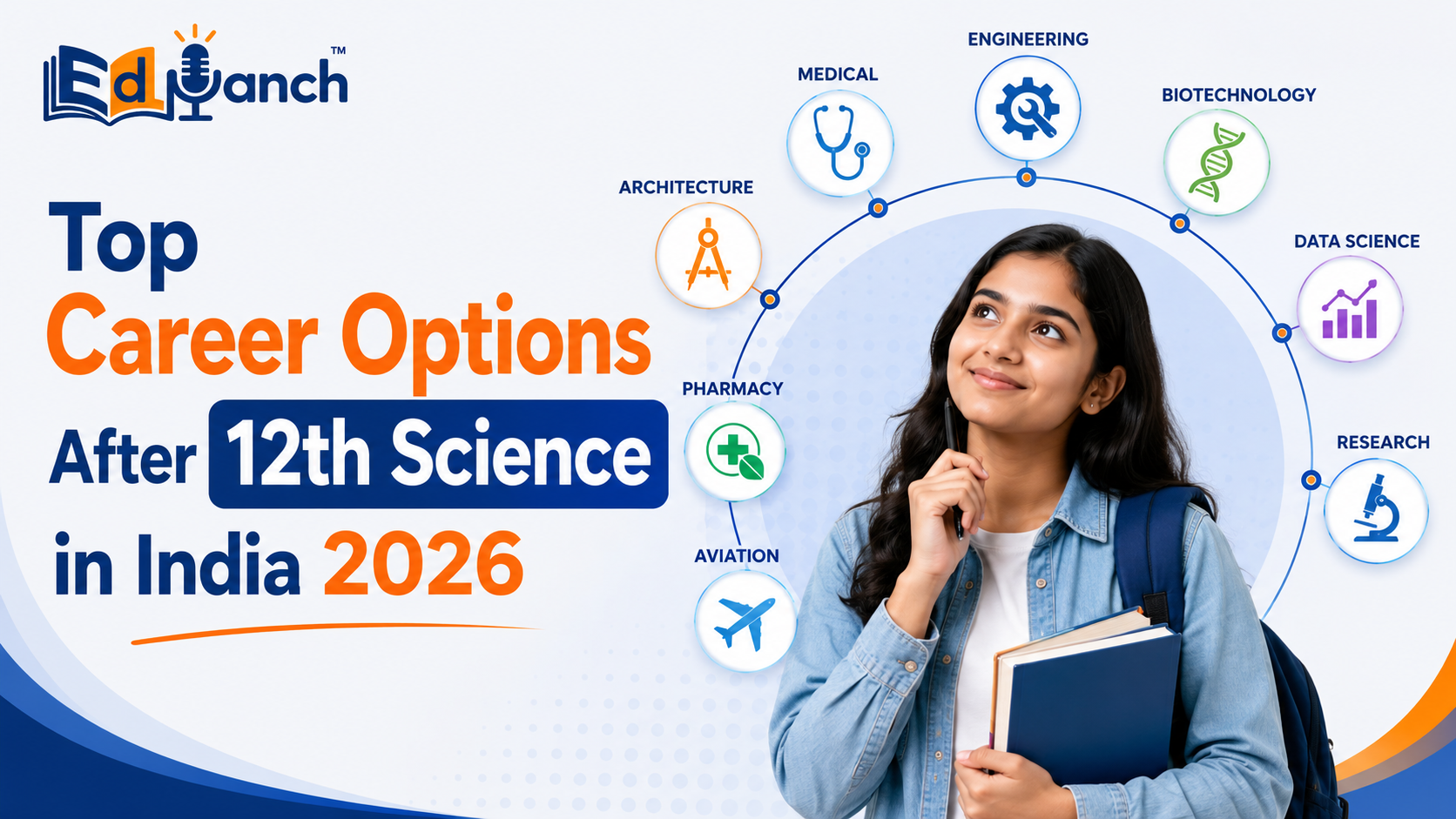
 A practical guide to career options after Class 12 science in India, covering engineering, medicine, biotechnology, data science, aviation, and research paths for PCM and PCB student




Top Career Options After Class 12 Science: A Complete Guide for Indian Students in 2026
Finishing Class 12 in the science stream opens one of the widest career doors available to any student in India. Yet that width is precisely what makes the next decision so difficult. Should a student with Physics, Chemistry, and Mathematics (PCM) head straight into engineering, or is data science a smarter long-term bet? Should a Physics, Chemistry, and Biology (PCB) student prepare for NEET, or are there equally rewarding paths outside medicine? These questions matter because the choice made at this stage shapes the next four to six years of education and, very often, the direction of an entire career.
This guide walks through the most relevant and currently in-demand career options after 12th science for Indian students, organised in a way that reflects both traditional strengths and the newer, fast-growing sectors reshaping the job market. The goal is not to tell every student which path is best, since that depends entirely on individual interest and aptitude, but to lay out the landscape clearly enough that an informed decision becomes possible.
Why the Stream Chosen After Class 12 Still Matters
Many students assume that subject choice in Class 11 and 12 only affects entrance exam eligibility. In practice, it does a great deal more. Science with PCM keeps doors open to engineering, architecture, defence services, pure sciences, and increasingly to data-driven fields such as analytics and artificial intelligence. Science with PCB, on the other hand, is the gateway to medicine, dentistry, nursing, allied health sciences, biotechnology, and agricultural sciences.
What makes the science stream particularly valuable in the current job market is its flexibility. A student who later wishes to move into management, law, or the civil services can usually do so without major obstacles. The reverse is rarely true for students from other streams trying to enter engineering or medicine later. This built-in flexibility is one reason parents and counsellors across India continue to view science as a dependable foundation, even when the eventual career has little to do with laboratories or clinics.
Engineering and Technology: Still the Largest Pathway for PCM Students
Engineering remains the most commonly chosen route for PCM students, and for good reason. The Bachelor of Technology or Bachelor of Engineering degree now spans far more specialisations than the traditional mechanical, civil, and electrical branches. Computer Science Engineering, along with newer combinations such as Computer Science with Artificial Intelligence and Machine Learning, has overtaken older branches in terms of student demand and recruiter interest.
Admission typically happens through JEE Main and JEE Advanced for the Indian Institutes of Technology and National Institutes of Technology, while private universities often conduct their own entrance tests, such as BITSAT or VITEEE. State-level engineering entrance exams remain relevant for students aiming at government colleges within their home states.
Within engineering, certain specialisations are seeing particularly strong momentum. Artificial intelligence and machine learning roles are growing rapidly as Indian companies expand their technology teams. Cybersecurity has become a board-level concern for organisations across banking, healthcare, and government, creating sustained demand for trained professionals. Renewable energy and clean technology roles are expanding as India pushes its solar and green hydrogen targets, while space technology is gaining visibility with the growth of the Indian Space Research Organisation alongside private players entering satellite launch and space technology services.
Architecture deserves a separate mention for PCM students with a creative inclination. The National Aptitude Test in Architecture, alongside JEE Main Paper 2, opens admission into Bachelor of Architecture programmes that combine design thinking with technical structural knowledge, leading to careers in urban planning, sustainable building design, and construction management.
Medicine and Healthcare: The Traditional Strength of PCB Students
For students who chose Biology, medicine continues to be the most aspired-to career, and the competition reflects that. The National Eligibility cum Entrance Test, conducted by the National Testing Agency, remains the single gateway into MBBS, BDS, BAMS, BHMS, and most other medical undergraduate programmes in the country. With several lakh students appearing for NEET each year and a comparatively limited number of seats, preparation timelines and realistic goal-setting matter enormously.
MBBS leads to the most recognised and respected medical career, but it is far from the only option. Dentistry through BDS offers a shorter and often less competitive path into healthcare with a strong scope for private practice. Ayurveda through BAMS and homoeopathy through BHMS continue to find steady demand in India, particularly as government schemes under the Ministry of Ayush promote integrated approaches to healthcare alongside conventional medicine.
Nursing deserves far more attention than it typically receives in career conversations. A Bachelor of Science in Nursing opens not only domestic hospital careers but also strong international opportunities, with countries such as the United Kingdom, Canada, and Australia actively recruiting trained Indian nurses. Allied health fields such as physiotherapy, medical laboratory technology, radiology and imaging technology, and optometry are also growing steadily as India's healthcare infrastructure expands beyond metro cities into Tier 2 cities, supported in part by national digital health initiatives such as the Ayushman Bharat Digital Mission, which is gradually creating demand for healthcare professionals comfortable working with digital patient records and telemedicine systems.
Veterinary science is worth considering for PCB students interested in animal health rather than human medicine, with a growing scope in companion animal care, livestock health in rural India, and wildlife conservation programmes.
Biotechnology, Pharmacy, and Life Sciences
Biotechnology sits at an interesting intersection for PCB students who want a science career without committing to the long and intensely competitive medical route. A Bachelor of Science in Biotechnology or Biochemistry opens doors into genetic research, drug development, agricultural biotechnology, and quality control roles within India's pharmaceutical and biotech industries, which have grown substantially given India's position as a major global supplier of generic medicines and vaccines.
Pharmacy, through a Bachelor of Pharmacy degree, leads to roles in drug manufacturing, clinical research, regulatory affairs, and community or hospital pharmacy practice. India's pharmaceutical sector, often described as the pharmacy of the world because of its export volumes, continues to need pharmacists who understand both the science and the regulatory environment governed by bodies such as the Central Drugs Standard Control Organisation.
Genomics and genetic counselling represent a smaller but rapidly growing niche, expanding alongside the global shift toward precision and personalised medicine. While still an emerging field in India compared to markets like the United States, the early movers in this space are likely to find strong long-term opportunities as genetic testing becomes more mainstream in Indian healthcare.
Data Science, Artificial Intelligence, and the New Digital Careers
It would be incomplete to discuss career options after 12th science without addressing how thoroughly data and artificial intelligence have reshaped the job market, regardless of whether a student comes from a PCM or PCB background. Data science as a career no longer requires an engineering degree exclusively. Several universities now offer a direct Bachelor of Science in Data Science, alongside more traditional routes through Computer Science Engineering or Statistics.
The appeal of this field lies in its breadth. Data analysts, machine learning engineers, and business intelligence professionals are needed across banking, healthcare, retail, logistics, and government departments alike. Cybersecurity analysts are increasingly important as digital transactions and personal data handling expand throughout India, partly driven by the rapid scaling of platforms built around the Unified Payments Interface and the broader push for digital governance through Digital India initiatives.
Bioinformatics is a smaller but meaningful crossover field for PCB students with an interest in computing, combining biological knowledge with data analysis to support drug discovery and genomic research. For students who enjoy mathematics and want a quantitative career outside pure engineering, actuarial science through the Institute of Actuaries of India offers one of the more financially rewarding, though academically demanding, paths into the insurance and risk management sector.
Aviation, Defence, and Uniformed Services
Science students, particularly those from a PCM background, have access to career paths that combine physical discipline with technical training. A career as a commercial pilot requires a Commercial Pilot Licence from a Directorate General of Civil Aviation-approved flying institute and remains one of the more financially attractive options, though training costs are a significant consideration for many Indian families.
Defence services through the National Defence Academy entrance exam allow PCM students to join the Indian Army, Navy, or Air Force directly after Class 12, combining a degree with officer training. The Merchant Navy, accessed through courses in nautical science, offers another path that blends technical education with strong international earning potential, particularly appealing to students drawn to travel and structured career progression.
Pure Sciences, Research, and Academia
Not every science student wants an applied, job-focused path immediately. For those genuinely drawn to scientific inquiry, a Bachelor of Science in Physics, Chemistry, Mathematics, or Statistics followed by postgraduate study and research remains a respected and intellectually rewarding route. Institutions under the Department of Atomic Energy, the Council of Scientific and Industrial Research, and various Indian Institutes of Science Education and Research offer strong research environments for students willing to commit to a longer academic timeline.
This path suits students who value depth over speed and are comfortable with the slower, more deliberate pace of academic and research careers compared to industry-facing roles.
How Students Should Actually Approach This Decision
Given the sheer range of career options after 12th science, the real challenge for most students is not a shortage of choice but an overload of it. A few practical considerations help narrow things down sensibly. Genuine interest should outweigh family expectation or peer pressure wherever possible, since sustained motivation over a four to six-year degree is difficult without it. Financial realities matter too, particularly for fields like aviation or private medical and engineering colleges where fees can be substantial, making scholarship research and education loan planning an important part of the decision process rather than an afterthought.
Students should also resist the urge to treat this as a single irreversible choice. The science stream's flexibility means that a student who starts in engineering can later move into management, and a B.Sc. graduate can pivot into data science with the right additional certifications. Career counselling, whether through school counsellors, structured aptitude assessments, or platforms that consolidate verified information on courses, eligibility, and admission timelines, can meaningfully reduce the confusion that students and parents commonly experience during this period. Staying updated on admission notifications, scholarship windows, and entrance exam pattern changes throughout the academic year is just as important as choosing the right field, since missing a deadline can cost a student an entire admission cycle.
Bringing It Together
The career options after 12th science available to Indian students today are broader and more varied than they were even five years ago. Engineering and medicine remain strong, well-trodden paths, but they now sit alongside genuinely promising alternatives in data science, biotechnology, aviation, and research that did not carry the same weight a decade earlier. What matters most is that the decision is made with accurate information rather than assumptions, since misconceptions about eligibility, fees, or scope often lead students away from paths that would have suited them well.
There is no single correct answer to what a science student should do after Class 12. There is only the answer that fits a particular student's interests, financial situation, and long-term goals, arrived at through careful research rather than rushed comparison with classmates.
Frequently Asked Questions
Which is the best career option after 12th science for a PCM student who is unsure about engineering?
Students who are uncertain about engineering still have strong alternatives within PCM, including architecture, data science through a direct Bachelor of Science programme, actuarial science, defence services through the National Defence Academy route, and commercial aviation. The right choice depends on whether the student prefers a technical, creative, analytical, or service-oriented work environment.
Can a PCB student pursue a career outside medicine without wasting their science background?
Yes. PCB students have strong options beyond MBBS, including biotechnology, pharmacy, nursing, physiotherapy, veterinary science, and bioinformatics. Many of these fields have lower entrance competition than medicine while still making full use of a biology and chemistry foundation.
Is it necessary to clear JEE or NEET to have a good career after 12th science?
No.While JEE and NEET remain the primary routes into engineering and medical colleges respectively, many rewarding science careers, including data science, biotechnology, nursing through state-level entrance exams, pure sciences, and aviation, do not require JEE or NEET, making them practical alternatives for students who do not clear these exams.





.png)
.png)

.png)

.png)



.png)
.png)


.png)


.png)