 Monday, November 16, 2026
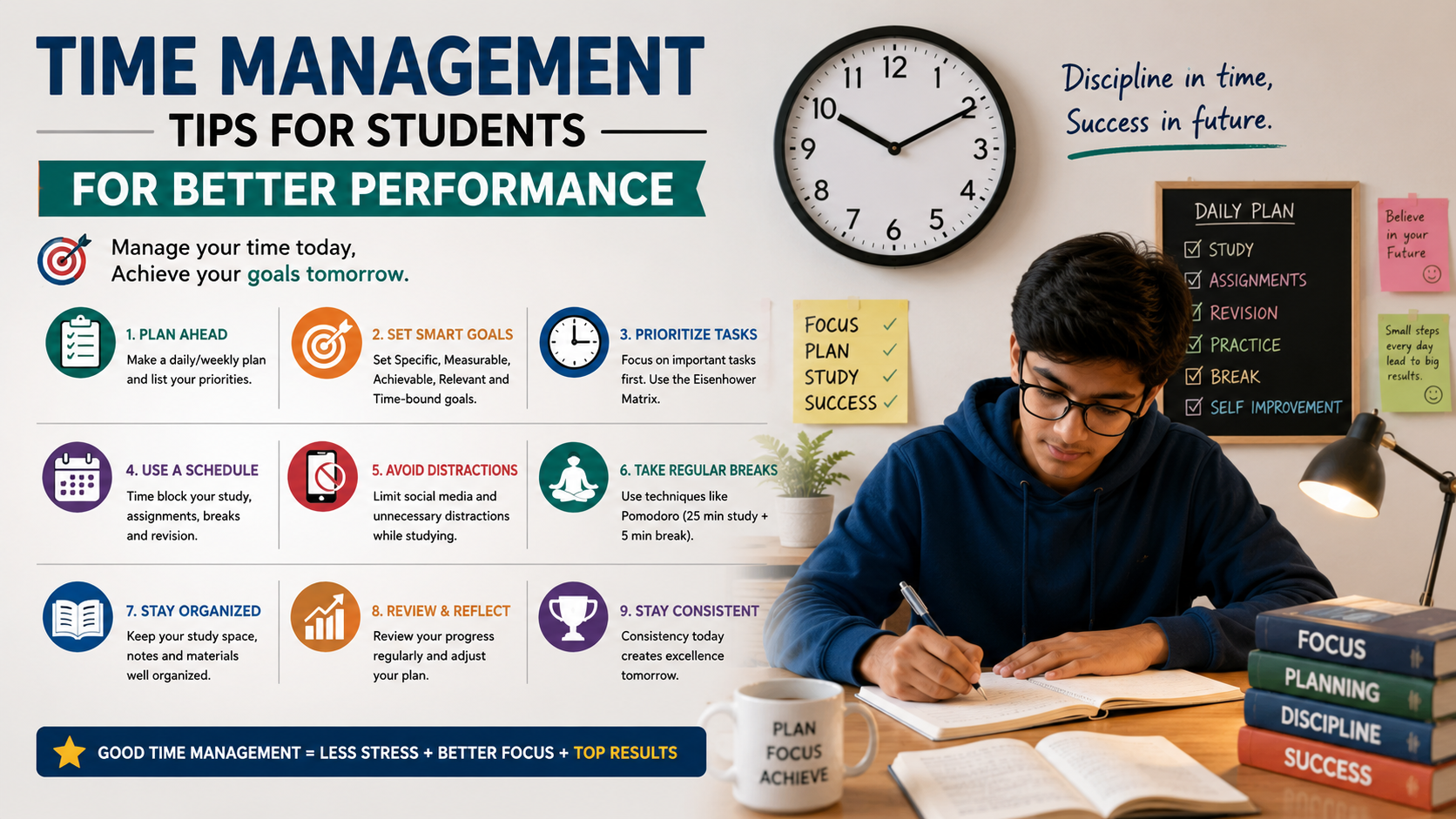
 Discover proven time management tips for students to boost academic performance. From daily planning to study scheduling, learn how to manage your time smartly and score better.





Why Time Management Is the #1 Skill Every Student Needs
You might be the smartest student in your class, but if you don't know how to manage your time, your grades will tell a different story. Time is the one resource you cannot earn back — and for students juggling studies, extracurricular activities, tuition, and personal life, managing it well can make all the difference.
This article gives you practical, easy-to-follow time management tips that will help you study smarter, reduce stress, and perform better — whether you're in school, preparing for board exams, or getting ready for competitive entrance tests.
What Is Time Management and Why Does It Matter for Students?
Time management is your ability to plan and control how you spend your hours so you can accomplish your goals effectively. For students, strong time management skills directly translate into:
- Higher academic performance
- Reduced last-minute exam stress
- More time for hobbies and rest
- Better confidence and mental clarity
If you feel like your day disappears without getting enough done, you don't have a discipline problem — you have a planning problem. And that's completely fixable.
5 Tips for Time Management Every Student Should Start With
If you're new to structured planning, start here. These 5 tips for time management form the foundation of every high-performing student's routine.
- Know Where Your Time Actually Goes
Before you can manage your time, you need to understand where it's currently going. For one week, track how you spend each hour — classes, travel, social media, meals, studying, entertainment. You'll be surprised how much time slips away unnoticed.
Once you see the patterns, you can make better choices.
- Set Clear Daily and Weekly Goals
Vague intentions like "I'll study today" don't work. Instead, write down specific goals:
- "I will complete Chapter 4 of Physics by 6 PM."
- "I will revise 30 Math problems before dinner."
Clear goals give your brain a target. When you know exactly what you're working toward, you stop wasting time figuring out what to do next.
- Build a Realistic Timetable
A timetable is your most powerful tool for managing time management effectively. It removes the daily decision fatigue of "what should I study now?" and keeps you on track automatically.
Here's how to build one that actually works:
- Block study time when your energy is highest (morning for most students)
- Keep study sessions to 45–60 minutes with short breaks in between
- Allocate more time to weaker subjects
- Leave buffer time for unexpected delays
Don't create a timetable so packed that one missed hour throws off your entire day.
- Use the Priority Matrix
Not all tasks are equally important. Use the Eisenhower Priority Matrix to sort your work:
|
Urgent + Important |
Not Urgent + Important |
|
Do it NOW |
Schedule it |
|
Urgent + Not Important |
Not Urgent + Not Important |
|
Delegate or minimize |
Eliminate it |
This is one of the best methods for time management that helps you focus on what actually moves your grades forward — not just whatever feels urgent in the moment.
- Protect Your Study Time Like an Appointment
Once you schedule a study block, treat it like a doctor's appointment. You wouldn't cancel a doctor's visit for a casual reason — apply the same seriousness to your study time. Tell family members, silence your phone, and sit down ready to work.
Advanced Time Management Techniques for Students
Once you've mastered the basics, these time management techniques for students will take your performance to the next level.
The Pomodoro Technique — Study in Focused SprintsThis is one of the most popular tips for managing your time among students worldwide. Here's how it works:
- Choose one task to focus on
- Set a timer for 25 minutes
- Work with complete focus until the timer rings
- Take a 5-minute break
- After 4 rounds, take a longer 20–30 minute break
This method prevents burnout, keeps your brain fresh, and trains you to concentrate deeply. Try it for a week and notice the difference in your productivity.
Time Blocking for Exam Preparation
Time blocking means dedicating specific hours of your day to specific subjects or tasks — with no multitasking allowed.
For example:
- 6:00 AM – 7:00 AM: Mathematics revision
- 4:00 PM – 5:30 PM: Science reading + notes
- 8:00 PM – 9:00 PM: Language practice
Time blocking is especially powerful during exam season. When you manage your time in blocks, you make sure no subject gets ignored and every topic gets the attention it deserves.
The "Two-Minute Rule"If a task takes less than two minutes — do it immediately. Replying to a teacher's message, noting down homework, or organizing your bag — handle these right away instead of letting them pile up mentally.
Small tasks left undone create mental clutter that drains your focus during study time.
Weekly Review SessionsEvery Sunday, spend 20 minutes reviewing your week. Ask yourself:
- Did I complete what I planned?
- Which subjects need more attention this week?
- What distracted me most, and how can I handle it better?
This kind of self-reflection is the secret behind student time management skills that actually improve over time.
Common Time Wasters Students Must Eliminate
Even with the best intentions, certain habits silently destroy your productivity. If you want solid time management advice that actually changes your results, start by identifying and cutting these:
Social Media Without LimitsUnplanned scrolling is one of the biggest time thieves. Use app timers or website blockers during study hours. Apps like Forest, StayFocusd, or Freedom can help you stay off distracting platforms.
MultitaskingYour brain cannot do two things at once effectively. Studying while watching videos or chatting cuts your retention by nearly half. Single-tasking is not just advice about time management — it's proven by neuroscience.
Studying Without a PlanSitting at your desk without knowing what to study leads to hours of low-quality "studying" that achieves very little. Always enter a study session with a specific goal.
Perfectionism Over ProgressSpending three hours perfecting one answer instead of covering three topics is a classic student trap. Progress beats perfection — especially in exam preparation.
Time Management Tips Specifically for Board Exam Students
If you're preparing for board exams, these time management tips for students are especially important:
- Divide your syllabus into weekly targets — Don't leave it all for the last month
- Revise consistently — Small daily revisions beat marathon last-night sessions
- Simulate exam conditions — Practice solving papers within the time limit to build real exam speed
- Balance all subjects — Use your timetable to ensure no subject is consistently skipped
- Sleep and exercise — A rested brain manages time better than an exhausted one
Suggestions for Time Management: What Parents and Teachers Can Do
This section is especially for parents and teachers reading this on Edumanch.in.
For Parents:- Help your child create a consistent daily routine at home
- Minimize interruptions during their dedicated study hours
- Celebrate planning wins, not just marks
- Avoid overscheduling extracurriculars that leave no time for rest or study
- Teach students how to break large assignments into smaller deadlines
- Model good planning by giving students clear timelines for projects
- Introduce classroom discussions on time management advice for students as part of academic counseling
- Recognize and reward students who demonstrate organized, consistent effort
A Sample Daily Timetable for a School Student
Here's a practical example to inspire your own plan. Adjust it based on your school hours, subjects, and personal needs.
|
Time |
Activity |
|
5:30 – 6:00 AM |
Wake up, freshen up |
|
6:00 – 7:30 AM |
Morning study (tough subject) |
|
7:30 – 8:00 AM |
Breakfast + school prep |
|
8:00 AM – 2:00 PM |
School |
|
2:00 – 3:30 PM |
Lunch + rest |
|
3:30 – 5:00 PM |
Homework + classwork revision |
|
5:00 – 6:00 PM |
Outdoor activity / hobby |
|
6:00 – 8:00 PM |
Self-study (second subject) |
|
8:00 – 9:00 PM |
Dinner + family time |
|
9:00 – 9:30 PM |
Light reading / revision |
|
9:30 – 10:00 PM |
Plan next day + sleep preparation |
Quick-Reference: Top Time Management Advice Summary
Here's a condensed list of time mgmt tips you can pin above your study desk:
✅ Track your time for one week before planning
✅ Set specific daily goals, not vague intentions
✅ Build a timetable and follow it consistently
✅ Use the Pomodoro Technique for focused study
✅ Block social media during study hours
✅ Prioritize tasks using the Eisenhower Matrix
✅ Review and adjust your plan every Sunday
✅ Sleep 7–8 hours — it directly affects how well you manage my time during the day
✅ Start with the hardest task when your energy is highest
✅ Reward yourself after hitting your daily targets
Final Thoughts: Time Management Is a Skill You Can Learn
Nobody is born managing time perfectly. Like Math or Science, managing time is a skill — one that gets stronger the more you practice it. If you start small, stay consistent, and review your progress regularly, you will see measurable improvement in your academic performance within weeks.
Remember: it's not about studying more hours. It's about making your hours count.
Start today. Plan tomorrow tonight. And watch your results transform.