 Monday, November 16, 2026
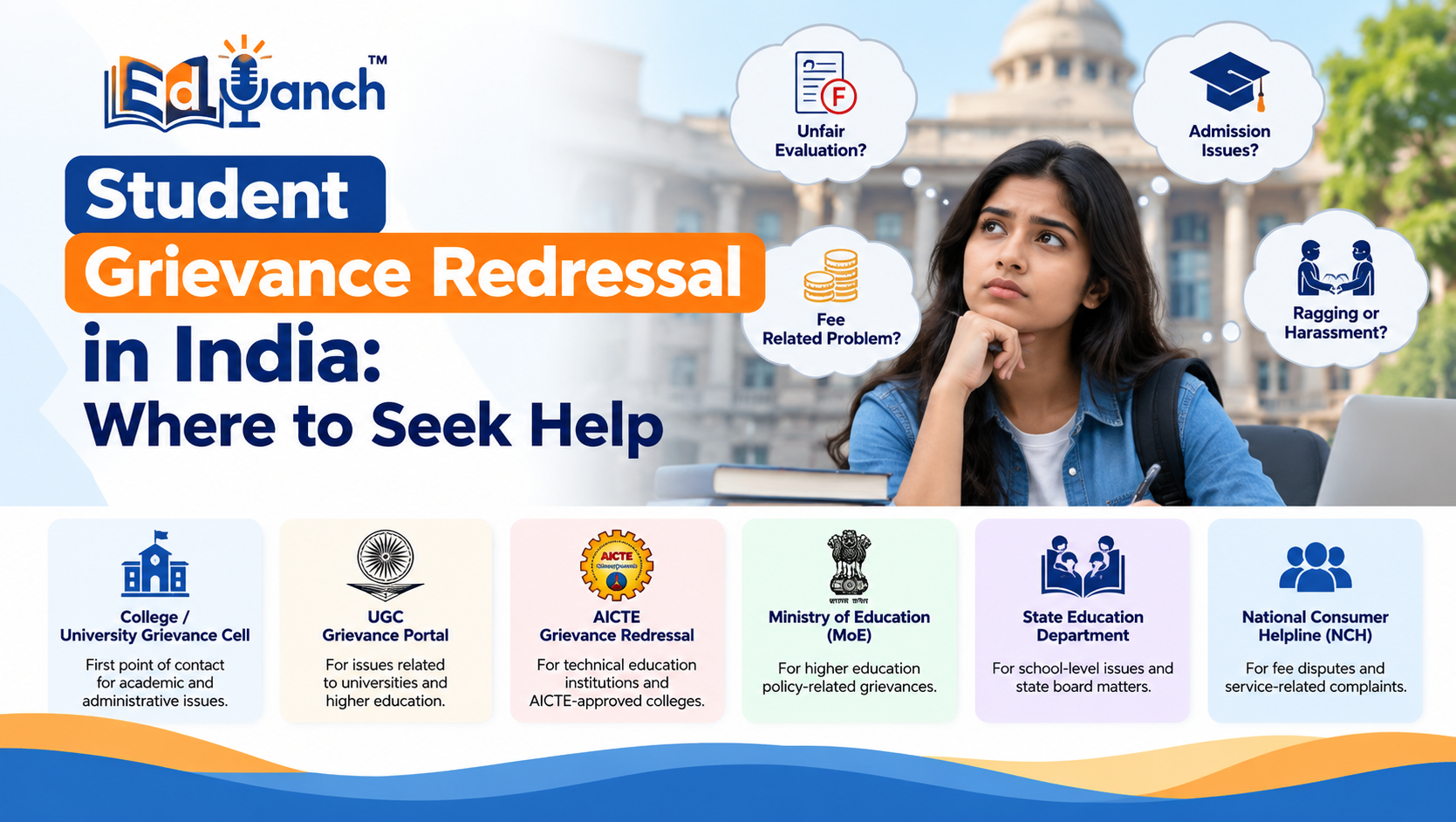
 Students in India can seek redressal through UGC portals, AICTE, NCPCR, consumer forums, and institutional committees. Knowing the right channel ensures every grievance receives a proper response.





Introduction
Every student enters an educational institution with expectations: fair treatment, proper academic resources, transparent examinations, and a safe campus environment. However, not every student experience unfolds without problems. Fee disputes, examination errors, discrimination, harassment, and administrative negligence are challenges that students across India encounter at various points in their academic journey.
The question that most students and parents find themselves asking is: where exactly can a student go for help?
India has developed a structured system of grievance redressal mechanisms over the years, covering schools, colleges, and universities. These mechanisms exist through regulatory bodies, institutional committees, and state and national government channels. The challenge is that many students are unaware of these options, and that lack of awareness often results in students silently enduring unfair situations that they are fully entitled to challenge.
This article explains the landscape of student grievance redressal in India, outlines who regulates what, and guides students and parents toward the right channels based on the nature of their complaint.
Understanding Student Grievances and Why Redressal Matters
A student grievance refers to any formal complaint raised by a student regarding the services, conduct, policies, or decisions of an educational institution that the student believes are unfair, incorrect, or in violation of established norms.
Grievances in the education sector can take many forms. Some of the most commonly reported categories include:
- Wrongful denial of admission or manipulation of merit lists
- Arbitrary fee hikes or non-refund of fees after course withdrawal
- Examination irregularities such as paper leaks, incorrect evaluation, or withheld mark sheets
- Discrimination based on caste, gender, religion, or region
- Ragging, bullying, or sexual harassment on campus
- Non-issuance of degree certificates or migration certificates
- Poor quality of academic infrastructure or hostel facilities
The importance of a functional grievance redressal system goes beyond individual students. When institutions are held accountable for their conduct, it raises the overall standard of education governance. Students who know they have a platform to raise complaints are also less likely to abandon their studies due to unresolved institutional issues.
The Institutional Level: Your First Stop
The first and most immediate avenue for any student with a grievance is the institution itself. Both the University Grants Commission and the All India Council for Technical Education have made it mandatory for affiliated colleges and universities to establish internal grievance redressal bodies.
Student Grievance Redressal CommitteeUnder the UGC (Redressal of Grievances of Students) Regulations, 2023, every higher education institution must constitute a Student Grievance Redressal Committee. This committee is typically chaired by a senior faculty member and must include student representatives.
Students can submit a written complaint to this committee, which is required to acknowledge the complaint and respond within a defined period. The internal process allows institutions to resolve matters without external escalation and gives students a documented record of having raised the issue formally.
Anti-Ragging CommitteeRagging remains one of the most serious issues faced by students entering new institutions. The Regulations of the University Grants Commission on Curbing the Menace of Ragging in Higher Educational Institutions, 2009, make it compulsory for all colleges and universities to have an Anti-Ragging Committee and an Anti-Ragging Squad. Any student who experiences or witnesses ragging must report it to this committee immediately.
Internal Complaints CommitteeFor complaints related to sexual harassment, the Sexual Harassment of Women at Workplace (Prevention, Prohibition and Redressal) Act, 2013, commonly known as the POSH Act, extends to educational institutions. Every institution is required to have an Internal Complaints Committee where students can file complaints confidentially and expect a fair inquiry process.
Regulatory Bodies at the National Level
When the institution fails to act or when the grievance involves the institution itself, students must approach the relevant national regulatory body. The correct authority depends on the type of institution involved.
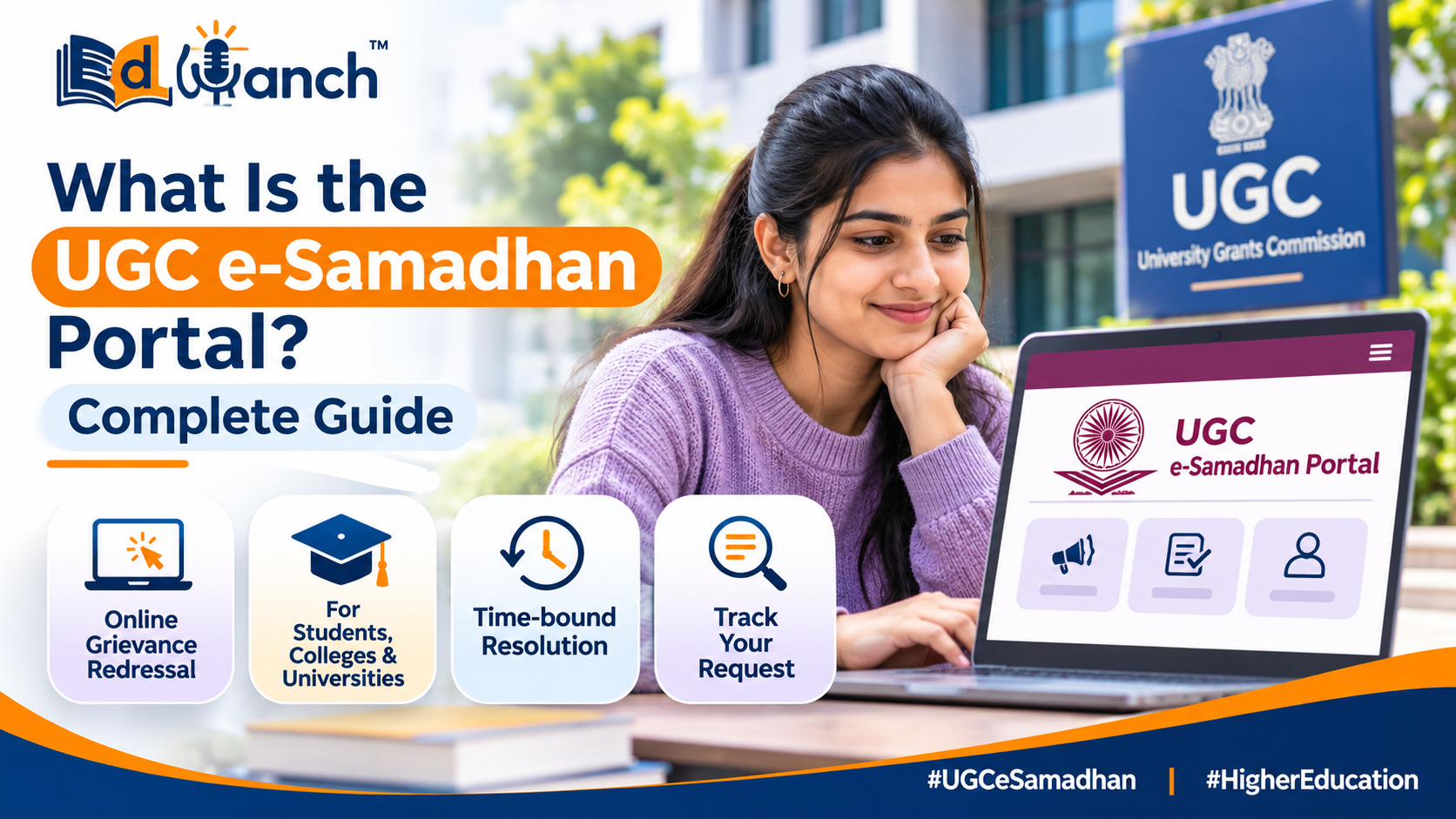
University Grants CommissionThe UGC is the apex body governing higher education in India. It operates the UGC Student Grievance Redressal Portal, accessible at ugcgrievance.in, where students enrolled in UGC-recognized universities and affiliated colleges can file complaints online. Categories covered include admission disputes, fee-related issues, examination concerns, discrimination, and non-issuance of documents.
The UGC also appoints an Ombudsperson in each university. The Ombudsperson functions as an independent authority to hear escalated grievances that the institution has not resolved. Students can directly approach the Ombudsperson after trying internal channels.
All India Council for Technical EducationFor students in engineering, architecture, management, pharmacy, and other technical programs, the AICTE grievance portal is the appropriate channel. AICTE handles complaints about fee refund violations, non-approved programs being sold as AICTE-approved, and infrastructure deficiencies in technical institutions. Students can visit the AICTE Grievance Portal through the official website at aicte-india.org.
National Medical CommissionStudents pursuing medical education under MBBS, BDS, and postgraduate programs fall under the purview of the National Medical Commission and the Dental Council of India. Fee hikes in medical colleges, capitation fee demands, and bond policy disputes are among the issues that the NMC addresses. Students can approach the NMC through its official website at nmc.org.in.
State-Level Mechanisms and Lokayukta
In India, education is a concurrent subject under the Constitution, meaning both the central and state governments have jurisdiction. Each state has its own Department of Education, and most states have set up dedicated grievance portals or help desks for students.
Students in government or state-aided schools can approach the District Education Officer or the State Board of Secondary Education. For college-level issues, the State Higher Education Council or the Commissionerate of Higher Education is the appropriate authority.
Several states have also empowered their Lokayukta or State Ombudsman offices to hear complaints against government educational institutions. In states like Karnataka, Maharashtra, and Rajasthan, the Lokayukta has historically taken suo motu cognizance of serious lapses in educational institutions.
Students who believe that state government educational authorities themselves are acting wrongly can approach the State Human Rights Commission for issues involving fundamental rights violations.
National Commission for Protection of Child Rights
For students below the age of 18, the National Commission for Protection of Child Rights provides a dedicated platform. The NCPCR operates a complaint portal called SHIKSHA (System for Holistic Integrated Kanoon for School Automation) where parents and students can file complaints related to denial of admission under the Right to Education Act, corporal punishment, child labor in schools, and other rights violations.
State-level Commissions for Protection of Child Rights function as parallel bodies and are particularly active in addressing school-level grievances in regional languages and within local jurisdictions.
Consumer Forums and Legal Avenues
Education has been recognized as a service under the Consumer Protection Act, 2019, and students or parents can approach the District Consumer Disputes Redressal Commission, the State Consumer Disputes Redressal Commission, or the National Consumer Disputes Redressal Commission for complaints involving fee fraud, misleading admission information, or failure to deliver promised academic services.
Consumer forums offer a relatively accessible and low-cost legal route, particularly for fee-related disputes. Students do not need a lawyer to file a complaint in the District Commission, and the time taken to resolve such cases has improved significantly over the past few years.
For serious legal matters involving constitutional rights, High Courts and the Supreme Court of India remain options under writ jurisdiction. Public Interest Litigations in education have historically resulted in landmark judgments protecting student rights in India.
National Student Helplines and CPGRAMS
The Government of India operates the Centralized Public Grievance Redress and Monitoring System at pgportal.gov.in, which allows citizens including students to file complaints against central government educational institutions and ministries. Complaints submitted through CPGRAMS are tracked and assigned to the concerned ministry for resolution.
The Ministry of Education also runs student-specific support through its various portals and helplines. Students preparing for competitive exams and facing issues with National Testing Agency conduct can raise complaints directly through the NTA grievance system, which came under significant public scrutiny following the NEET controversy in 2024.
Practical Steps for Students Filing a Grievance
Navigating the grievance system can feel overwhelming, especially during the academic year when students are also managing studies and examinations. A clear and systematic approach helps significantly.
Students should begin by documenting everything related to the grievance, including written communications, fee receipts, mark sheets, admission letters, and any verbal commitments that were made in writing. A written record is essential because regulatory bodies and consumer forums require evidence to process complaints effectively.
The complaint should first be submitted at the institutional level. If the institution does not respond within 15 to 30 days, the student can escalate to the respective national regulatory body. Students should retain copies of all complaints submitted and keep track of reference numbers or acknowledgment receipts.
For students who find the process confusing, several student legal aid organizations and NGOs active in India's education sector offer guidance and sometimes free representation. Law school legal aid clinics in cities like Delhi, Mumbai, Pune, and Bengaluru have taken up student rights cases in the past.
How Edumanch Supports Students in Understanding Their Rights
Platforms like Edumanch play an important role in bridging the information gap that exists around student rights and redressal mechanisms in India. By providing clear, updated, and reliable guidance on education governance, regulatory frameworks, policy changes, and student resources, Edumanch helps students and parents make more informed decisions when navigating institutional challenges.
Understanding where to go for help is the first step in actually getting it. Edumanch's commitment to simplifying education information means that students across Tier 1, Tier 2, and Tier 3 cities in India can access guidance that was previously available only to those with access to legal advisors or education consultants.
Conclusion
The grievance redressal ecosystem for students in India is more developed than most students realize. From institutional committees to national regulatory portals, consumer forums to child rights commissions, multiple channels exist to ensure that no student has to suffer in silence. The key is knowing which door to knock on.
Students must understand that raising a grievance is not an act of confrontation. It is an exercise of a legitimate right, and the institutions and regulators governing India's education system are obligated by law to respond. Parents and students should stay informed, document issues carefully, and use the appropriate channels without hesitation.
Frequently Asked Questions
Q1: What is the UGC Student Grievance Redressal Portal?
The UGC Student Grievance Redressal Portal is an online platform launched by the University Grants Commission where students can register complaints related to admission, fee refund, examination, discrimination, and other academic issues in UGC-recognized colleges and universities.
Q2: Can a school student file a formal grievance in India?
Yes. School students or their parents can approach the State Education Department, District Education Officer, or CBSE and CISCE grievance portals for complaints related to fee irregularities, examination disputes, or harassment.
Q3: What happens if my college does not resolve my grievance?
If the institution fails to resolve the grievance within a reasonable time, students can escalate the matter to the UGC Grievance Portal, AICTE, the State Regulatory Commission, or approach the National Consumer Disputes Redressal Commission if the issue involves fee fraud or service deficiency.
Q4: Is there a time limit to file a student grievance?
While time limits vary by institution and regulatory body, students are generally advised to file their grievance as soon as possible. The UGC Grievance Regulations specify that institutions must acknowledge complaints within a defined period and resolve them promptly.
Q5: Are grievance committees mandatory in Indian colleges?
Yes. As per UGC regulations, all higher education institutions are required to establish a Student Grievance Redressal Committee. Institutions that fail to maintain these committees can face regulatory action.
Resources
- University Grants Commission (UGC): Official regulatory body for higher education in India, operating the national student grievance redressal portal at ugcgrievance.in
- All India Council for Technical Education (AICTE): National body overseeing technical education institutions, with a dedicated grievance portal at aicte-india.org for fee and accreditation complaints
- National Commission for Protection of Child Rights (NCPCR): Central body for child rights enforcement, operating the SHIKSHA portal for school-level grievance filing
- CPGRAMS, Government of India: Centralized Public Grievance Redress and Monitoring System for complaints against central government bodies, accessible at pgportal.gov.in
- National Medical Commission (NMC): Regulatory authority for medical education in India, handling grievances related to MBBS and postgraduate medical programs at nmc.org.in
Interlinking Keywords
student grievance redressal India, UGC grievance portal, AICTE student complaints, student rights in India, anti-ragging committee India, NCPCR school complaints, consumer forum education disputes, POSH Act colleges, Right to Education grievance, CPGRAMS student complaints, higher education ombudsperson India, student legal rights India
Last reviewed by:
Dr. Manthan Tripathi, Edumanch Editorial and Education Guidance Team on October 27, 2026.
Disclaimer
This article is intended for informational and educational purposes only. It does not constitute legal advice. Students and parents are advised to consult a qualified legal professional or directly contact the relevant regulatory authority for guidance specific to their situation. Information about regulatory portals, bodies, and procedures is subject to change, and readers should verify current details from official government and regulatory websites.