 Monday, November 16, 2026
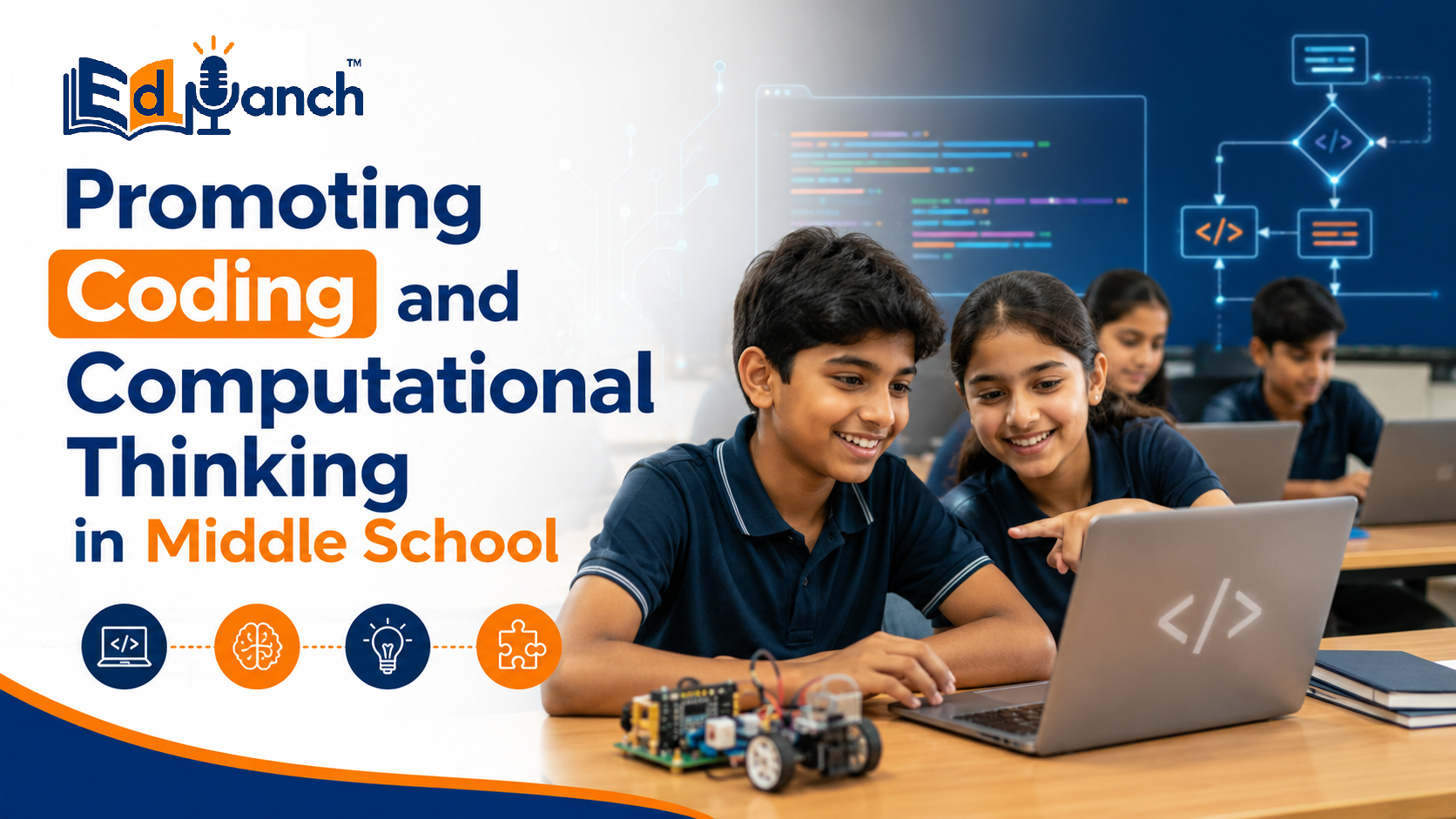
 This article explains how middle school coding can develop computational thinking through progressive learning, combining unplugged activities, block-based programming, physical computing, Python, project-based learning, and inclusive teaching strategies.





As digital technologies and algorithmic systems reshape global industries, digital literacy in early education must evolve beyond basic computer operations. In the modern educational landscape, learning to code is not simply about acquiring vocational software skills; it is about developing Computational Thinking (CT)—a structured, analytical problem-solving methodology applicable across all scientific and humanities disciplines.
Middle school (Grades 6 to 8, ages 11 to 14) represents the critical developmental bridge. At this cognitive stage, students transition from Jean Piaget's concrete operational stage to formal operational thinking, gaining the capacity for abstract logic, variable manipulation, and systematic hypothesis testing.
However, introducing advanced, syntax-heavy text programming too early often induces cognitive overload and discourages learners. Progressive middle school curricula must balance unplugged computational logic, visual block-based scaffolding, tangible physical computing (robotics), and gentle transitions to text-based languages like Python.
1. The Four Pillars of Computational Thinking
Before writing a single line of code, middle school students must master the foundational mental models that govern algorithmic reasoning:
- Pillar 1: Decomposition: Breaking a complex, intimidating problem or system down into smaller, manageable, and isolated sub-problems (e.g., decomposing a video game into player physics, score tracking, and enemy movement).
- Pillar 2: Pattern Recognition: Analyzing trends, recurring structures, and shared characteristics across data points to identify similarities and avoid redundant effort.
- Pillar 3: Abstraction: Filtering out irrelevant details and background noise to focus exclusively on the core mechanics and mathematical relationships that matter.
- Pillar 4: Algorithmic Design: Creating an ordered, step-by-step sequence of unambiguous instructions or logical rules to solve a specific problem or execute an automated process.
2. The Scaffolding Spectrum: Block-Based to Text-Based Progression
A developmentally appropriate middle school computer science curriculum scaffolds complexity across three academic years:
- Grade 6 (Visual Logic & Creative Expression): Visual Block Programming (Scratch, Blockly, App Inventor). Focuses on drag-and-drop code blocks to eliminate syntax errors while building loops, conditional logic (if-else), event listeners, and variable tracking through interactive storytelling and 2D game design.
- Grade 7 (Physical Computing & Microcontrollers): Hardware Integration (BBC micro:bit, Raspberry Pi Pico, Arduino). Connects abstract logic to physical reality using on-board LED matrices, accelerometers, temperature sensors, and servo motors to build environmental monitors and simple robotics.
- Grade 8 (The Text-Based Transition): Hybrid Block-to-Text and Introductory Python. Bridges visual blocks into readable, text-based scripting (e.g., Python Turtle graphics, basic arithmetic automation, text adventure games), emphasizing syntax rules, indentation, data types, and functions.
3. Structural Comparison: Syntax-First Coding vs. Computational Thinking-First Pedagogy
- Instructional Focus:
- Syntax-First Coding Model: Memorizing programming syntax, punctuation, brackets, and compiler commands.
- CT-First Scaffolding Model: Cultivating algorithmic decomposition, pattern design, and iterative logic.
- Student Impact: Removes intimidating syntax hurdles and builds confidence in conceptual problem solving.
- Primary Toolset:
- Syntax-First Coding Model: Standard command-line terminal, code editors, and professional IDEs.
- CT-First Scaffolding Model: Visual block editors (Scratch), unplugged logic games, and physical microcontrollers (micro:bit).
- Student Impact: Delivers immediate visual and physical feedback, maintaining high student engagement.
- Assessment Methodology:
- Syntax-First Coding Model: Written syntax tests, debugging error outputs, and closed-book coding exams.
- CT-First Scaffolding Model: Project-based portfolios, collaborative pair-programming artifacts, and design showcases.
- Student Impact: Evaluates real-world creative synthesis and functional problem-solving ability.
- Classroom Equity & Inclusivity:
- Syntax-First Coding Model: High barrier to entry; often alienates students with lower typing fluency or math anxiety.
- CT-First Scaffolding Model: Highly inclusive; engages diverse learning styles through storytelling, art, and hands-on making.
- Student Impact: Closes early gender and socioeconomic gaps in computer science participation.
4. Unplugged Computational Thinking: Teaching Logic Without Screens
Integrating "unplugged" activities allows students to grasp computational concepts kinesthetically without screen fatigue or hardware limitations:
- Human Algorithmic Mazes: Students write precise step-by-step movement algorithms (Step Forward, Turn Right 90°, If Wall Then Turn Left) for a blindfolded classmate, demonstrating the necessity of unambiguous instructions.
- Binary Sorting Parity Games: Using physical balance scales, weights, or card-sorting grids to simulate search algorithms (Linear Search vs. Binary Search) and bubble-sort mechanics.
- Pixel Grid Cryptography: Teaching image compression and run-length encoding (RLE) by having students encode and decode black-and-white grid drawings using numerical run counts.
5. Strategic Implementation Blueprint for Middle Schools
To deploy an effective, equitable middle school coding program, school administrators should follow a four-pillar framework:
- Pillar 1: Adopt a Project-Based Learning (PBL) Framework: Shift away from isolated coding worksheets toward student-driven capstone projects (e.g., designing an interactive quiz game, coding an automated plant-watering sensor, or creating an animated social awareness story).
- Pillar 2: Standardize Dedicated Physical Computing Labs: Equip classrooms with low-cost microcontrollers (such as BBC micro:bit or Raspberry Pi boards) and reusable sensor kits that allow students to see their code interact directly with the physical world.
- Pillar 3: Integrate Cross-Curricular Coding Projects: Connect computer science directly to standard subjects—such as coding planetary orbit simulations in Science, modeling algebraic coordinate geometry in Mathematics, or building interactive timelines in History.
- Pillar 4: Invest in Non-Specialist Teacher Training: Provide continuous professional development for general science and math teachers, using standardized, open-source curricula (such as Code.org CS Discoveries) to build faculty instructional confidence.
10 Frequently Asked Questions (FAQs)
Q1. Why is middle school the ideal time to introduce computational thinking?Middle school students are developing abstract cognitive reasoning capabilities. Introducing structured computational thinking during this window solidifies algorithmic logic before academic pressure and high school specialization begin.
Q2. What is the difference between coding and computational thinking?Coding is the technical act of writing instructions in a specific programming language (like Python or Java). Computational thinking is the broader cognitive problem-solving process—breaking problems down, recognizing patterns, and designing algorithmic solutions—that occurs before coding.
Q3. Why should middle schools start with block-based programming instead of Python?Block-based programming (like Scratch) eliminates syntax and punctuation errors (such as missing colons or semicolons), allowing young learners to focus entirely on logical structures (loops, variables, conditionals) without frustration.
Q4. What is the BBC micro:bit, and why is it popular in middle schools?The micro:bit is a pocket-sized programmable microcontroller equipped with LEDs, buttons, motion sensors, and Bluetooth. It allows students to create physical computing projects (like step counters or digital compasses) using either visual blocks or Python.
Q5. Can computational thinking be taught without computers?Yes. "Unplugged" computer science activities use physical games, puzzles, card sorting, and role-play to teach algorithms, binary numbers, and logic networks without requiring digital devices.
Q6. How does learning to code support mathematics performance?Coding reinforces mathematical concepts like Cartesian coordinate planes, algebraic variables, conditional inequalities, angles, and ratios by applying them directly inside visual game design and simulations.
Q7. How much classroom time should be allocated to coding in middle school?A standard recommendation is 1 to 2 hours per week of structured computer science instruction, integrated either as a dedicated weekly subject or embedded into STEM/mathematics project blocks.
Q8. What is "Pair Programming," and how does it benefit students?Pair programming is a collaborative learning technique where two students share one computer—one acts as the "Driver" (typing the code) while the other acts as the "Navigator" (reviewing logic and catching errors). It enhances communication, teamwork, and code quality.
Q9. How can schools make coding programs inclusive for all genders?Curricula should emphasize creative, real-world, and social-impact projects (e.g., interactive art, healthcare monitors, digital storytelling) rather than solely gaming mechanics, fostering an inclusive environment for all students.
Q10. What is the best progression from Scratch to text-based coding?The transition works best through hybrid platforms (such as MakeCode or Scratch-to-Python environments) that display block code and text side-by-side, followed by beginner-friendly visual Python environments like Python Turtle graphics.