 Monday, November 16, 2026
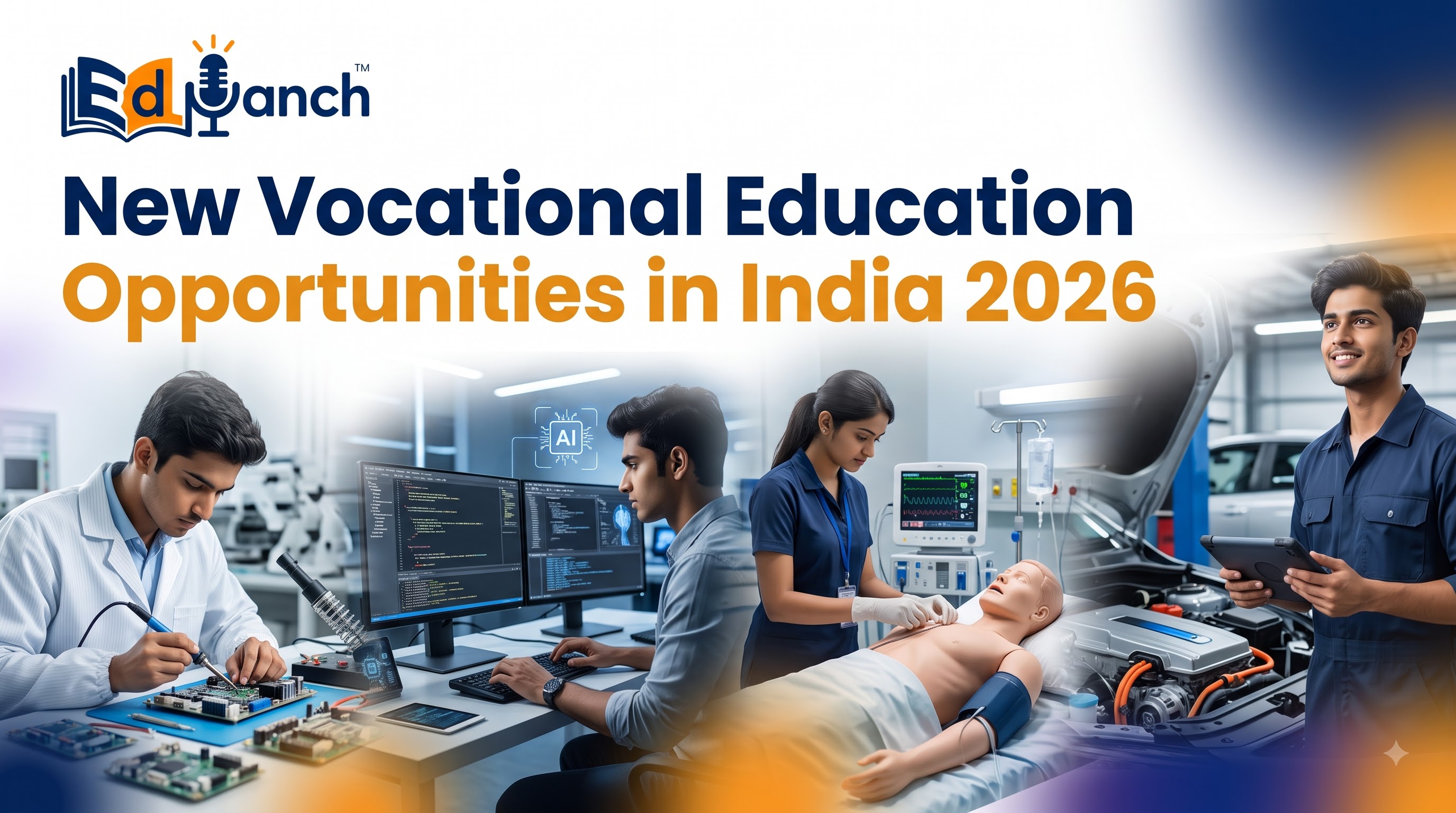
 This article explores India's expanding vocational education landscape, covering government schemes, emerging sector opportunities, and employment outcomes to guide students and families toward informed career decisions.





Introduction
India stands at a defining moment in its education and employment journey. With the largest youth population in the world and a rapidly transforming economy, the country faces both an enormous opportunity and a persistent challenge: bridging the gap between education and employability. Millions of young Indians complete their schooling or graduation each year, yet a significant portion remain underprepared for the practical demands of the modern workforce.
Vocational education is the answer that policymakers, educators, and employers are increasingly rallying around. Unlike conventional academic programmes that focus primarily on theoretical knowledge, vocational education builds hands-on, job-ready skills. It prepares students to enter the workforce faster, with confidence and competence, whether in traditional trades like construction and electrical work or emerging sectors like electric vehicles, solar energy, and digital services.
What makes this moment particularly significant is the convergence of several forces: the National Education Policy 2020 has formally integrated vocational learning into mainstream education, new government funding is flowing into skilling infrastructure, and India's economy is creating demand for technically skilled workers across dozens of new sectors. For students, parents, and job seekers, understanding these opportunities is no longer optional. It is essential for informed decision-making about careers and futures.
Understanding Vocational Education in India
Vocational education refers to structured learning that equips individuals with the specific skills needed to perform a defined occupation or trade. It is practical, targeted, and directly connected to employment outcomes. In India, vocational education exists across multiple levels and pathways, making it accessible to a wide range of learners.
At the foundational level, Industrial Training Institutes, commonly known as ITIs, have been the backbone of formal vocational training in India for decades. There are currently over 15,000 ITIs operating across the country, offering courses in trades ranging from electrician and welder to electronics mechanic and computer hardware technician. Alongside ITIs, polytechnic institutions offer diploma-level programmes in engineering and technology disciplines, typically lasting two to three years.
Beyond these traditional institutions, a newer and more flexible ecosystem of skill development centres has emerged under the Skill India Mission. These centres, affiliated with the National Skill Development Corporation (NSDC), offer short-term certification courses that can be completed in weeks or months rather than years. This flexibility is particularly important for working adults, school dropouts, and rural youth who cannot commit to multi-year academic programmes.
It is also important to understand the distinction between formal and informal vocational training. Formal training follows a structured curriculum, leads to a recognised certificate, and is typically delivered through an institution or government-approved programme. Informal training, by contrast, happens organically through family traditions, workplace learning, and self-initiated practice. While informal training is far more widespread in India, it often does not lead to certifiable credentials that employers can verify.
According to data from the Periodic Labour Force Survey, only about 4 percent of working-age Indians between the ages of 15 and 59 have received formal vocational training. In contrast, 30 percent report having received informal training. This gap between formal and informal skilling is one of the central challenges that new vocational education policies are attempting to address.
Key Government Schemes and Initiatives Driving Vocational Education
The Government of India has invested significantly in expanding vocational education through a series of targeted schemes and institutional reforms. Understanding these programmes is crucial for anyone seeking to benefit from the opportunities they create.
Pradhan Mantri Kaushal Vikas Yojana (PMKVY) is the most prominent among these. Launched in 2015 and currently in its fourth phase, PMKVY has trained millions of youth across India in sectors ranging from beauty and wellness to construction and electronics. The scheme offers free short-term training with certification and a financial reward upon successful completion. PMKVY 4.0, aligned with the vision of Industry 4.0, specifically focuses on emerging technologies including artificial intelligence, robotics, drone operation, and coding.
The National Apprenticeship Promotion Scheme (NAPS) is another critical initiative. It provides financial incentives to employers who take on apprentices, making it easier for young people to gain paid, on-the-job training while simultaneously earning a recognised qualification. Apprenticeship is widely regarded as one of the most effective models for skill development because it combines structured learning with real workplace experience.
Jan Shikshan Sansthans (JSS), spread across hundreds of districts, bring vocational training to non-literate and school dropout populations, particularly women in rural and semi-urban areas. Courses offered through these centres are practical, locally relevant, and designed to support self-employment and microenterprise development.
Under the National Education Policy 2020, vocational education has been formally embedded into the school curriculum from Class 6 onwards. The policy also introduces credit transfer mechanisms and lateral entry pathways, allowing vocational education students to move into higher education without losing academic credits. This is a landmark shift that removes the longstanding stigma and structural barriers that had made vocational pathways feel like a dead end for many students and families.
Emerging Sectors Creating New Vocational Opportunities
One of the most exciting developments in India's vocational education landscape is the emergence of entirely new sectors that are generating strong demand for technically trained workers. These are not the traditional trades of the past. They represent the industries that will define India's economy over the next two decades.
Green Energy and Sustainability is one of the fastest-growing areas. India has committed to significant renewable energy targets, and achieving them requires a large workforce trained in solar panel installation, wind turbine maintenance, energy auditing, and green building construction. Courses in these areas are being rolled out through NSDC-affiliated centres and state skill development missions, creating genuine employment pathways in both urban projects and rural electrification programmes.
Electric Vehicle Technology is another high-growth area. As India pushes for widespread EV adoption, the demand for technicians who can assemble, maintain, and repair electric vehicles is rising sharply. ITIs and private training partners have begun offering EV-specific trade courses, and several automobile manufacturers have set up dedicated training facilities in partnership with the government.
Healthcare Support and Allied Health Services represent a massive and often overlooked vocational opportunity. India needs millions of trained general duty assistants, phlebotomists, medical equipment technicians, and community health workers. These roles do not require a full medical degree but do require certified practical training. With India's healthcare sector expanding rapidly under programmes like Ayushman Bharat, this is a sector offering stable, long-term employment.
Digital Services and IT-Enabled Services (ITeS) continue to dominate formal vocational training enrolments. Courses in digital marketing, data entry, graphic design, video editing, and basic software support are accessible even to students from Tier 2 and Tier 3 cities and towns. The penetration of affordable internet and smartphones has made digital skilling more achievable for a broader population than ever before.
Logistics and Supply Chain is a sector that received massive attention following the growth of e-commerce. Trained workers in warehousing, cold chain management, last-mile delivery coordination, and freight operations are in high demand, particularly in logistics hubs developing across states like Rajasthan, Uttar Pradesh, and Maharashtra.
Who Is Benefiting and Who Needs Better Access
The current landscape of vocational education in India is not equally accessible to all. Research shows that formal vocational training is disproportionately accessed by individuals who already hold higher educational qualifications. Those with less schooling, despite having the greatest need for structured skill-building, are least likely to access formal training programmes.
Women represent another group where access gaps are significant. While women enrol in formal training at roughly comparable rates to men, they are less likely to access informal on-the-job training due to workplace entry barriers. Women who do access formal training are often concentrated in sectors like textiles and beauty services, while IT and high-paying technical trades remain male-dominated. Expanding women's access to non-traditional vocational fields is a priority area for both equity and economic growth.
Rural youth face geographical barriers, as quality training infrastructure remains concentrated in urban and semi-urban centres. Mobile training units, community college programmes, and online skill courses with offline assessment components are being piloted to address this gap, but scale remains a challenge.
It is also worth noting the employment outcomes linked to different types of training. Workers with formal vocational certifications earn significantly higher wages than those with only informal training. Among salaried employees, the median monthly income of a formally trained worker is more than 50 percent higher than that of an untrained or informally trained worker. However, even among formally trained graduates, more than half end up in informal employment, where job security and benefits remain limited. This points to the need not only for better training but also for stronger employer linkages and job placement support within vocational programmes.
Conclusion
Vocational education in India is undergoing a genuine transformation. The combination of policy reform under NEP 2020, flagship skilling schemes, and strong demand from new-age industries has created a moment of real possibility for students who are willing to explore pathways beyond conventional academic degrees.
For students making decisions about their futures, for parents seeking clarity about which options offer genuine employment prospects, and for educators guiding young people through a rapidly changing world, understanding vocational education is now more important than ever. The opportunities are real, the government support is substantial, and the industries seeking skilled workers are actively hiring.
The challenge ahead is one of awareness, access, and quality. When more young Indians, especially those from rural areas, lower-income families, and underrepresented communities, can access high-quality formal vocational training, the benefits will ripple far beyond individual careers. They will reshape India's workforce, strengthen its economy, and deliver on the promise of inclusive growth.
Platforms like Edumanch play a meaningful role in this ecosystem by making information about vocational schemes, courses, institutions, and career pathways accessible and easy to understand for students and families across the country.
Frequently Asked Questions
Q1: What is vocational education in India?
Vocational education in India refers to skill-based learning that prepares students for specific trades or occupations. It includes programmes offered through ITIs, polytechnics, NSDC-affiliated training centres, and government skill development schemes such as PMKVY.
Q2: Which government scheme supports vocational training in India?
Pradhan Mantri Kaushal Vikas Yojana (PMKVY) is the flagship scheme. Other key programmes include the National Apprenticeship Promotion Scheme (NAPS), Jan Shikshan Sansthans, and the Skill India Mission, all of which support free or subsidised skill training across dozens of sectors.
Q3: What are the top vocational courses in demand in India in 2026?
The most in-demand vocational courses in 2026 include IT and ITeS, electric vehicle technology, solar energy installation, healthcare support services, digital marketing, logistics management, and advanced manufacturing trades.
Q4: Can vocational education students pursue higher education in India?
Yes. Under the National Education Policy 2020, vocational education students can pursue higher education through lateral entry pathways and academic credit transfer mechanisms, removing earlier structural barriers between the vocational and academic streams.
Q5: How does vocational education improve employment outcomes in India?
Formally trained vocational education graduates are significantly more likely to secure salaried employment and earn higher wages than untrained workers. Research indicates that the median income of a formally trained worker is more than 50 percent higher than that of an informally trained or untrained worker in equivalent roles.
Resources
- National Skill Development Corporation (NSDC): India's primary institutional body for vocational training partnerships, certifications, and skill development programme delivery across sectors.
- Ministry of Skill Development and Entrepreneurship (MSDE): The nodal government ministry overseeing Skill India, PMKVY, apprenticeship policy, and vocational education reform in India.
- National Education Policy 2020, Ministry of Education: The foundational policy document that formally integrates vocational education into India's school and higher education systems.
- Periodic Labour Force Survey (PLFS), Ministry of Statistics and Programme Implementation: The primary source of data on vocational training prevalence, employment outcomes, and workforce participation in India.
- National Council for Vocational Education and Training (NCVET): The regulatory body overseeing quality assurance, recognition, and certification standards for vocational education and training in India.
Interlinking Keywords:
vocational education in India, Skill India Mission, PMKVY courses, ITI admissions, NEP 2020 vocational training, skill development schemes, career opportunities after vocational training, NSDC certification, apprenticeship programmes India, government skill development schemes
Last reviewed by:
Edumanch Editorial and Education Guidance Team on August 27, 2026
Disclaimer:
The information provided in this article is for general educational and informational purposes only. Scheme details, enrolment criteria, and programme availability are subject to change based on government policy updates. Readers are advised to verify current information directly through official government portals and recognised institutions before making any educational or career decisions.