 Monday, November 16, 2026
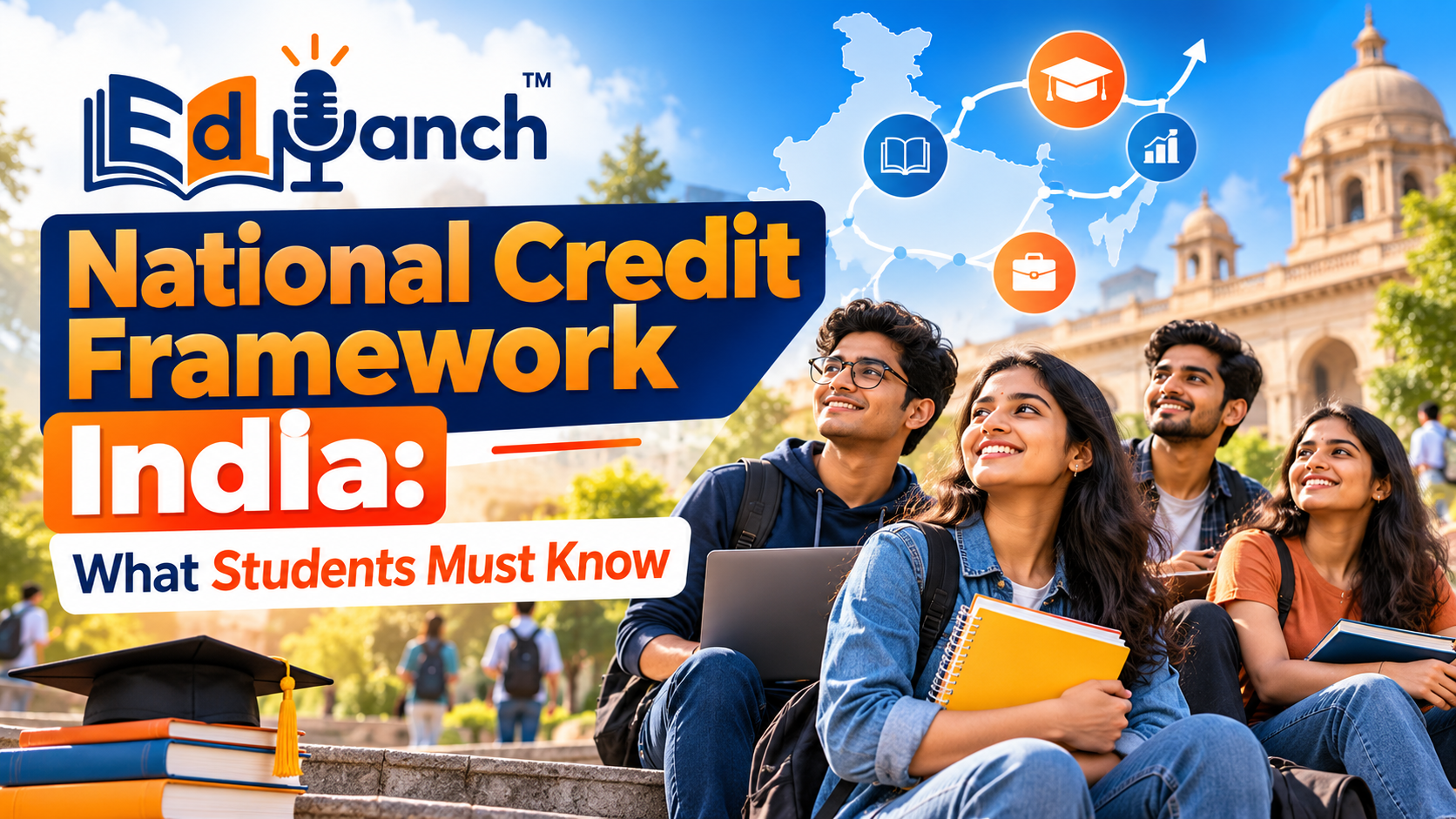
 The National Credit Framework (NCrF) unifies academic, vocational, and experiential learning under one system, offering Indian students flexibility, credit portability, and recognition across all education levels.





Introduction
Education in India is undergoing one of its most significant structural transformations since independence. At the heart of this transformation lies the National Credit Framework, or NCrF, a policy initiative that redefines how learning is measured, recognized, and rewarded. Whether a student is pursuing formal academics, vocational training, or co-curricular activities, the NCrF aims to ensure that all of that effort translates into tangible academic credit.
For millions of students navigating a rapidly evolving education landscape, understanding the NCrF is no longer optional. It is a foundational step toward making informed academic decisions. The framework touches every level of education, from Class 6 in school through postgraduate study at university. It is perhaps the single most consequential structural change introduced under the National Education Policy 2020, and its full implementation is already underway across institutions.
This guide breaks down everything students, parents, and educators in India need to know about the National Credit Framework: what it is, how it works, and how it will reshape the educational journey ahead.
Understanding the National Credit Framework
The National Credit Framework, officially introduced by the University Grants Commission (UGC) in 2023 in alignment with NEP 2020, is a unified system for accumulating, transferring, and recognizing academic credits across different levels and streams of education. Before the NCrF existed, credits earned in school education, vocational training, and higher education operated in completely separate silos. A student who completed a diploma or a vocational certification had no official pathway to carry those credits into a degree program. The NCrF changes this entirely.
At its core, the NCrF assigns credit levels to learning outcomes rather than simply to time spent in a classroom. This is a fundamental shift in educational philosophy. Under the earlier system, learning was largely measured by how long a student studied. Under the NCrF, what matters is what a student has actually learned and demonstrated through assessment.
The framework covers eight levels of learning, beginning from foundational school education and progressing through secondary, higher secondary, undergraduate, and postgraduate stages. Each level has a defined credit requirement, and students can accumulate those credits through multiple pathways including formal coursework, vocational programs, internships, co-curricular activities, and research work.
One credit under the NCrF corresponds to 30 notional hours of learning. These hours include contact hours in the classroom, self-study, practical sessions, project work, and any other recognized learning activity. This definition makes the credit system transparent and comparable across institutions and disciplines.
How the Credit Structure Works at Different Education Levels
Understanding how credits are distributed across different stages of education helps students plan their academic journey with greater clarity.
At the school level, students from Class 6 onward are covered under the NCrF. Students in Classes 6 to 8 are expected to earn a total of 40 credits per year. In Classes 9 and 10, the credit requirement is structured to include both curricular and co-curricular components, and students are expected to complete 40 credits annually. Similarly, for Classes 11 and 12, the framework assigns credits not just for academic subjects but also for vocational courses, sports, arts, and community engagement activities.
At the higher education level, the structure is as follows:
- A one-year certificate program requires 40 credits
- A two-year diploma requires 80 credits
- A three-year undergraduate degree requires 120 credits
- A four-year undergraduate degree with research requires 160 credits
- A postgraduate degree requires 60 to 80 credits depending on the program
This tiered credit structure ensures that students always know where they stand and what they need to achieve in order to progress.
The Academic Bank of Credits and Its Role
One of the most forward-looking components of the NCrF is the Academic Bank of Credits, commonly referred to as the ABC. This is a centralized digital repository maintained by the UGC where students can store the credits they earn from different institutions and programs. The ABC functions somewhat like a bank for academic achievements. Just as one deposits money and withdraws it when needed, a student deposits earned credits into the ABC and can draw on them later to meet degree requirements.
The practical implications of this system are significant. A student who completes a semester at one university and then moves to another does not have to repeat coursework. The credits earned are stored in the ABC and remain valid for redemption. Similarly, a student who takes a break from formal education due to financial constraints, personal circumstances, or career demands can return to studies without starting from scratch, provided the credits remain within their validity period.
The ABC is integrated with DigiLocker, the Government of India's digital document wallet platform, making it accessible and verifiable. Students can register on the ABC portal using their Aadhaar-linked credentials and begin accumulating credits immediately.
Integration of Vocational and Experiential Learning
One of the most progressive aspects of the National Credit Framework is its recognition of vocational education and experiential learning as legitimate sources of academic credit. In the traditional Indian education system, vocational training was often seen as a secondary track, separate from and lower in prestige than mainstream academic education. The NCrF explicitly dismantles this hierarchy.
Under the framework, a student who completes a skill development course certified by the National Skill Development Corporation (NSDC), or a vocational program affiliated with the National Council for Vocational Education and Training (NCVET), can earn credits that count toward their academic qualifications. This integration has been welcomed by educators and industry stakeholders alike.
For a student in a Tier 2 or Tier 3 city who may have pursued a vocational course at an Industrial Training Institute (ITI) before enrolling in a degree program, this recognition means that prior learning is not wasted. It can count toward the total credit requirement for a qualification. This pathway is particularly meaningful in the Indian context, where many students follow non-linear educational journeys due to socioeconomic realities.
Co-curricular activities also receive credit recognition under the NCrF. Activities such as NCC participation, NSS volunteering, sports at the competitive level, and arts performance can earn students credits. This acknowledges that education is not confined to lecture halls and that skills developed outside the classroom have genuine value.
Benefits of the NCrF for Indian Students
The National Credit Framework introduces several tangible benefits that directly affect the student experience:
- Flexibility in learning: Students are no longer locked into a single rigid pathway. They can pursue multiple streams of learning simultaneously and have all of it credited formally.
- Multiple entry and exit options: Students who need to pause their education for any reason can exit with a certificate or diploma and re-enter later to continue toward a full degree.
- Reduced repetition: Credits earned at one institution transfer to another, reducing the need to repeat coursework when changing colleges or programs.
- Recognition of diverse skills: Vocational training, internships, and co-curricular participation are formally credited, making the system more equitable and practical.
- Global alignment: The NCrF aligns with international credit systems, making Indian qualifications more comparable and recognized globally, which matters greatly for students planning higher education abroad.
Challenges and What Students Should Be Aware Of
While the NCrF represents a significant step forward, students and parents should be aware of certain challenges in the early stages of implementation.
Not all institutions have fully integrated the NCrF into their administrative systems yet. The shift requires significant changes in how institutions maintain records, assign assessments, and communicate with the Academic Bank of Credits. In some colleges, particularly in smaller cities, the transition is still in progress.
Students may also find that not all vocational programs or co-curricular activities are yet mapped to the credit framework in a way that their institution formally accepts. It is advisable for students to verify with their institution's academic office how NCrF credits are being implemented at their specific college or university.
The quality and standardization of credit assignment across institutions is another area that regulators are still working on. The UGC and the National Assessment and Accreditation Council (NAAC) are actively developing mechanisms to ensure consistency, but students should stay updated on policy announcements from the UGC official portal.
How to Make the Most of the NCrF as a Student
For students who want to take full advantage of the National Credit Framework, a few practical steps can make a meaningful difference.
First, register on the Academic Bank of Credits portal at abc.gov.in at the earliest opportunity. Registration is free and straightforward. Once registered, students can view, manage, and transfer their credits across institutions.
Second, students should speak with their institution's academic counselor or registrar's office to understand exactly which activities, courses, and programs are currently credit-bearing at their institution and how those credits are being recorded in the ABC.
Third, students pursuing vocational training or skill certification programs should confirm whether those programs are affiliated with NSDC or NCVET and whether the credits will be mapped to the NCrF. This is particularly relevant for students who are pursuing dual pathways in both academic and vocational education.
Fourth, students who plan to transfer institutions or take academic breaks should document all earned credits meticulously and ensure they are properly deposited in the ABC before any institutional transition.
Conclusion
The National Credit Framework marks a turning point in how India defines, measures, and rewards learning. For students, it offers something that the earlier system could not: genuine flexibility, portability of learning, and recognition for every form of academic and vocational effort. Whether a student is studying in a metropolitan university or a regional college, pursuing a skill certification alongside a degree, or returning to education after a gap, the NCrF ensures that no learning is lost.
The framework is still evolving, and full implementation across all institutions and levels will take time. However, the direction is clear, and the benefits are real. Students who understand the NCrF today will be better positioned to plan smarter academic journeys, build stronger portfolios of learning, and navigate an education system that is finally becoming more responsive to the diverse realities of Indian students.
Edumanch will continue to track every development around the NCrF and bring students, parents, and educators the clearest and most practical education guidance available.
Frequently Asked Questions
Q1: What is the National Credit Framework in India?
The National Credit Framework (NCrF) is a unified credit accumulation and transfer system introduced under NEP 2020. It integrates academic, vocational, and experiential learning under one framework, covering students from school level through postgraduate education.
Q2: How does the NCrF benefit students?
The NCrF benefits students by allowing flexible entry and exit from education, credit transfer between institutions, formal recognition of vocational and co-curricular learning, and the ability to accumulate credits over time for degree completion without starting over.
Q3: Is NCrF applicable to school students?
Yes. The NCrF covers students from Class 6 onward and extends through higher education. It integrates school education, vocational training, and undergraduate and postgraduate degrees under a single credit recognition system.
Q4: What is the Academic Bank of Credits?
The Academic Bank of Credits (ABC) is a digital repository where students can store credits earned from various institutions. These credits can later be redeemed for degree completion or transferred when a student moves to a different institution.
Q5: How many credits are required for a degree under NCrF?
Under the NCrF, a three-year undergraduate degree requires 120 credits, a four-year undergraduate degree with research requires 160 credits, and a postgraduate degree requires 60 to 80 credits depending on the structure of the program.
Resources
- University Grants Commission (UGC): Official guidelines and notifications on NCrF implementation and the Academic Bank of Credits
- National Education Policy 2020 (Ministry of Education): Full policy text and NEP 2020 implementation roadmap relevant to the NCrF
- Academic Bank of Credits Portal (abc.gov.in): Student registration portal and credit management platform for ABC
- National Skill Development Corporation (NSDC): Information on vocational programs mapped to NCrF credit levels
- NCERT (ncert.nic.in): Curriculum and learning outcome documents relevant to school-level credit integration under NCrF
Interlinking Keywords
National Education Policy 2020 India, Academic Bank of Credits, UGC credit framework, vocational education credits India, NEP 2020 higher education reforms, credit transfer Indian universities, multiple entry exit policy India, NSDC vocational certification, NCVET recognized courses, undergraduate degree structure India
Last reviewed by:
Dr. Manthan Tripathi, Edumanch Editorial and Education Guidance Team on October 14, 2026.
Disclaimer
The information provided in this article is intended for general educational and informational purposes only. While every effort has been made to ensure accuracy and alignment with the latest official guidelines from the University Grants Commission (UGC) and the Ministry of Education, Government of India, education policies and implementation details are subject to change. Readers are advised to verify the latest updates directly from official sources such as the UGC portal (ugc.ac.in), the Academic Bank of Credits portal (abc.gov.in), and their respective institutions before making any academic or career decisions. Edumanch does not take responsibility for any decisions made solely on the basis of the information presented in this article.