 Monday, November 16, 2026
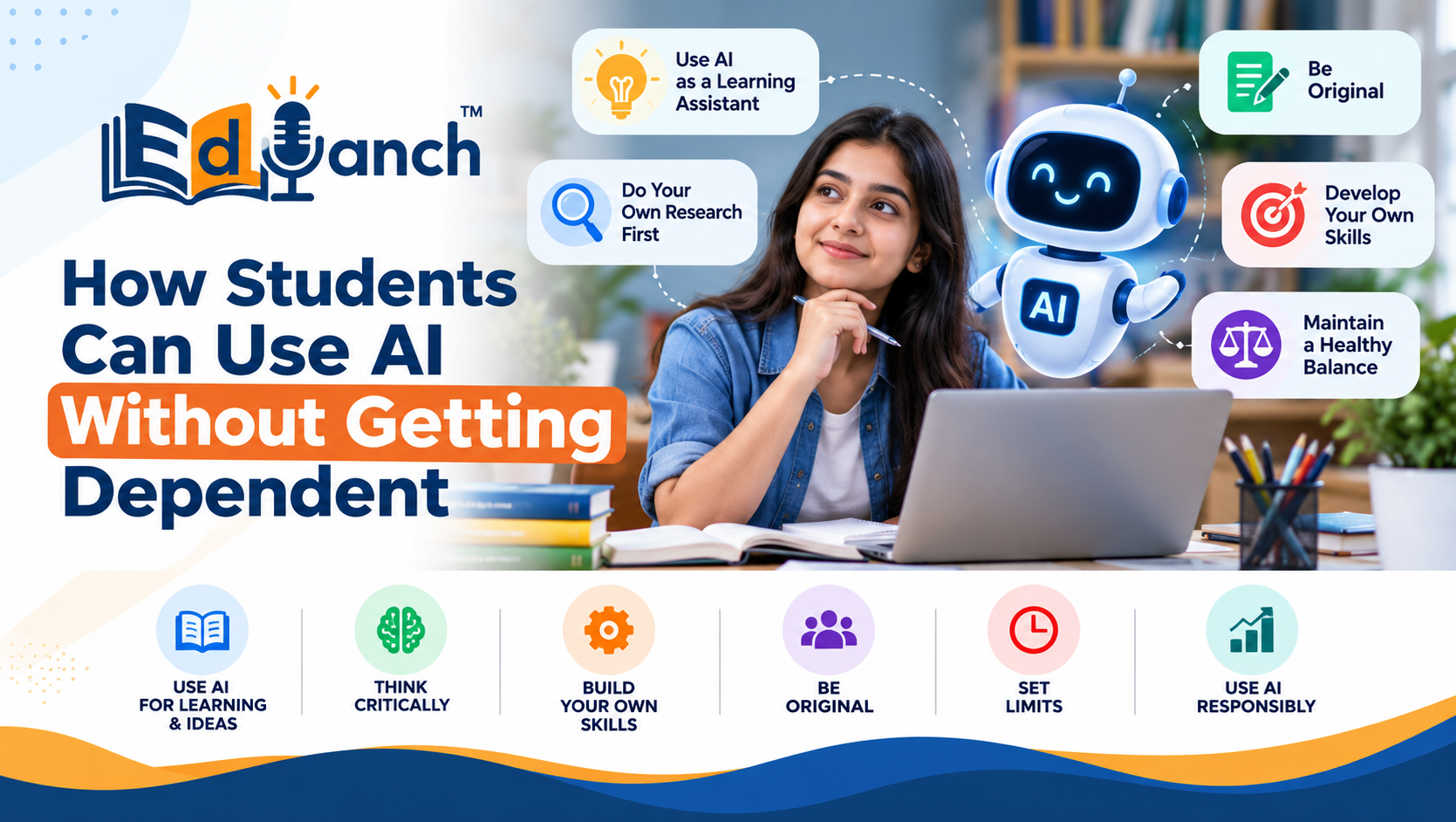
 Students can use AI tools productively by staying engaged in their own learning, attempting problems independently first, verifying AI outputs, and setting intentional usage boundaries to preserve critical thinking skills.





Introduction
Artificial intelligence has entered the daily study routine of millions of Indian students. From generating essay drafts to explaining complex physics concepts in seconds, AI tools have become genuinely useful companions in the learning process. Platforms like ChatGPT, Google Gemini, and Microsoft Copilot are now as familiar to students as textbooks and YouTube tutorials.
But alongside the obvious benefits, a quieter concern is growing among educators, parents, and thoughtful students themselves. What happens when a student stops thinking for themselves because an AI is always available to think for them? What happens to problem-solving ability, recall, creativity, and academic independence when every difficult question is immediately handed over to a machine?
This is not a reason to fear AI or avoid it. It is a reason to use it wisely. The difference between a student who benefits from AI and one who is harmed by it comes down to one thing: awareness of how they are using it.
Understanding What AI Tools Actually Do
Before students can use AI responsibly, they need to understand what these tools actually are and what they are not. AI language models are trained on enormous amounts of text data. They are very good at generating fluent, structured responses on a wide range of topics. They can summarise, explain, rewrite, translate, and suggest.
However, AI tools do not think the way human beings think. They do not truly understand a problem. They generate responses based on patterns in data, which means they can also produce confident-sounding but incorrect information. This is a critical point for students, particularly those preparing for board exams, JEE, NEET, CLAT, UPSC, or any other high-stakes examination in India where accuracy matters enormously.
When a student treats an AI response as a final answer without verifying it, they are trusting a pattern-matching system with their education. The smarter approach is to treat AI as a knowledgeable but fallible assistant, one that must always be cross-checked against authoritative sources such as NCERT textbooks, official syllabi, peer-reviewed content, and UGC-approved academic material.
How AI Dependency Develops in Students
AI dependency does not happen overnight. It creeps in gradually through small habits that feel harmless in the moment.
A student who is stuck on a question turns to ChatGPT once and gets a helpful explanation. The next time they are stuck, they go back. Before long, the first instinct when facing any difficulty is to open an AI tool rather than to sit with the problem, attempt it, struggle with it, and eventually understand it through effort.
This pattern matters because the struggle itself is where learning happens. Cognitive science research consistently shows that effortful retrieval, working through difficulty, and making and correcting mistakes are the experiences that build durable knowledge and strong thinking skills. When AI removes that productive struggle, it also removes the learning that comes with it.
In Indian classrooms, this concern is particularly relevant because academic pressure is high and shortcuts are tempting. Students facing board exam pressure or entrance exam preparation cycles may be especially vulnerable to over-relying on AI tools when time feels short, and the volume of content feels overwhelming.
Signs That a Student Is Crossing From Use to Dependence
There is a meaningful difference between using AI as a learning tool and depending on it as a crutch. Students and parents should watch for these patterns:
- The student cannot begin writing an essay, assignment, or answer without first asking AI for an outline or starting point.
- The student feels anxious or stuck when AI tools are unavailable.
- The student copies AI-generated content with minimal or no engagement, editing, or verification.
- Handwriting, recall during revision, and performance in timed practice tests are noticeably weaker than performance when AI is available.
- The student struggles to explain, in their own words, the content they submitted in assignments.
These signs do not mean a student is lazy or wrong to use AI. They mean the student needs to consciously reset how they are engaging with these tools.
Smart Ways to Use AI Without Losing Independent Thinking
The goal is not to avoid AI but to use it with intention. Here are approaches that allow students to benefit from AI while protecting and developing their own thinking abilities.
Use AI after attempting, not before: The most effective habit is to attempt a problem, write a first draft, or form an initial understanding before consulting an AI tool. AI then becomes a checker and enricher rather than a replacement for thought. A student who writes their own answer first and then uses AI to identify gaps is practising active learning. A student who asks AI for the answer first and then copies it is practising passive consumption.
Ask AI to explain, not to answer: Instead of asking an AI tool to solve a problem or write a paragraph, students can ask it to explain a concept in simpler terms, suggest what they should read next, or identify what is missing from their own attempt. This keeps the student in control of their own work while using AI to fill knowledge gaps.
Verify everything against reliable sources: AI tools can and do make factual errors. For any study-related content, students should verify AI-generated information against NCERT content, official government publications, peer-reviewed academic sources, or subject experts. This habit also builds research skills that are valuable far beyond school.
Set boundaries on AI tool usage: Just as students set study schedules, they can set intentional rules for AI use. For example, AI tools can be used for concept understanding after a revision session but not for completing assignments directly. Such boundaries help maintain the discipline of independent thinking.
Use AI for exploration, not just completion: One of the most underused applications of AI among students is genuine intellectual exploration. AI can help curious students go deeper into a topic, discover related ideas, understand historical context, explore different perspectives on a debate, or prepare better questions for teachers. This kind of use enhances learning rather than replacing it.
AI, Critical Thinking, and the Indian Education Context
India's education system places enormous value on examination performance, and rightly so given the competitive landscape. But the skills that matter most in the long run, including critical thinking, problem-solving, communication, and adaptability, are built through practice and effort, not shortcuts.
The National Education Policy 2020 explicitly prioritises critical thinking, creativity, and competency-based learning. AI tools, used thoughtfully, actually align well with these goals. A student who uses AI to understand multiple perspectives on a historical event is developing analytical thinking. A student who uses AI to generate an entire history project without reading or thinking about it is undermining those same goals.
For students in Tier 2 and Tier 3 cities across India, AI tools have opened access to quality explanations and learning support that might not have been available locally. This is genuinely valuable. The task is to channel that access into genuine learning rather than easy output.
Teachers and institutions across India are also beginning to adapt their assessment methods to account for AI. Oral assessments, in-class writing, open-ended problem solving, and project-based evaluations are all approaches that reward genuine understanding over AI-assisted output. Students who have maintained strong independent thinking skills will be well-prepared for these formats. Those who have over-relied on AI may find themselves underprepared.
Building a Balanced Relationship With AI as a Student
A healthy relationship with AI tools looks like a relationship with any useful resource, such as a library, a tutor, or a calculator. It is used when appropriate, not used as a substitute for understanding, and never used without the student remaining actively engaged with the material.
Students who build this kind of balanced relationship with AI early in their academic lives are preparing themselves for the professional world as well. In virtually every field, from medicine to law to engineering to education, professionals are now expected to work alongside AI tools. The ability to use AI critically and responsibly, knowing when to trust it, when to question it, and when to set it aside, is itself a valuable skill.
Edumanch encourages students, parents, and educators to approach AI not as a threat to education and not as an effortless solution, but as a tool that reflects the intelligence and intention of the person using it. The students who will thrive are those who use AI to think better, not instead of thinking.
Conclusion
AI is here; it is powerful, and it is not going away. For Indian students navigating a demanding academic environment, the question is not whether to use AI but how to use it with awareness and purpose. The students who will benefit most from AI are not those who use it the most, but those who use it the most wisely. By attempting problems independently first, verifying AI-generated content, setting intentional boundaries, and keeping their own thinking at the centre of their learning process, students can gain everything AI has to offer without giving up what education is ultimately building in them.
Frequently Asked Questions
Q1: Is using AI tools harmful for students?
AI tools are not harmful when used with awareness and intention. The risk lies in using AI as a substitute for thinking rather than a supplement to it. Students who use AI to understand concepts, explore ideas, and verify their own reasoning benefit from it. Those who use AI to complete work without engagement lose learning opportunities over time.
Q2: Which AI tools are safe and useful for Indian students?
Several AI tools are widely used by Indian students, including ChatGPT, Google Gemini, Microsoft Copilot, Perplexity AI, and Notion AI. These tools are generally safe for academic use when students treat them as research and explanation aids rather than answer machines. Students should always verify information from authoritative sources such as NCERT, UGC-approved content, or subject textbooks.
Q3: How does AI dependency affect student performance in exams?
Students who rely heavily on AI for answers without engaging with the material often struggle during exams where AI tools are unavailable. Recall ability, problem-solving speed, and analytical thinking weaken when they are not practised regularly. Board exams, JEE, NEET, UPSC, and other competitive exams in India test independent reasoning, which cannot be replaced by AI assistance during the actual test.
Q4: Can AI improve student performance in India?
Yes, AI can meaningfully improve student performance when used correctly. It helps students access personalised explanations, practise through adaptive quizzes, understand complex topics in regional languages, and manage study schedules more effectively. For students in Tier 2 and Tier 3 cities with limited access to quality coaching, AI tools have opened significant learning opportunities.
Q5: What is the right balance between AI use and independent study?
The right balance involves using AI to support the learning process, not to replace it. Students should attempt problems, write drafts, and form opinions independently first. AI can then be used to check understanding, fill knowledge gaps, get explanations for difficult concepts, or explore topics further. Setting boundaries for AI tool usage and maintaining habits of handwritten notes, reading, and offline problem-solving helps maintain this balance.
Resources
- National Council of Educational Research and Training (NCERT): Official curriculum content and textbooks for Indian students across all levels.
- University Grants Commission (UGC): Regulatory body for higher education in India, publishing guidelines on academic integrity and digital learning.
- Ministry of Education, Government of India: Policy documents including the National Education Policy 2020 and digital education initiatives.
- All India Council for Technical Education (AICTE): Guidelines and resources for technical education institutions on emerging technology integration.
- UNESCO Institute for Lifelong Learning: International research and guidance on AI in education, digital literacy, and future-ready learning.
Interlinking Keywords
AI for students India, AI dependency in education, how to use AI tools responsibly, ChatGPT for students, AI and critical thinking, National Education Policy 2020, digital learning India, AI in Indian classrooms, student learning skills, avoid AI overdependence
Last reviewed by:
Dr. Manthan Tripathi, Edumanch Editorial and Education Guidance Team on October 24, 2026.
Disclaimer
The content published on Edumanch is intended for general educational awareness and informational purposes only. It does not constitute professional academic counselling or institutional advice. Students and parents are encouraged to consult qualified educators, school authorities, and academic advisors for personalised guidance. Edumanch does not endorse any specific AI tool or platform mentioned in this article.