 Saturday, September 26, 2026
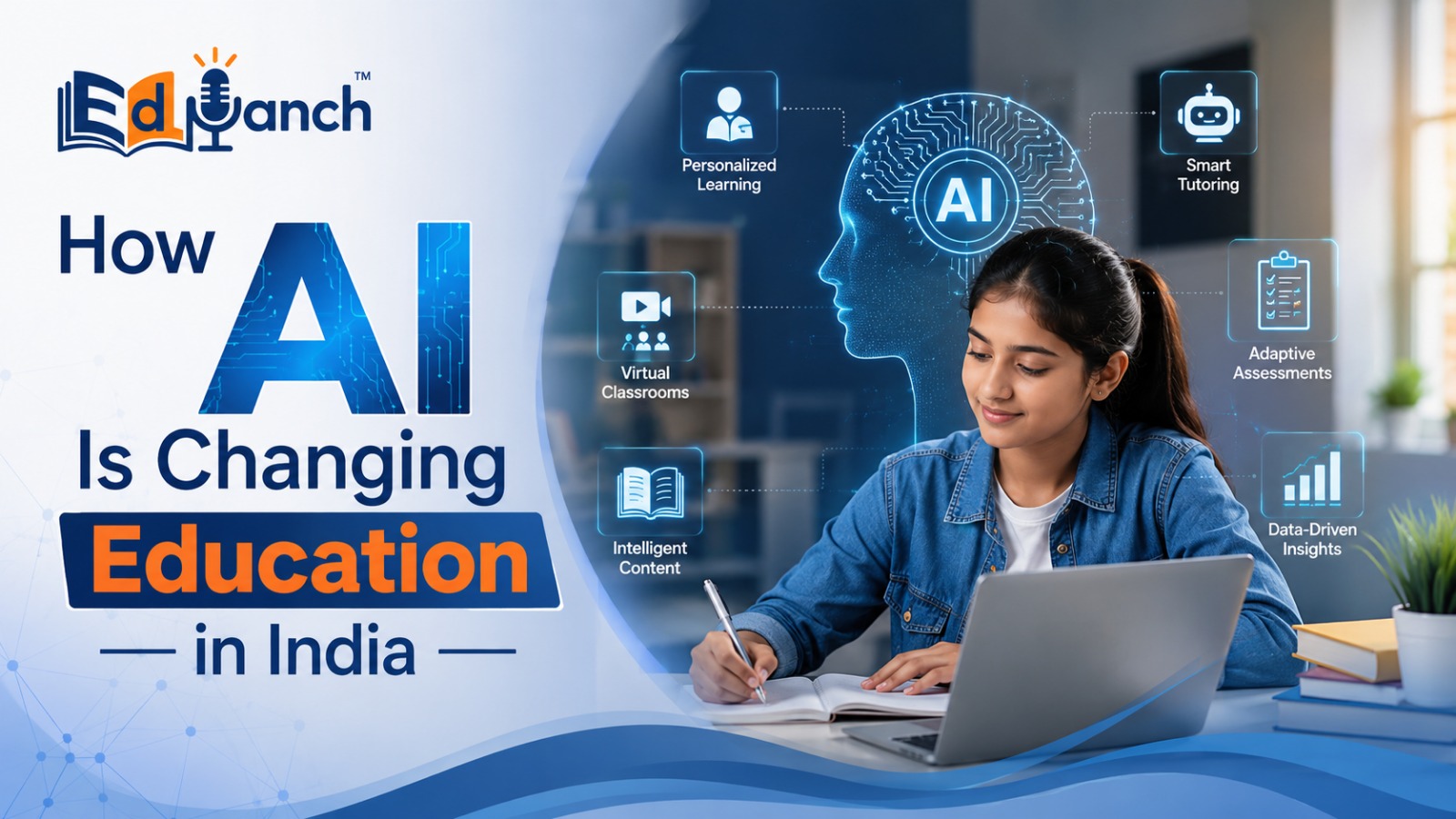
 Artificial intelligence is reshaping Indian education through NEP 2020, a 2026-27 AI curriculum rollout, and platforms like DIKSHA, offering personalisation while raising concerns about bias, access, and over-reliance.





Introduction
Artificial intelligence has moved from being a distant, futuristic idea to an everyday presence in Indian classrooms. Students are using AI-powered apps to prepare for board exams, teachers are relying on automated tools to reduce paperwork, and policymakers are actively rewriting curriculum frameworks to include AI as a core skill rather than an optional extra. This shift is not confined to metro cities alone. From Kendriya Vidyalayas in Tier 2 towns to elite engineering institutes, AI is reshaping how India teaches, learns, and evaluates progress.
For students and parents trying to make sense of what this means for their academic journey, the changes can feel overwhelming. Will AI make learning easier or will it weaken the very skills schools are meant to build? Will every student get equal access, or will AI widen the gap between well-resourced and under-resourced schools? This article breaks down what is actually happening in Indian education right now, what the government is planning for the near future, and what students, parents, and educators need to know to navigate this transition with confidence.
Why AI Is Entering Indian Classrooms Now
India runs one of the largest school systems in the world, with roughly 1.5 million schools and about 250 million students, alongside a shortage of nearly one million teachers. This scale creates a structural problem that traditional classroom methods struggle to solve. A single teacher managing forty or more students with different learning speeds, language backgrounds, and academic gaps cannot realistically give each child individual attention. Artificial intelligence is being positioned as one practical way to address this gap, particularly through personalised learning, faster feedback, and administrative automation that frees up teacher time for actual mentoring.
The National Education Policy 2020 laid the groundwork for this shift years before most classrooms had access to generative AI tools. NEP 2020 recognises artificial intelligence as important for economic growth, teacher capacity building, and personalised education, and it recommends AI learning across all educational stages. Because education sits on the Concurrent List, NEP recommendations shape both central and state-level policy, which is why AI integration is now appearing in curriculum documents across different states rather than being limited to a handful of premium institutions.
Government Policy and the NEP 2020 Connection
Understanding AI in Indian education is difficult without understanding the policy backbone supporting it. Several coordinated initiatives are currently driving this transformation.
The IndiaAI Mission, launched to position India as a global AI leader, spans government, academia, startups, and private industry, with a strong emphasis on extending AI access to tribal and aspirational districts rather than concentrating benefits in urban centres. Complementing this, the Union Budget allocated funding for a dedicated Centre of Excellence in AI for Education, intended to serve as a national hub for integrating AI into teaching, research, and student training, with collaboration from premier institutions such as the IITs and IIITs.
On the school curriculum side, the Ministry of Education has confirmed plans to introduce AI as a foundational, universal skill starting from Class 3 in the 2026-27 academic year, developed with input from CBSE, NCERT, Kendriya Vidyalaya Sangathan, and Navodaya Vidyalaya Samiti. This is a meaningful shift from earlier efforts, where CBSE offered AI only as an elective subject from Class 9 onward. Teacher readiness is being addressed through NISHTHA, the flagship teacher training programme, alongside newer initiatives such as SOAR, aimed at building AI awareness among both students and educators.
Platforms like DIKSHA already use AI to support inclusive learning, including keyword search within videos and read-aloud features for visually impaired students, while NCERT has used AI and machine learning to translate early primary textbooks into twenty-two Indian languages. These are not small pilot projects. They represent an attempt to make AI-supported learning available across India's linguistic and geographic diversity, not just in English-medium urban schools.
How AI Is Changing the Way Students Learn
For students, the most visible change is personalisation. Adaptive learning platforms can adjust the difficulty of questions based on how a student performs in real time, offering additional practice to those who are struggling while allowing faster learners to move ahead without waiting for the rest of the class. This kind of individual pacing was nearly impossible to achieve consistently in a traditional classroom of thirty or more students.
AI-powered tutoring tools are also filling gaps outside school hours. Chatbots that answer subject-specific questions at any time of day give students in smaller towns and cities access to a kind of on-demand academic support that was previously available mostly through expensive private tuition. This matters significantly in the Indian context, where coaching culture already places heavy financial and time pressure on families, particularly around board exams and competitive entrance tests.
At the same time, students are now expected to develop a new kind of literacy. Knowing how to evaluate an AI-generated answer, recognise when a tool has made an error, and use AI responsibly without letting it replace genuine effort are becoming essential academic skills in their own right, not just optional extras.
How AI Is Changing the Way Teachers Teach
Teachers are experiencing a shift in what their daily work actually looks like. Administrative tasks that once consumed hours, such as grading objective assessments, tracking attendance, and preparing lesson plans, can now be significantly reduced through automation. This does not eliminate the teacher's role. It changes it. Teachers increasingly function as reviewers, editors, and mentors who guide how AI-generated material gets used in the classroom rather than doing every repetitive task manually.
This shift does bring a real risk that education experts are actively discussing. If AI is used to remove all productive struggle from learning, such as a student never having to work through a difficult problem without help, the deeper thinking that struggle is meant to build may never develop. The most effective use of AI in Indian classrooms is likely to be one where teachers deliberately decide when a tool should assist and when students need to be left alone with the challenge in front of them.
Teacher preparation itself is an ongoing concern. Most existing teacher training programmes in India were not originally designed to build the specific judgment required to evaluate AI tools, integrate them responsibly, and teach students to use them with integrity. This is part of why NISHTHA and similar training efforts are being scaled up alongside the curriculum rollout.
AI and the Changing Nature of Assessment
Traditional take-home assignments and essays are becoming less reliable as a way to measure genuine student understanding, since AI tools can now generate polished written work in seconds. Indian education bodies are responding to this in a few different ways.
The PARAKH framework, established under NCERT, is pushing schools toward competency-based evaluation rather than rote memorisation, supported by real-time analytics and structured progress reporting. Some institutions are also shifting toward process-based assessment, where drafts, revisions, and in-class writing carry more weight than a single final submission, making a student's actual thinking process more visible than the finished product alone.
There is an important distinction education leaders are drawing here: using AI to assess learning is different from assessing whether students understand AI itself. Both need attention. Schools need to check whether AI-based assessment tools are actually measuring what they claim to measure, while also building students' judgment about responsible AI use as a skill in its own right.
Benefits of AI in Indian Education
When implemented thoughtfully, AI offers several genuine advantages for the Indian education system.
- Personalised learning paths that adapt to each student's pace, rather than forcing every learner through identical material at identical speed
- Wider accessibility for students with disabilities and those facing language barriers, particularly through multilingual and assistive AI tools
- Faster, more specific feedback that helps students correct mistakes closer to when they are made
- Reduced administrative burden for teachers, creating more time for mentorship and individual attention
- Support for reaching India's large population of underserved and out-of-school children, including the 47.4 million out-of-school children reported for 2023 to 2024, through scalable digital delivery
These benefits are meaningful, but they depend heavily on how well AI tools are designed, regulated, and integrated into existing teaching practices rather than simply layered on top of an already stretched system.
Risks and Challenges That Need Attention
No honest discussion of AI in education can ignore the risks. Algorithmic bias is a genuine concern, since AI systems trained on non-diverse datasets can end up amplifying existing gender, caste, or socio-economic biases rather than correcting them. This is why Indian policy discussions increasingly emphasise the need for strict, responsible AI guardrails rather than unregulated adoption.
There is also a documented anxiety among educators about AI displacing meaningful human interaction in the classroom, even though officials consistently frame AI as a support tool rather than a replacement for teachers. Over-reliance on AI for tasks that build foundational thinking, such as working through a difficult maths problem or drafting an original argument, risks weakening exactly the skills schools exist to build. Some experts describe the need for a kind of digital temperance, where students are encouraged to wrestle with core concepts unaided before turning to AI assistance, so that meta-cognitive resilience develops alongside technical fluency.
Access inequality is another real challenge. Urban, well-funded schools are far more likely to have the infrastructure and trained staff needed to use AI tools effectively, while rural and under-resourced schools risk falling further behind unless deliberate efforts are made to extend access, which is precisely why the IndiaAI Mission places explicit emphasis on tribal and aspirational districts rather than assuming benefits will trickle down naturally.
What This Means for Students, Parents, and Institutions
For students, the practical takeaway is that AI literacy is becoming as important as traditional academic skills. Learning to use AI tools thoughtfully, question their outputs, and avoid letting them replace genuine effort will matter for both school performance and future employability, particularly as India's AI talent requirements grow sharply in the coming years.
For parents, staying informed about how a child's school is integrating AI, whether through adaptive learning apps, AI-assisted homework tools, or curriculum changes, allows for better conversations at home about how these tools should and should not be used. Parents do not need to become technical experts, but understanding the basic shift underway helps in guiding healthier study habits.
For institutions and educators, the coming years will likely bring closer scrutiny of which AI tools actually improve learning outcomes versus which ones simply add convenience without real educational value. Staying updated on evolving CBSE, NCERT, and state-level guidelines will be essential as the 2026-27 curriculum rollout approaches. Edumanch continues to track these policy developments, curriculum updates, and institutional changes so that students, parents, and educators have a reliable, jargon-free source to understand what is actually changing and why it matters for real academic decisions.
Conclusion
Artificial intelligence is not a distant possibility for Indian education anymore. It is already shaping how lessons are planned, how assignments are graded, how struggling students are identified, and how curriculum frameworks are being redesigned at the national level. The direction of travel is clear: AI as a foundational skill from Class 3 onward, competency-based assessment through frameworks like PARAKH, and a growing policy focus on extending access beyond India's major cities. The outcome, however, is not predetermined. Whether AI strengthens Indian education or simply adds a new layer of inequality will depend on how thoughtfully schools, teachers, and policymakers implement it over the next few years. Staying informed, rather than either uncritically embracing or entirely resisting these changes, remains the most useful approach for anyone navigating India's evolving education system today.
Frequently Asked Questions
Q1: Will artificial intelligence replace teachers in Indian schools?
No. Government officials and education experts consistently describe AI as a support tool designed to reduce administrative workload, such as grading and scheduling, so that teachers can focus more time on mentorship, relationship building, and individualised guidance rather than being replaced by automation.
Q2: When will AI officially become part of the school curriculum in India?
The Ministry of Education plans to roll out AI as a foundational, universal skill starting from Class 3 in the 2026-27 academic year, developed in coordination with CBSE, NCERT, and other central education bodies, aligned with NEP 2020 and the National Curriculum Framework for School Education 2023.
Q3: How is AI helping students in rural and underserved areas of India?
Government platforms such as DIKSHA use AI for multilingual content delivery and accessibility features like read-aloud support for visually impaired learners, while the IndiaAI Mission specifically aims to extend AI-based educational tools to tribal and aspirational districts rather than concentrating benefits in urban areas alone.
Q4: What are the biggest risks associated with AI use in Indian classrooms?
Key concerns include algorithmic bias if tools are trained on non-diverse data, over-reliance that can weaken students' critical thinking and problem-solving abilities, data privacy questions, and unequal access between well-funded urban schools and under-resourced rural institutions.
Q5: Which Indian government programmes are driving AI adoption in education?
Major efforts include the IndiaAI Mission, the Centre of Excellence in AI for Education funded under the Union Budget, AI curriculum integration led by CBSE and NCERT, digital learning platforms like DIKSHA and SWAYAM, and teacher training delivered through the NISHTHA programme.
Resources
- Ministry of Education, Government of India: Official updates on NEP 2020 implementation and AI curriculum integration in schools
- National Council of Educational Research and Training (NCERT): Curriculum frameworks, PARAKH assessment guidelines, and AI-integrated textbooks
- IndiaAI Mission: Government initiative details on AI infrastructure, skilling, and inclusive access across India
- Press Information Bureau, Government of India: Press releases on AI education policy, budget allocations, and Centre of Excellence announcements
- DIKSHA Platform: National digital infrastructure for AI-supported multilingual and accessible learning content
Interlinking Keywords
AI in education India, NEP 2020, artificial intelligence classrooms, AI curriculum CBSE, personalised learning, AI for teachers, education policy India, digital learning platforms, competency-based assessment, AI literacy students
Last reviewed by:
Edumanch Editorial Team on July 10, 2026
Disclaimer:
This article was generated for informational and content-drafting purposes. Please independently verify all statistics, policy details, dates, and government initiative names against official sources (Ministry of Education, PIB, NCERT, CBSE) before publishing, as policy specifics can change or be updated.




.png)
.png)
.png)

.png)



.png)
.png)



.png)


.png)