 Monday, November 16, 2026
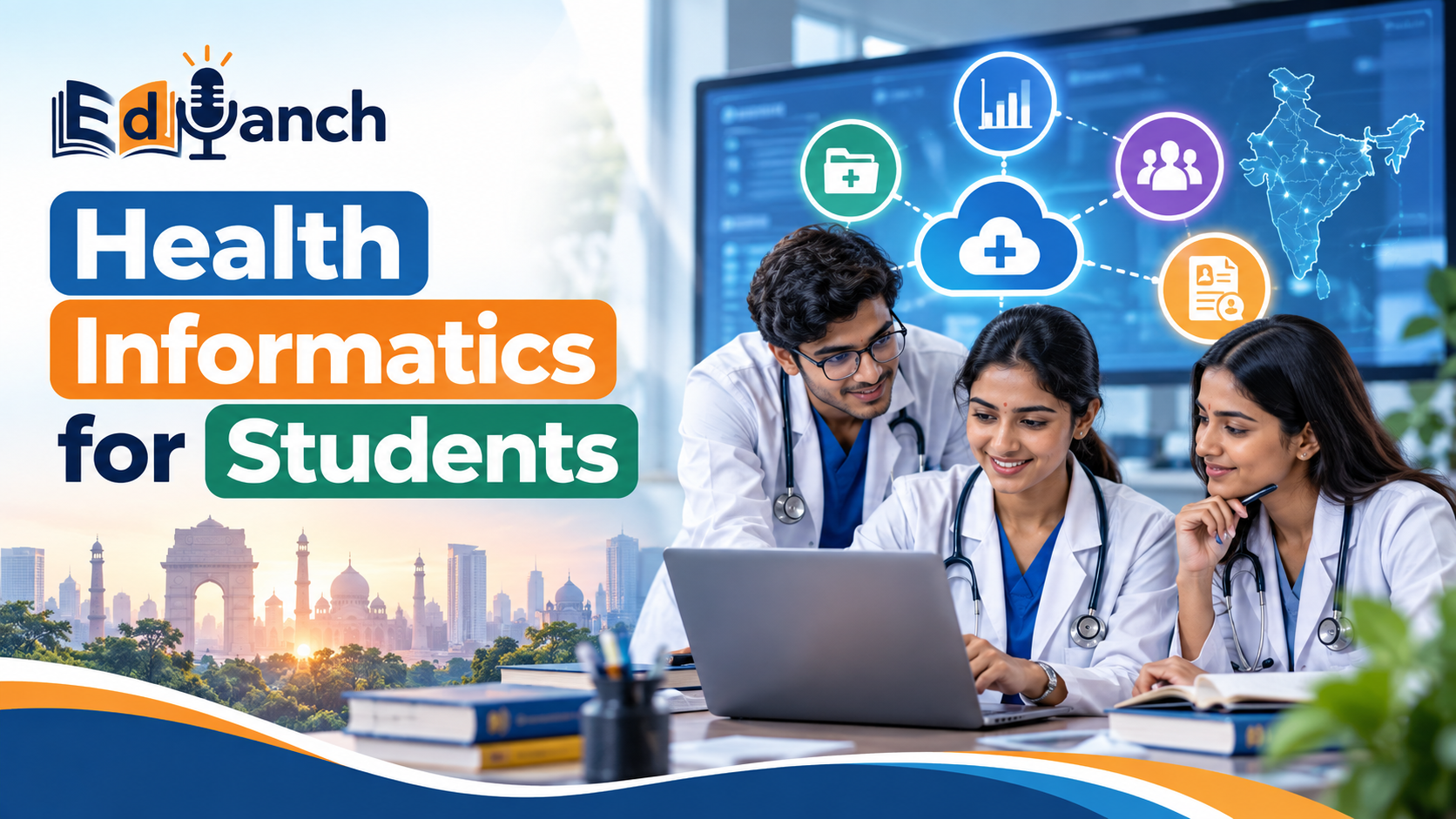
 Health informatics offers Indian students a growing career path combining healthcare, technology, data analytics, electronic records, interoperability, and ethics, with opportunities across hospitals, government, startups, research, and public health systems.





Introduction
If you're a medical, nursing or allied health student in India wondering how technology fits into future healthcare careers, you're not alone. The shift to electronic records, the rise of health analytics and the spread of digital health services are changing how care is delivered. Health informatics sits at the intersection of these changes, and it offers concrete pathways for students who enjoy both healthcare and technology.
This article is written for students and early-career learners exploring healthcare education options. I will walk you through what health informatics means, the subjects to study, the practical skills employers expect, and realistic career routes in India. I’ll also point out limitations and risks so you can make balanced choices.
What it means
Health informatics combines health sciences, information technology and data analytics to improve patient care, workflows and public health. At its core, it asks: how can data be collected, organized and used safely and effectively to help clinicians, administrators and patients make better decisions?
You will hear terms such as clinical data, electronic records and interoperability. Clinical data refers to information gathered during patient care — test results, diagnoses, prescriptions and clinician notes. Electronic records are the digital systems, like hospital EHRs (electronic health records), that store that data. Interoperability is the ability of different systems to share and use data across hospitals, labs and apps.
Why it matters
In India, the need for informed digital systems is growing. Large hospital chains, government programmes and startups are investing in digital health education and infrastructure. For students, this means new roles are opening where understanding both clinical realities and technical systems is valuable.
Health informatics matters because it reduces duplicate tests, speeds decision-making, supports population health planning and enables remote care models. For example, a district public health team using health analytics can identify hotspots of a contagious disease earlier and target resources. Clinicians using well-designed electronic records can spend less time on paperwork and more on patients. But these benefits only appear when systems are designed and used thoughtfully.
Core subjects and what you’ll learn
Health informatics is interdisciplinary. Below are common subjects and what you should expect to learn from each.
- Introduction to Health Systems: Learn how healthcare is organised in India, including primary, secondary and tertiary care, and how data flows through these levels. This helps you understand the context for any digital solution.
- Medical Terminology and Clinical Workflows: Basic clinical knowledge is essential for translating clinician needs into technical requirements. Expect modules on anatomy, common diagnoses and how care teams work.
- Clinical Data Management: Covers how to collect, clean and validate clinical data. You will learn about data models, coding systems (basic exposure), and the importance of data provenance and quality.
- Electronic Health Records (EHRs): Practical understanding of how electronic records are structured, typical modules (admissions, discharge summaries, lab results), and common EHR platforms used in India.
- Health Informatics Standards and Interoperability: Concepts and standards that enable systems to communicate. You will learn why interoperability is challenging and what standards, in principle, support data exchange.
- Health Analytics and Biostatistics: Skills for making sense of clinical data. Expect basic statistics, data visualisation, and introductory machine learning topics framed for health applications.
- Data Privacy, Ethics and Legal Aspects: Patient confidentiality, consent, and ethical risks when using clinical data. You will explore real-world scenarios where ethics guide design choices.
- Project Management and Implementation Science: How to plan and roll out health IT projects, manage stakeholders and measure impact.
Practical skills employers look for
Beyond coursework, employers want demonstrable capability. Build a mix of the following skills.
- Data literacy: Comfortable with spreadsheets, SQL and a statistical tool such as R or Python for basic analysis.
- EHR familiarity: Hands-on experience with an electronic records system, even a training instance, helps you understand user workflows.
- Health analytics: Ability to clean clinical datasets, create dashboards and communicate insights to clinicians and managers.
- Basic programming: Even modest scripting helps automate tasks and manipulate data. Focus on practical problem-solving rather than deep software engineering.
- Interoperability basics: Understand APIs, data formats and why data mapping matters when moving information between systems.
- Communication and stakeholder engagement: Translating technical outputs into clear recommendations for clinical teams is a core part of the job.
- Ethical awareness: Practical knowledge of privacy-preserving methods and consent processes.
Practical guidance: how to build a pathway while you study
If you are planning an academic or career route, think of 3 layers: foundation knowledge, hands-on practice and career positioning.
1) Foundation knowledge
Select courses that blend healthcare and data skills. If your institution offers an informatics degree or a health analytics module, prioritise it. If not, combine allied courses: computer science, statistics or management plus short courses in digital health.
For many students in India, an effective sequence is to complete an undergraduate degree in a related field (BSc, MBBS, BPharm, BPT or BSc Nursing) and then pursue a postgraduate diploma or masters with a health informatics focus. There are specialised informatics degree programs and multidisciplinary masters; evaluate curricula for hands-on elements like capstone projects and internships.
2) Hands-on practice
Internships: Seek internships in hospital IT departments, government digital health initiatives, or startups working in EHRs and telemedicine. Even short stints provide exposure to clinical data and real-world constraints.
Projects: Work on projects that use de-identified data or publicly available datasets. Build dashboards, data-cleaning pipelines or small apps that demonstrate your ability to turn data into insights.
Certifications: Consider short certifications in electronic health records, health analytics or data privacy. These add credibility and fill specific skill gaps. Remember, certificates are helpful when paired with practical work.
3) Career positioning
Network: Join professional groups, online forums and local meetups in digital health. Networking helps you find internships and mentors.
Portfolio: Maintain a simple portfolio with project summaries, code samples (without sensitive data), and a clear description of your role and outcomes.
Apply smartly: Tailor your applications to the role. If a job emphasises clinical workflow optimisation, highlight any experience with clinician-facing projects and communication skills. If the role is analytical, emphasise your data projects.
Career pathways in India: realistic roles and employers
Health informatics career pathway for students in India can lead to roles across hospitals, government, startups and pharma. Here are common entry and mid-level roles:
- Health Data Analyst: Focus on cleaning clinical data, producing reports and dashboards for hospitals or public health teams.
- Clinical Informatics Specialist: Work closely with clinicians to configure electronic records, design forms and optimise workflows.
- EHR Implementation Consultant: Help hospitals select and implement electronic records systems, coordinate training and manage rollouts.
- Health IT Project Manager: Plan and deliver IT projects in healthcare settings, ensuring timelines and stakeholder buy-in.
- Health Data Scientist: Use advanced analytics and modelling for research, predictive analytics or product development (often requires stronger statistics and programming skills).
- Digital Health Product Roles: Product management or UX roles in startups building telemedicine platforms, clinical decision support tools or health apps.
- Public Health Informatician: Focus on population-level data, disease surveillance and digital tools for government or NGOs.
Employers in India include large hospital networks, government bodies running digital health programmes, clinical research organisations, medical device companies, and an expanding ecosystem of digital health startups. Government-led digitisation efforts have opened new opportunities in public sector agencies as well. Remember that institutional hiring processes and titles vary; focus on the skills required rather than job titles alone.
Limitations, risks and ethical considerations
No technology is a silver bullet. Expect these limitations:
- Data quality: Clinical data is often messy, incomplete or inconsistent. Solutions that ignore data hygiene will produce misleading results.
- Privacy and consent: Working with clinical data carries strong ethical obligations. Learn local policies and institutional review procedures, and never use identifiable patient data without proper approvals.
- Interoperability challenges: Even when systems exist, sharing data across platforms, hospitals and regions is hard because of differing formats, terminologies and vendor practices.
- Bias and fairness: Datasets can reflect systemic biases. Analytic models trained on biased data may perpetuate disparities rather than solve them.
- Resource constraints: In some settings, limited infrastructure, power or internet connectivity can constrain digital solutions.
Students should understand these risks and be prepared to work with ethics committees, legal advisors or senior clinicians on institutional decisions. For clinical questions or patient care decisions, always consult qualified health professionals rather than relying on analytics alone.
Common questions
Below are frequently asked questions students raise about this field. These are general educational answers, not legal or institutional advice.
1) Do I need to be a clinician to work in health informatics?No. Many roles are filled by professionals with backgrounds in computer science, statistics, management or allied health. Clinical training helps for clinician-facing roles, but you can combine a technical background with clinical exposure through internships and coursework.
2) Will learning to code be necessary?Basics of scripting and data manipulation are highly recommended. You don’t need to be a software engineer, but being able to write queries, automate simple tasks and process datasets will make you much more effective.
3) How important are certifications?Certificates are useful for targeted skills like EHR use or health analytics, especially if your degree lacks hands-on training. Prioritise certificates that include practical assessments or projects.
4) Is there demand for health informatics in smaller cities and rural areas?Yes. Digital health efforts and government programmes aim to extend services beyond major cities, creating roles in health data management, telemedicine support and public health informatics across regions.
5) Can I transition later from another career into informatics?Many professionals switch careers into health informatics after gaining technical or domain expertise. You may need to add formal study, certificates and practical experience to make the transition.
6) Are there online programs that India employers respect?Several reputable international and Indian institutions offer online courses. Employers value demonstrable skills and projects more than the delivery mode. Verify the course content, instructors and hands-on components before enrolment.
7) How do I handle sensitive datasets during projects?Never use identifiable patient data without approvals. Use de-identified or synthetic datasets for learning. Follow institutional policies and learn about privacy-preserving techniques.
Conclusion
Health informatics is a practical, growing field for students who want to bridge healthcare and technology. By learning core subjects like clinical data management, electronic records and health analytics, gaining hands-on experience, and developing both technical and communication skills, you can build a meaningful career path in hospitals, government programmes, startups or research.
Remember that the field also demands ethical awareness and patience. Interoperability, data quality and resource constraints are real challenges. Approach projects with humility, seek mentorship, and prioritise patient privacy and safety.
If you are weighing options, try short internships and project-based learning before committing to a full degree. That will give you clarity about whether you enjoy the practical work of turning clinical data into better decisions.
Medical/Professional/Technology disclaimer
This article provides educational and career guidance and does not constitute professional, legal or medical advice. For clinical decisions, consult qualified healthcare professionals. For institutional policy or legal questions related to data privacy, ethics, or compliance, consult authorised institutional representatives, legal counsel or ethics committees. The pathways described are general guidance; specific programmes, curricula and hiring practices vary by institution and over time.
Resources
- World Health Organization – Digital Health: https://www.who.int/health-topics/digital-health
- Ayushman Bharat Digital Mission: https://abdm.gov.in
- National Health Authority (India): https://nha.gov.in
- Ministry of Health and Family Welfare (India): https://www.mohfw.gov.in
- Indian Council of Medical Research (ICMR): https://icmr.gov.in
- National Medical Commission (NMC): https://www.nmc.org.in
- PubMed: https://pubmed.ncbi.nlm.nih.gov
- Centers for Disease Control and Prevention (CDC) - Digital Health: https://www.cdc.gov
Interlinking Keywords
medical courses in India, digital health education, health analytics course, clinical data management, electronic health records training, informatics degree programs, career counseling for healthcare students, public health informatics