 Monday, November 16, 2026
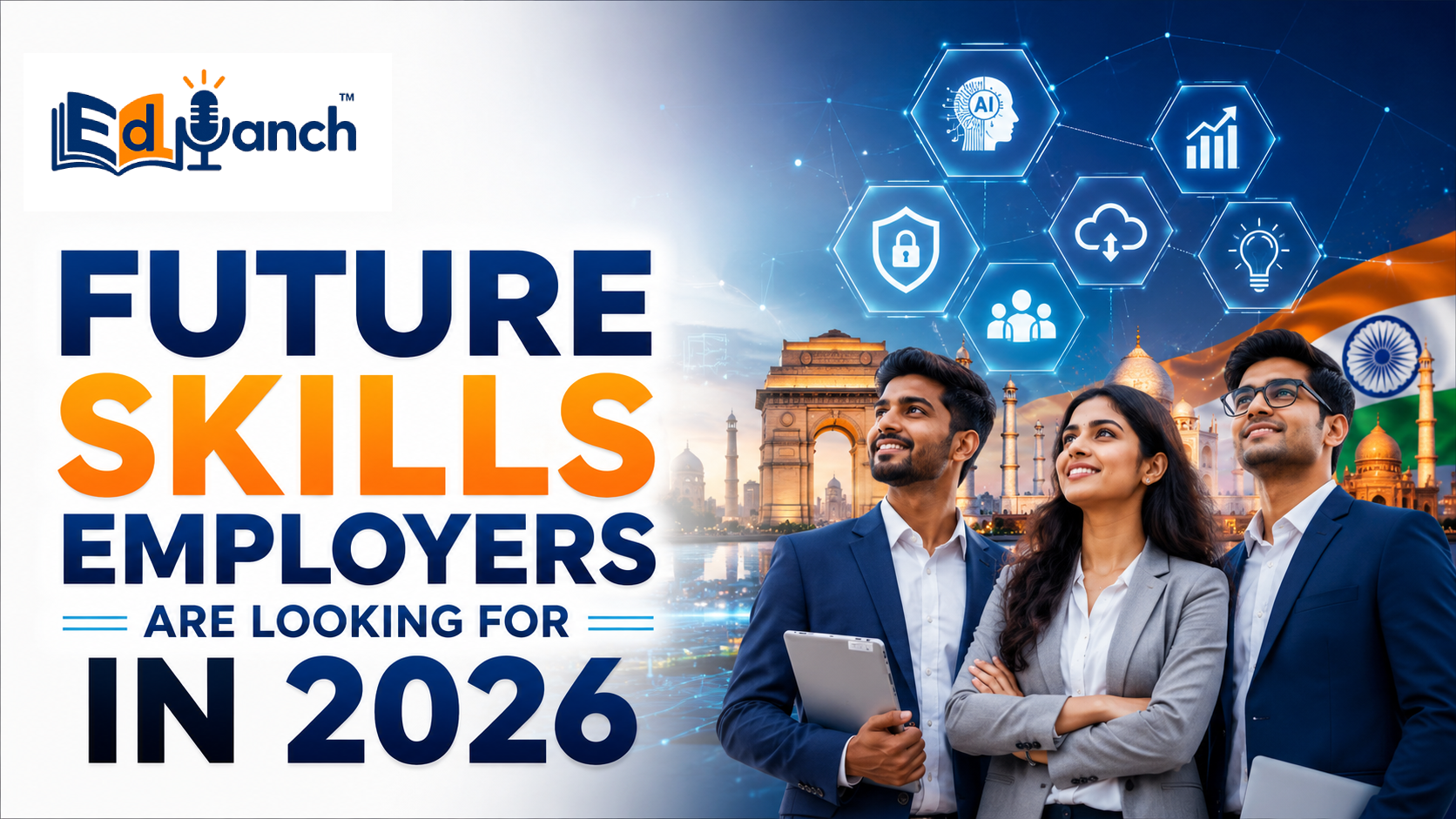
 This article explains the future skills employers in India are prioritising for 2026, covering AI literacy, data analysis, and human skills like adaptability, while outlining practical ways students can build career readiness through government skilling programmes.





Introduction
The Indian job market is changing faster than most academic curricula can keep pace with. Employers are no longer hiring purely on the basis of degrees or years of study. They are asking a more direct question: can this person actually do the work, adapt when things change, and add value from day one? This shift matters enormously for Indian students, parents, and early career professionals trying to plan a future in a workforce shaped by artificial intelligence, automation, and constantly evolving business needs.
According to the India Skills Report 2026, national employability rose to 56.35 percent this year, up from 54.81 percent in 2025, and India now holds 16 percent of the world's AI talent. At the same time, industry data shows a sharp rise in demand for digital capability. Taggd's India Decoding Jobs Report 2026 found that demand for advanced digital skills surged 42 percent year on year, with companies across IT, banking, manufacturing, and global capability centres all competing for the same limited pool of skilled talent.
This article breaks down exactly what future skills employers are looking for in 2026, why these skills matter, and how students and professionals across India, including those in tier two and tier three cities, can begin building them in a structured way.
Understanding Why Future Skills Matter Now
The pace of change in the workplace has accelerated because of three overlapping forces: rapid AI adoption, automation of routine tasks, and a shift toward flexible and hybrid work arrangements. The India Skills Report 2026 notes that employers expect nearly one in five roles to change meaningfully by 2030, which means the skill set that gets someone hired today may need to evolve significantly within a few years of starting a career.
Global research reinforces this trend. The World Economic Forum's Future of Jobs Report estimates that around 92 million jobs may be displaced by automation by 2030, while roughly 170 million new roles could be created, resulting in overall positive job growth but a very different mix of required skills. For Indian students, this means the goal should not be to memorise a fixed skill list, but to build a habit of continuous learning that keeps pace with industry needs.
Importantly, this shift is not limited to large metro cities. India's transformation is supported by policies like NEP 2020 and improving digital infrastructure that allow skilled work to move into tier two and tier three cities, opening opportunities well beyond traditional urban hiring hubs.
Technical Future Skills Employers Value in 2026
Technical skills form the foundation of employability in most modern roles, even for students who do not plan to work in a purely technical function. The following capabilities consistently appear across Indian industry reports this year.
Artificial intelligence and generative AI literacy stands at the very top of employer priority lists. Taggd's India Decoding Jobs Report 2026 places AI, GenAI, data engineering, cloud computing, and cybersecurity at the top of employer priorities across IT, BFSI, global capability centres, manufacturing, and consumer technology. This does not necessarily mean every student must become an AI developer. Even a working understanding of how to use AI tools responsibly, verify their output, and apply them to everyday tasks is now considered a baseline expectation in many entry-level roles.
Data analysis and interpretation remain essential because organisations across every sector increasingly rely on data to make decisions. Students do not need to become data scientists to benefit here. Basic comfort with spreadsheets, simple data visualisation, and drawing conclusions from numbers can meaningfully strengthen a resume, regardless of the academic stream.
Cloud computing and cybersecurity continue to grow in relevance as more Indian businesses move operations online. AWS Solutions Architect, Microsoft Azure, and Google Cloud Professional certifications remain the highest-demand cloud credentials, while CISSP and CompTIA Security+ lead in cybersecurity hiring. For students interested in IT-adjacent careers, these are practical, credential-backed pathways worth exploring.
Digital marketing and content skills are valuable well beyond marketing roles, since almost every organisation now needs some digital presence, whether that is social media, email communication, or basic content strategy.
Product and project management fundamentals matter because many roles, technical or otherwise, involve coordinating tasks, timelines, and stakeholders. Understanding how to plan, prioritise, and track progress is a transferable skill that applies across industries.
It is worth noting that value does not lie in chasing every trending skill, but in developing genuine depth where scarce skills meet real business demand. A student who develops one or two technical skills thoroughly, alongside strong communication ability, is often better positioned than one who has surface-level exposure to many tools.
Human and Workplace Skills That Complement Technical Ability
Technical skills alone rarely secure long-term career growth. As AI takes over more routine and repetitive tasks, the skills that remain distinctly human are becoming more, not less, important.
Analytical and critical thinking is consistently ranked as the single most valued workplace skill by global employers, since it allows professionals to break down complex problems and make sound decisions using available evidence. Closely related is adaptability, the ability to respond calmly and effectively to changing priorities, new tools, or unexpected challenges. Given how quickly job requirements are shifting, professionals who can learn new systems quickly and unlearn outdated habits will consistently outperform those who resist change.
Communication remains non-negotiable. Whether writing a professional email, presenting an idea, or explaining a technical concept to a non-technical audience, strong communication consistently sets candidates apart. This is particularly relevant in India's diverse professional environments, where teams often work across languages, regions, and cultural contexts.
Other workplace skills gaining recognition this year include emotional intelligence, collaborative leadership, creative problem-solving, and what several reports now call digital ethics, the ability to use AI and digital tools responsibly rather than blindly. A useful way to think about this combination comes from one industry analysis, which observed that professionals who combine domain expertise with digital skills will have a clear advantage in the future job market, rather than those who specialise narrowly in either technology or soft skills alone.
How Indian Students and Professionals Can Start Building These Skills
Building future-ready skills does not require an expensive degree or a complete career change. It requires a structured, consistent approach.
Start with free or affordable online courses in areas that align with your interests, whether that is basic AI tools, spreadsheet analysis, or digital communication. Many platforms offer beginner-level certificates that, while not a replacement for a full degree, demonstrate initiative and applied learning to employers. Alongside formal courses, look for small real-world projects, internships, or volunteer opportunities where you can practise these skills directly rather than only studying them in theory.
India's public skilling infrastructure has also expanded considerably this year. The Union Cabinet has approved continuation of the Skill India Programme with an outlay of Rs 8,800 crore through 2025 to 2026, alongside Rs 3,000 crore for ITI upgrades and 50,000 Atal Tinkering Labs for hands-on learning. In addition, the National Skill Development Corporation is establishing 50 new Future Skills Centres and 10 International Academies, while the IndiaAI Mission is supporting thousands of fellows and students across undergraduate, postgraduate, and PhD levels. Students in tier two and tier three cities should actively look into these government-backed programmes, since they are specifically designed to widen access beyond metro areas.
For students still deciding on a career direction, platforms like Edumanch can help by simplifying information on courses, skilling opportunities, government schemes, and admission pathways, so that decisions are based on clear, reliable information rather than guesswork.
Common Mistakes Students Make While Chasing Future Skills
Many students fall into predictable traps while trying to future-proof their careers. One common mistake is trying to learn too many skills superficially instead of building genuine depth in one or two areas. Another is ignoring soft skills entirely, assuming that technical ability alone guarantees employment. Some students also delay skill building until after graduation, missing the opportunity to gain practical experience during college years when internships and projects are more accessible.
It also helps to remember that the half-life of professional skills is shortening, meaning knowledge gained today may need updating within a few years. Treating skill development as a one-time achievement rather than an ongoing habit is one of the most common reasons professionals fall behind mid-career.
Conclusion
The future skills employers are looking for in 2026 are not a fixed checklist but a moving target shaped by AI adoption, changing business needs, and evolving workplace expectations. What remains constant is the value of combining strong technical foundations, whether in AI, data, or digital tools, with distinctly human capabilities like communication, critical thinking, and adaptability. For Indian students and early career professionals, the most reliable path forward is consistent, practical learning supported by the country's expanding skilling infrastructure, rather than waiting for a single qualification to guarantee success. Building this combination early gives students a genuine head start in an employment landscape that continues to reward readiness over credentials alone.
Frequently Asked Questions
Q1: What are the most important future skills employers want in India in 2026?
Employers are prioritising AI literacy, data analysis, cybersecurity awareness, and digital communication, alongside human skills such as critical thinking, adaptability, and leadership. A combination of technical and human capabilities tends to matter more than any single skill on its own.
Q2: Do students need a technical background to learn future skills?
No. Many future skills, including communication, problem-solving, and adaptability, do not require a technical degree. Even foundational AI literacy and basic data interpretation can be picked up through short courses regardless of academic stream.
Q3: How can Indian students start building future skills while still in college?
Students can begin with free or low-cost online courses, seek internships, join skill development programmes under Skill India, and work on small real-world projects that demonstrate practical ability alongside academic learning.
Q4: Is AI going to replace jobs or create new ones in India?
Current reports suggest AI is redistributing work rather than eliminating it altogether. India aims to create millions of new AI-related jobs by 2030, though many existing roles will change in nature and require reskilling.
Q5: Which Indian government programmes support future skills development?
Programmes such as the Skill India Programme, National Skill Development Corporation Future Skills Centres, Atal Tinkering Labs, and the IndiaAI Mission all support skilling, AI education, and industry-aligned training across the country.
Resources
- India Skills Report 2026 (Wheebox and partners): Annual employability survey covering employability trends and workforce readiness across Indian states
- World Economic Forum, Future of Jobs Report: Global research on job displacement, job creation, and core workplace skills
- National Skill Development Corporation (NSDC): Government body overseeing Skill India Programme and Future Skills Centres
- IndiaAI Mission, Ministry of Electronics and Information Technology: National initiative supporting AI education and fellowships
- NEP 2020, Ministry of Education: Policy framework guiding skill integration into Indian education
Interlinking Keywords
skill development in India, career readiness, AI literacy for students, Skill India Programme, employability trends, digital skills for students, government skilling schemes, career guidance for students
Last reviewed by:
Edumanch Editorial and Education Guidance Team on August 27, 2026
Disclaimer:
This article is intended for general informational and educational purposes only. It does not constitute career, financial, or professional advice. Readers are encouraged to verify current details of government schemes, courses, and certifications directly with the relevant official sources before making any decisions. Edumanch does not guarantee employment outcomes or specific salary figures referenced from third-party industry reports.