 Monday, November 16, 2026
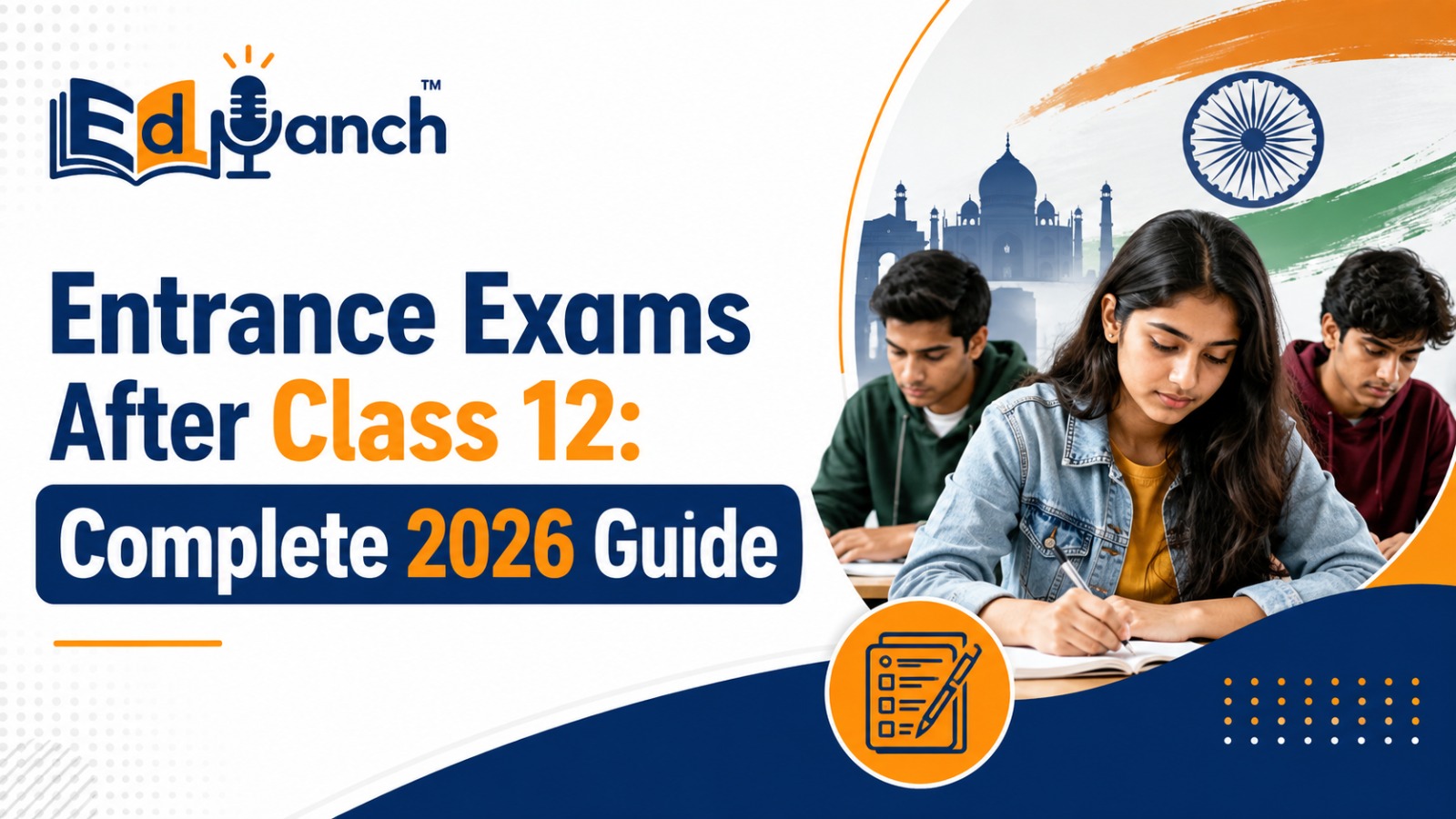
 A complete stream-wise guide to major entrance exams after Class 12 in India for 2026, covering JEE, NEET, CUET, CLAT, NDA, and government examinations for Science, Commerce, and Arts students.





Introduction
The moment Class 12 board results are announced, students and parents across India face one of the most consequential decisions of a young person's academic life: which entrance exam to prepare for, and why. With more than fifty major examinations conducted annually across engineering, medicine, law, management, design, and defence, the landscape can feel overwhelming at first glance.
The good news is that this complexity has a clear structure. Every major entrance exam in India is tied to a specific stream, a specific career path, and a specific set of institutions. Once a student understands where they want to go and what they want to study, the list narrows considerably. This guide from Edumanch is designed to help students, parents, and school educators understand the most important entrance exams after Class 12 in India for the 2026 academic cycle, organised by stream and career goal, so that informed decisions replace confusion.
Understanding How Entrance Exams Work After Class 12
Entrance examinations after Class 12 serve as a standardised gateway between school education and higher education. They are conducted at three levels: national, state, and university level. National-level exams like JEE Main, NEET UG, and CUET UG carry the widest acceptance and open doors to premier institutions. State-level exams such as MHT-CET in Maharashtra or KCET in Karnataka cater to students targeting institutions within their home state. University-level exams are conducted independently by specific institutions like BITSAT by BITS Pilani or IPMAT by IIM Indore.
These exams act as a common platform to test a student's knowledge, skills, and readiness for advanced studies, and they cover a wide range of fields such as engineering, medicine, law, management, commerce, and the arts. Understanding this structure helps students identify exactly which examination or set of examinations they need to target rather than preparing blindly for multiple unrelated tests.
One critical shift that every student and parent must be aware of is the growing centrality of CUET UG. CUET UG is a national-level computer-based exam for admission to undergraduate programmes in central universities across India, with scores used by universities to shortlist students for various courses. This has significantly changed how students across all three streams plan their post-Class 12 examination strategy.
Stream-Wise Breakdown of Major Entrance Exams
Science Stream: PCM (Physics, Chemistry, Mathematics)Students who have studied Physics, Chemistry, and Mathematics in Class 12 have access to some of the most competitive and career-defining examinations in the country.
JEE Main and JEE Advanced
JEE Main is the primary national-level engineering entrance exam conducted by the National Testing Agency and serves as the gateway to top institutes like NITs, IIITs, and GFTIs. It is held in two sessions (January and April), and the best score is considered for ranking. JEE Advanced, which is the next stage, grants admission to the Indian Institutes of Technology and is considered one of the most rigorous undergraduate entrance examinations in the world.
For students targeting prestigious private institutions, BITSAT (Birla Institute of Technology and Science Admission Test) and VITEEE (Vellore Institute of Technology Engineering Entrance Examination) offer strong alternatives. State-level examinations such as MHT-CET, KCET, and AP EAMCET are essential for students who prefer admission within their home state.
CUET UG for Science
Beyond engineering, PCM students interested in pure science programmes, statistics, or computer science at central universities like Delhi University, Jawaharlal Nehru University, or Banaras Hindu University need to appear for CUET UG. A growing number of institutions now use CUET scores for undergraduate admissions.
Science Stream: PCB (Physics, Chemistry, Biology)NEET UG
For PCB students, NEET UG is the singular most important examination. It is the only nationally accepted gateway for admission to MBBS, BDS, and allied health sciences programmes across government and private medical colleges in India. The examination tests Physics, Chemistry, and Biology at the Class 12 level and is conducted once a year. Students must be at least seventeen years of age and must have cleared Class 12 with a minimum aggregate in the science subjects.
NEET UG is conducted by the National Testing Agency, and scores are accepted by all medical colleges across India including AIIMS institutions. Students targeting AIIMS, however, should note that AIIMS admissions are also processed through NEET UG scores, making this examination the single most critical test for any student aspiring to a medical career in India.
Commerce StreamCommerce students have several strong pathways depending on whether their interest lies in management, chartered accountancy, law, or general undergraduate education.
CUET UG for Commerce
CUET UG has become central to undergraduate admissions for Commerce students as well. For BBA and Commerce courses, the relevant subjects for CUET include Accountancy, Business Studies, Economics, Mathematics, and General Test. Top central universities offering BCom and BBA programmes are now admitting students primarily through CUET scores.
IPMAT
The Integrated Programme in Management Aptitude Test, commonly known as IPMAT, is conducted by IIM Indore and IIM Rohtak. It grants admission to a five-year integrated BBA plus MBA programme and is one of the most sought-after examinations for Commerce students with a strong aptitude for quantitative reasoning.
CA Foundation
Conducted by ICAI, the CA Foundation can be registered for immediately after Class 12. It covers accounting, business law, business mathematics, and economics. The career trajectory, which includes Chartered Accountant, Financial Analyst, and Tax Consultant, is strong across industries. This is a particularly popular route for Commerce students from Tier 2 cities across India who seek a career-specific qualification without the uncertainty of management entrance exams.
Arts and Humanities StreamArts students in India often face the misconception that their post-Class 12 examination options are limited. In reality, the Arts stream has some of the most structured and rewarding examination pathways in the country.
CLAT (Common Law Admission Test)
CLAT is the national-level entrance test for admission to undergraduate law programmes at the National Law Universities. It grants admission to 25 National Law Universities across India and tests English language, current affairs, legal reasoning, logical reasoning, and quantitative techniques. Law is one of the fastest-growing career fields in India, and CLAT scores open doors to some of the most prestigious legal education institutions in the country.
CUET UG for Arts
CUET UG covers BA programmes in Political Science, History, Sociology, Psychology, Economics, and Humanities at 45 central universities and 200 or more others. For Arts students, CUET preparation is significantly less intensive compared to science-stream examinations, making it a manageable and high-value examination to pursue alongside board preparations.
Design and Creative Fields
Students with an aptitude for design and creativity can appear for the NIFT Entrance Exam for fashion technology, NID DAT for product and communication design, and UCEED conducted by IIT Bombay for undergraduate design programmes. These examinations assess creative thinking, visual reasoning, and design aptitude rather than subject-specific knowledge, making them suitable for students across streams.
Government and Defence Examinations
A significant portion of Class 12 graduates in India choose to prepare for government examinations and defence entry. These pathways offer career stability and social prestige and are especially popular among students from Tier 2 and Tier 3 cities.
The National Defence Academy examination, commonly known as NDA, is one of the most respected and competitive defence entry examinations in India. It is conducted twice a year by the Union Public Service Commission and is open to male students who have cleared Class 12 with Physics and Mathematics. Female candidates can now also apply for NDA, which is a significant recent development in Indian defence recruitment policy.
Other notable government examinations include:
- SSC CHSL (Staff Selection Commission Combined Higher Secondary Level) for clerical and administrative positions in central government departments.
- Railway Recruitment Board examinations for technical and non-technical positions across the Indian Railways.
- NCC Special Entry and Territorial Army examinations for defence-related roles.
These examinations do not require specific stream combinations and are open to students across Science, Commerce, and Arts, making them a viable option for a broad section of Class 12 graduates.
How to Choose the Right Entrance Exam
The most common mistake students make after Class 12 is attempting too many examinations without adequate preparation for any of them. There are 50 or more entrance exams after 12th in India, but most students do not need all of them. Picking two to three based on stream and target career is far more effective than spreading preparation across ten different tests.
The right starting point is always a combination of three questions: What stream is the student in? What career are they targeting? And how much time do they realistically have for examination preparation beyond board exam revision?
For Science PCM students, JEE Main and CUET UG together cover most college admission needs. For Science PCB students, NEET UG is non-negotiable as the primary focus. Commerce students should prioritise CUET UG alongside IPMAT or CA Foundation depending on their career goal. Arts students should explore CLAT and CUET UG as their primary combination.
Most application windows open between October and February. Missing a deadline usually means waiting a full year. Students and parents must maintain a calendar of examination registration dates alongside board examination preparation, as missing an application window can delay academic plans by an entire year.
Preparation Approach That Builds Real Results
Strong entrance examination performance is built on three foundations: a clear understanding of the syllabus and examination pattern, consistent and structured daily practice, and regular self-assessment through mock tests and previous year papers.
For national-level examinations like JEE Main and NEET UG, preparation typically begins as early as Class 11. Students who begin their entrance examination preparation alongside their board curriculum are generally better positioned compared to those who start only after Class 12 results are declared.
At the same time, for examinations like CLAT and CUET UG, focused preparation of four to six months after Class 12 boards is often sufficient for students with strong foundational knowledge. The key is to align preparation strategy with examination requirements rather than following a one-size-fits-all approach.
Edumanch regularly publishes stream-specific preparation guides, examination calendars, and career guidance content to help students across India stay informed and make confident decisions at every stage of their academic journey.
Conclusion
Choosing the right entrance examination after Class 12 is not about selecting the most popular name or following peer pressure. It is about matching one's academic strengths, career aspirations, and institutional preferences to the right examination pathway. Whether a student is aiming for the IITs through JEE Advanced, a central university through CUET UG, the National Law Universities through CLAT, or a defence career through NDA, every pathway has a clear structure and a well-defined preparation approach.
India's entrance examination ecosystem, while vast, is ultimately student-friendly when understood correctly. The key is to start early, stay informed, and make decisions based on clarity rather than confusion. Platforms like Edumanch exist precisely to help students and parents navigate this landscape with confidence, accuracy, and practical guidance at every step.
Frequently Asked Questions
Q1: Which entrance exams are available after Class 12 for Science students?
Science students can appear for JEE Main and JEE Advanced for engineering, NEET UG for medical courses, CUET UG for central university admissions, BITSAT for BITS Pilani, and NDA for defence. The choice depends on whether the student has PCM or PCB as their subject combination.
Q2: Is CUET compulsory for all central university admissions after Class 12?
CUET UG is now the primary gateway for undergraduate admissions across central universities in India. Most central universities have adopted CUET scores for all streams, including Science, Commerce, and Arts. Students should verify the specific requirements of their target institutions before applying.
Q3: Can Arts stream students take competitive entrance exams after Class 12?
Yes. Arts students have multiple strong options, including CLAT for law, CUET UG for BA programmes at DU, JNU, and BHU, NIFT and NID for design, IIMC for journalism, and NDA Army entry for defence. The Arts stream offers more structured career pathways than most students realise.
Q4: How many entrance exams should a student attempt after Class 12?
Most education experts recommend attempting two to three examinations based on the student's stream, target career, and preparation level. Attempting too many exams without adequate preparation often leads to poor performance across all of them.
Q5: When do applications for entrance exams after Class 12 typically open?
Most application windows for major entrance exams open between October and February. JEE Main registration usually opens in October for the January session. NEET UG registration typically opens in November or December. Students should track official NTA and exam authority notifications to avoid missing deadlines.
Resources
- National Testing Agency (NTA): Official body conducting JEE Main, NEET UG, and CUET UG examinations; primary source for notification dates, syllabus, and registration details.
- University Grants Commission (UGC): Regulatory authority for higher education in India; publishes guidelines on university admissions and CUET UG implementation across institutions.
- National Council of Educational Research and Training (NCERT): Publisher of Class 12 textbooks that form the basis for most national-level entrance examinations, including NEET UG and CUET UG.
- Ministry of Education, Government of India: Official ministry overseeing education policy, examination reforms, and new guidelines for undergraduate admissions.
- Union Public Service Commission (UPSC): Conducting authority for NDA examinations; publishes official notifications, eligibility criteria, and examination calendars.
INTERLINKING KEYWORDS:
entrance exams after Class 12, JEE Main 2026, NEET UG 2026, CUET UG 2026, CLAT exam India, NDA entrance exam, commerce stream entrance exams, arts stream entrance exams, government exams after 12th, engineering entrance exams India
Last reviewed by:
Edumanch Editorial and Education Guidance Team on August 25, 2026
Disclaimer:
The information provided in this article is intended for general educational and informational purposes only. Examination dates, eligibility criteria, and admission processes are subject to change based on official notifications from relevant conducting authorities. Readers are advised to visit the official websites of the respective examination bodies for the most current and accurate information before making any decisions related to their academic future. Edumanch does not guarantee admission outcomes and is not affiliated with any examination authority.