 Monday, November 16, 2026
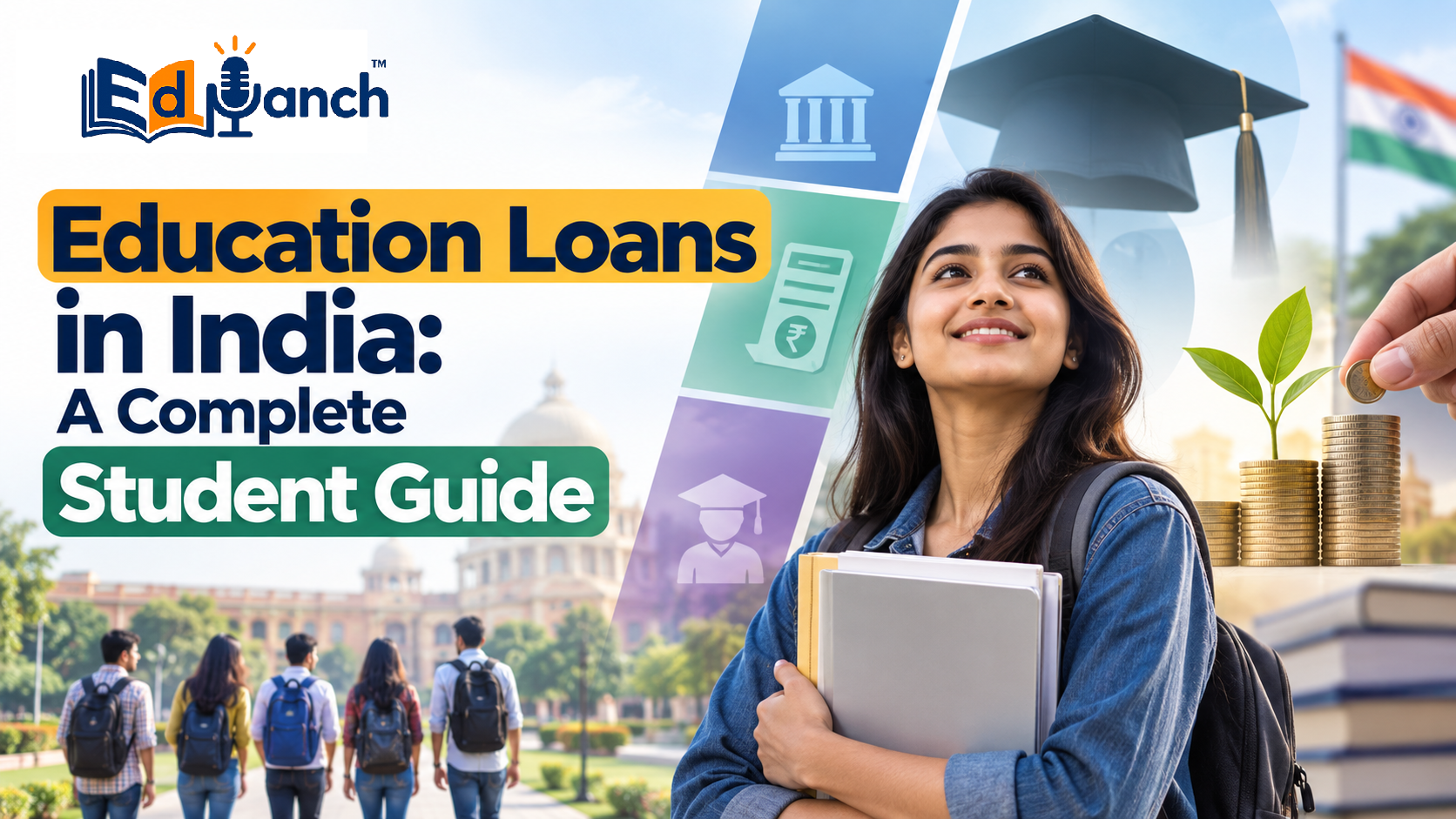
 Education loans in India help students fund higher education through government schemes, bank products, interest subsidies, and structured repayment options that support academic and career aspirations.





Introduction
Every year, lakhs of students in India find themselves at a crossroads. They have secured admission to a good college or university, have the ambition to pursue their chosen field, but are held back by one significant question: how will they fund their education? Tuition fees at private engineering colleges, medical schools, management institutes, and foreign universities have risen sharply over the past decade. For most middle-class and lower-income families, paying these fees from savings alone is simply not realistic.
Education loans exist precisely to bridge this gap. They allow students to pursue quality higher education without forcing their families into financial distress. Yet many students and parents approach the loan application process with confusion, hesitation, or incomplete information. Understanding how education loans work, what schemes are available, how to apply, and how repayment functions can make the entire experience far less stressful and far more empowering.
This guide is designed to give Indian students and their families a clear, reliable, and practical understanding of education loans in 2025 and beyond.
Understanding What an Education Loan Covers
An education loan is a financial product offered by banks, non-banking financial companies (NBFCs), and government-backed institutions to help students meet the cost of higher education. It is not limited to tuition fees alone.
Most lenders cover a broad range of expenses under the education loan umbrella. These typically include tuition fees, examination fees, library charges, hostel fees, the cost of books and equipment, travel expenses for studying abroad, and in some cases even laptop or computer costs that are required for the course. This comprehensive coverage means that students do not have to arrange funds separately for every education-related expense.
It is important to understand that education loans in India are structured as a deferred repayment product. This means that unlike a personal loan where repayment begins almost immediately, an education loan gives the student time to complete the course and find employment before the repayment obligation kicks in. This feature, called the moratorium period, is one of the biggest advantages of an education loan over other forms of borrowing.
Types of Education Loans Available in India
Not all education loans are the same. Students and parents should understand the key categories before deciding which option suits their situation.
Loans for domestic education cover courses pursued within India. These are offered by most public sector banks, private banks, and NBFCs. The amounts are generally lower than loans for overseas education, and the eligibility criteria are often more straightforward.
Loans for overseas education cover courses at foreign universities and institutions. These loans tend to be larger in value and may require collateral, a strong co-applicant profile, and detailed documentation of admission letters, visa status, and cost of study.
Secured education loans require the borrower to pledge collateral such as property, fixed deposits, or insurance policies. These loans usually offer lower interest rates and higher loan amounts.
Unsecured education loans do not require collateral and are typically offered for smaller loan amounts, usually up to Rs 7.5 lakh by most public banks. These are suitable for students who do not have assets to pledge but are enrolled in recognized courses.
Eligibility Criteria and Key Requirements
To qualify for an education loan in India, a student must meet a set of standard eligibility criteria. While specific requirements vary between lenders, the general conditions are fairly consistent across the banking system.
The applicant must be an Indian citizen. The student must have secured confirmed admission to a recognized institution through a merit-based selection process, whether that is an entrance exam like JEE, NEET, CAT, or a university-specific process. The course must be recognized by a competent authority such as UGC, AICTE, or an equivalent regulatory body.
A co-applicant is required in almost all cases. This is usually a parent, guardian, or spouse. The co-applicant's income, credit history, and financial standing play a significant role in determining loan approval and interest rates. For unsecured loans above certain thresholds, lenders evaluate the co-applicant profile very carefully.
Academic performance also matters. Students with stronger academic records, admissions to premier institutions, or professional courses with high employability tend to find the loan process smoother. Some lenders specifically offer preferential rates for students admitted to IITs, IIMs, NITs, AIIMS, and other top-ranked institutions.
Government Schemes and Subsidies Students Should Know
The Government of India has put in place several schemes to make education loans more accessible and affordable, particularly for students from economically weaker backgrounds.
The Central Sector Interest Subsidy (CSIS) Scheme is one of the most important. Under this scheme, students whose family income does not exceed Rs 4.5 lakh per year are eligible for a full interest subsidy on education loans during the moratorium period. This means no interest accumulates while the student is still studying, which significantly reduces the total loan burden at the time of repayment.
The Pradhan Mantri Vidya Lakshmi Karyakram is a single-window platform launched to help students apply for education loans and scholarships from multiple banks and government schemes through one portal. Students can visit the Vidya Lakshmi Portal at vidyalakshmi.co.in to compare loan options, apply online, and track application status.
The Dr. Ambedkar Interest Subsidy Scheme provides interest subsidy during the moratorium period for Other Backward Classes (OBC) and Economically Backward Classes (EBC) students pursuing overseas higher education. This is managed by the Ministry of Social Justice and Empowerment.
State governments across India also run their own scholarship and loan subsidy programs. Students should check with their respective state government portals or Directorate of Higher Education offices to identify schemes available in their state.
Interest Rates and How They Work
Interest rates on education loans vary based on the lender, loan amount, course type, and whether the loan is secured or unsecured. As of 2025, public sector banks typically offer rates ranging from 8 percent to 11 percent per annum for education loans. Private banks and NBFCs may charge higher rates but often offer faster processing and fewer documentation requirements.
Most education loans use a floating interest rate linked to the lender's Marginal Cost of Funds Based Lending Rate (MCLR) or the Repo Rate. This means the interest rate can change over time based on Reserve Bank of India (RBI) policy decisions.
During the moratorium period, interest continues to accrue on the loan. Borrowers have two choices: either pay only the simple interest during this period, which reduces the total repayment burden later, or allow the interest to accumulate and pay it all after the moratorium ends along with the principal. Paying interest during the moratorium period is always the more financially prudent option if the family can manage it.
Students should compare the Annual Percentage Rate (APR) and not just the headline interest rate when evaluating different loan offers. Processing fees, prepayment penalties, and other charges can make a significant difference in the actual cost of the loan.
The Application Process Step by Step
Applying for an education loan is more straightforward than many students assume. The process broadly follows these stages.
First, the student should finalize the institution and course and obtain the official admission letter. This document is central to the loan application.
Second, the student and co-applicant should gather all required documents. These typically include identity proof, address proof, mark sheets and certificates, the admission letter, fee structure from the institution, income documents of the co-applicant such as salary slips or IT returns, bank statements, and photographs.
Third, the student should research and compare loan offers from multiple lenders. The Vidya Lakshmi Portal is a useful starting point for this comparison. Public sector banks like State Bank of India, Bank of Baroda, and Canara Bank offer structured education loan products with government-linked subsidies. Private lenders like HDFC Credila, Avanse, and Auxilo focus specifically on education financing and may offer faster disbursements.
Fourth, the loan application is submitted along with documents. The bank will evaluate the application, conduct credit checks on the co-applicant, and may request additional documents or collateral valuation.
Fifth, upon approval, the loan is sanctioned and disbursed. Most lenders disburse directly to the institution in installments, aligned with the fee payment schedule.
Repayment Planning: Start Thinking About It Early
One of the most common mistakes students make is not thinking about repayment until they are already working. Repayment planning should ideally begin before the loan is even disbursed.
The standard repayment period for education loans is between five and fifteen years, depending on the loan amount and the lender's terms. Longer repayment tenures mean lower monthly EMIs but higher total interest paid over the life of the loan.
Under Section 80E of the Income Tax Act, the entire interest paid on an education loan is deductible from taxable income for up to eight consecutive assessment years. This is a substantial financial benefit that every working graduate should utilize. It is important to note that this deduction applies only to the interest component and only to the individual who took the loan, not the co-applicant.
Students should also be aware that defaulting on an education loan has serious consequences. It damages the credit score of both the borrower and the co-applicant, can lead to legal action by the lender, and may affect future financial products such as home loans or car loans. If repayment becomes difficult due to unemployment or a lower-than-expected starting salary, students should proactively contact the bank and request a restructuring or deferment rather than simply stopping payments.
How Edumanch Supports Students Through the Education Finance Journey
Navigating education loans in India requires reliable, updated, and jargon-free information, and this is exactly where Edumanch contributes meaningfully. The platform regularly covers education finance news, policy updates, scholarship alerts, and student guidance, helping students and parents stay informed about what is changing in the education funding landscape. Whether it is a new government scheme, a change in interest subsidy eligibility, or a comparison of top lenders, Edumanch aims to simplify these decisions for every student community across India.
Frequently Asked Questions
Q1: Who is eligible for an education loan in India?
Indian nationals who have secured admission to a recognized institution for higher education in India or abroad are eligible. The applicant must have completed Class 12 or an equivalent qualification, and a co-applicant such as a parent or guardian is typically required.
Q2: What is the maximum amount I can borrow through an education loan?
For studies in India, most banks offer up to Rs 10 lakh without collateral. For studies abroad, the amount can go up to Rs 1.5 crore or more depending on the lender, course, and institution.
Q3: Is there any government subsidy available on education loans?
Yes. Under the Central Sector Interest Subsidy Scheme, students from economically weaker sections with a family income below Rs 4.5 lakh per year are eligible for full interest subsidy during the moratorium period for approved courses.
Q4: When does education loan repayment begin?
Repayment typically begins after the moratorium period, which includes the course duration plus six months to one year after securing employment. During this period, some lenders charge simple interest only.
Q5: Can education loan interest be claimed as a tax deduction?
Yes. Under Section 80E of the Income Tax Act, the interest paid on an education loan is fully deductible for up to eight consecutive years from the year repayment begins. This benefit applies to the borrower, not the co-applicant.
Resources
- University Grants Commission (UGC): The regulatory body recognizing universities and courses eligible for education loans in India.
- Vidya Lakshmi Portal (vidyalakshmi.co.in): Government single-window platform for education loan applications and scholarship information.
- Reserve Bank of India (RBI): Guidelines and circulars on education loan norms, interest rate structures, and student borrower protections.
- Ministry of Education, Government of India: Policy documents on student finance, Central Sector Interest Subsidy Scheme, and higher education funding.
- Ministry of Social Justice and Empowerment: Information on the Dr. Ambedkar Interest Subsidy Scheme for OBC and EBC students pursuing overseas education.
Interlinking Keywords
education loan eligibility India, Central Sector Interest Subsidy Scheme, Vidya Lakshmi Portal, Section 80E tax deduction, education loan moratorium period, government scholarships for Indian students, study abroad loan India
Last reviewed by:
Dr. Manthan Tripathi, Edumanch Editorial and Education Guidance Team on September 8, 2026
Disclaimer:
The information provided in this article is intended for general educational and career guidance purposes only. It does not constitute professional career counselling or placement advisory services. Students are encouraged to consult with their college placement cells, career counsellors, or certified professionals for personalized guidance based on their specific academic background and career goals.