 Monday, November 16, 2026
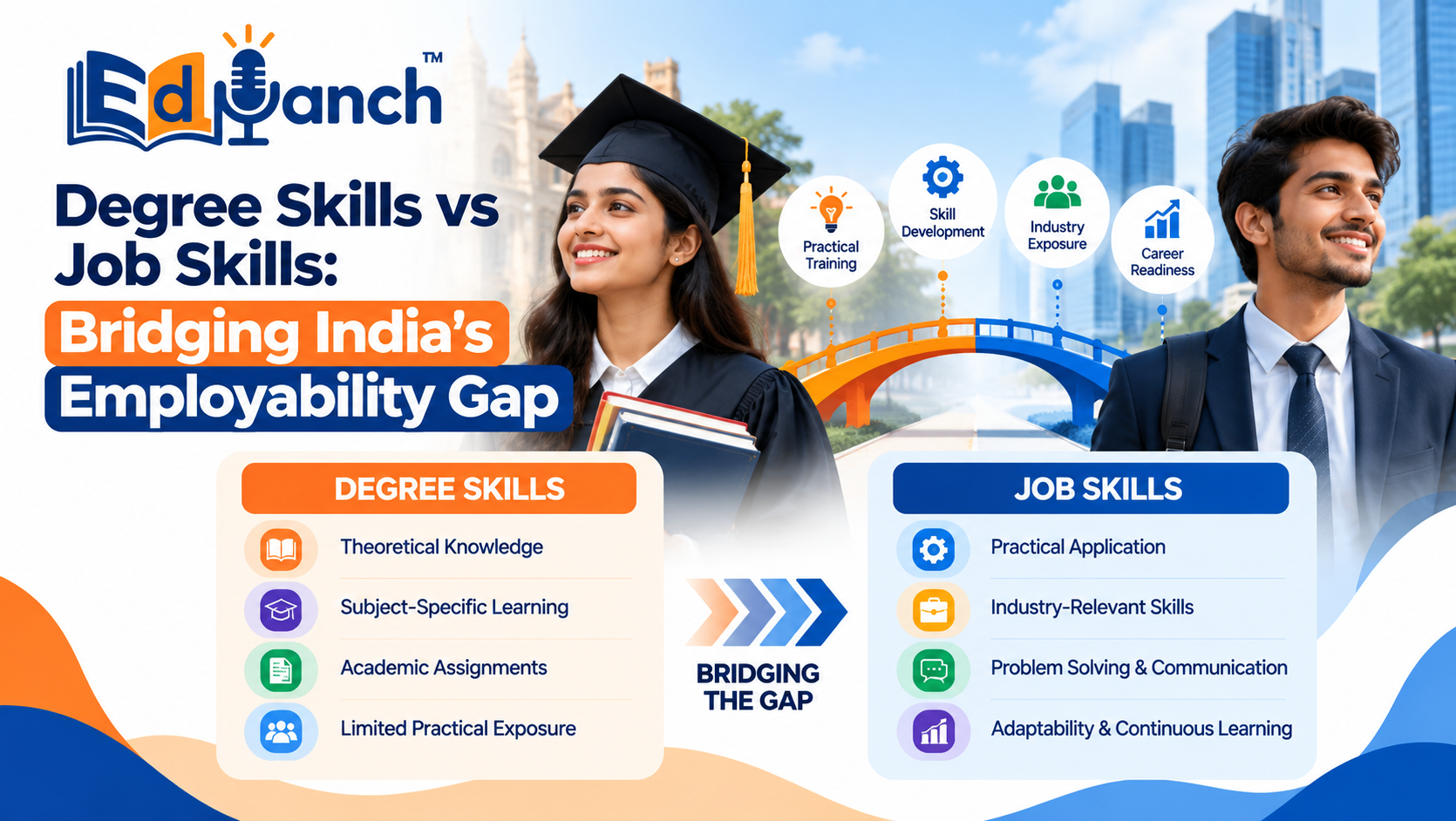
 India's degree-to-job skills gap stems from outdated curricula, limited practical exposure, and soft skills deficits. Students, institutions, and policymakers must collaborate to build truly employment-ready graduates.





Introduction
Every year, millions of graduates walk out of Indian colleges and universities with degrees in hand, ready to take on the world. Yet a large number of them struggle to find meaningful employment in their field of study. This is not a story about too many graduates chasing too few jobs. It is a story about the wrong kind of preparation meeting the right kind of demand.
The disconnect between what a degree teaches and what a job actually requires has become one of the most pressing challenges in India's education and employment landscape. Employers consistently report that fresh graduates lack practical skills, communication ability, and workplace readiness, even when they hold degrees from recognized institutions. Meanwhile, students and parents invest years of effort and significant financial resources into formal education, expecting it to deliver career security.
Understanding this gap, what causes it, why it persists, and how it can be bridged, is no longer optional. It is essential for every student, parent, educator, and institution that wants to stay relevant in India's rapidly changing economy.
Understanding the Degree Skills vs Job Skills Divide
Before addressing solutions, it is important to understand what these two categories of skills actually mean and why they often do not align.
Degree skills are the knowledge, theory, and academic competencies that a student acquires through a formal educational programme. These include understanding core concepts of a subject, passing examinations, completing assignments, and demonstrating academic proficiency as defined by a university curriculum.
Job skills, on the other hand, are the practical, behavioral, and technical abilities that employers expect a candidate to apply in a real workplace setting. These include problem-solving under pressure, effective communication, teamwork, industry-specific technical tools, project management, adaptability, and digital literacy.
The critical difference is that degree skills are often evaluated in controlled academic environments, while job skills are tested in fast-moving, unpredictable professional settings. A student can score well in financial accounting as a subject and still struggle to prepare a client-ready financial report in their first week of employment. A computer science graduate can clear theoretical examinations without ever having built a deployable software product.
This gap is not about intelligence or effort. It is a structural mismatch between what educational institutions are designed to deliver and what modern workplaces actually demand.
The Causes Behind the Skill Gap in Indian Graduates
India's employability crisis does not have one single cause. It is the result of several overlapping systemic issues that have built up over decades.
Curriculum That Has Not Kept Pace With IndustryMany university curricula in India were designed years, sometimes decades, ago. While industries have transformed with technology, automation, and global integration, academic syllabi have been slow to update. Engineering students may still learn programming languages that are largely obsolete in the current job market. Management students may study case studies from the early 2000s without ever being introduced to current business models or digital tools.
The National Education Policy 2020 acknowledged this problem directly and proposed significant changes, including multidisciplinary learning, vocational integration, and outcome-based education. However, implementation remains uneven across states and institutions.
Emphasis on Examinations Rather Than ApplicationIndia's education culture places enormous value on marks, rank, and academic performance. This incentivizes rote learning over critical thinking. Students are rewarded for memorizing and reproducing content, not for analyzing, questioning, or applying it. The result is a generation of graduates who are academically strong in theory but unprepared to handle practical, open-ended challenges.
Limited Exposure to Industry and Real-World ProjectsInternships, live projects, and industry mentorship programmes are often available only to students at premier institutions or in urban centres. Students from Tier 2 and Tier 3 cities, who form the majority of India's graduate population, frequently complete their degrees without a single meaningful industry interaction. This leaves them with no understanding of workplace norms, professional expectations, or industry tools before they enter the job market.
Soft Skills DeficitCommunication, teamwork, leadership, time management, and emotional intelligence are consistently ranked among the top skills that employers want. Yet these are rarely taught formally in Indian colleges. Lectures are monologue-based, group activities are minimal, and students are seldom placed in situations that require negotiation, persuasion, or collaborative problem-solving in a professional context.
The Digital Skills GapAcross sectors, from healthcare to banking to retail, digital fluency has become a basic requirement. Yet a significant portion of Indian graduates, particularly from non-metropolitan areas, lack exposure to digital tools, data literacy, or even basic productivity software used in professional environments.
Why This Gap Matters for India's Future
The consequences of the degree-job skill mismatch extend far beyond individual students struggling to find work. They touch India's broader economic and social trajectory.
According to reports from the India Skills Report and the National Skill Development Corporation, a substantial proportion of engineering, management, and arts graduates are assessed as not being employable in the roles for which they have trained. This places a dual burden on both graduates and employers. Students remain unemployed or underemployed despite years of investment in education, while companies spend heavily on retraining new hires before they can contribute meaningfully.
For India, which has one of the youngest populations in the world, this is a demographic dividend that risks becoming a demographic burden if the skills gap is not urgently addressed. The country needs millions of job-ready graduates annually, not just degree holders.
Beyond economics, the gap affects individual confidence, mental health, and long-term career satisfaction. A graduate who cannot secure employment in their field of study often questions their own ability rather than questioning whether the system prepared them adequately.
Recognizing the Signs of a Skill Gap in Students and Institutions
Both students and institutions benefit from recognizing the early signs of this disconnect.
For students, common indicators include:
- Difficulty translating theoretical knowledge into practical examples during interviews
- Lack of familiarity with tools and software commonly used in their industry
- Discomfort with team-based tasks, presentations, or professional communication
- No internship, project, or extracurricular portfolio to demonstrate applied learning
- Uncertainty about career direction even after completing a specialization
For institutions, warning signs include consistently low campus placement rates, negative feedback from recruiting companies about graduate readiness, high dropout rates in early employment, and alumni reporting that their degree did not prepare them for their actual job responsibilities.
How Students Can Bridge the Degree-to-Job Skills Gap
The responsibility does not rest with institutions alone. Students in India today have more access to self-directed learning resources than any previous generation. The key is intentionality.
Supplement Formal Education with Skill-Based LearningOnline learning platforms offer courses in coding, data analytics, digital marketing, design, finance, communication, and dozens of other fields. Completing a relevant certification alongside a formal degree signals initiative and builds practical competency that academic curricula may not provide.
Prioritize Internships and Live ProjectsEven unpaid or short-duration internships provide invaluable exposure to workplace culture, industry tools, and professional expectations. Students should pursue internships actively, starting as early as the first year of their programme rather than waiting until final year.
Build a Portfolio, Not Just a ResumeIn many fields, a portfolio of completed projects, written articles, designed materials, or coded applications demonstrates capability far more convincingly than a grade sheet. Students should document and share their work throughout their education, not just at graduation.
Develop Communication and Interpersonal Skills DeliberatelyJoining college debate clubs, participating in group discussions, volunteering for public speaking opportunities, and engaging in collaborative projects all help build the soft skills that employers consistently prioritize. These skills cannot be acquired in isolation or through passive study.
Stay Updated on Industry TrendsReading industry publications, following professional communities, attending webinars, and engaging with practitioners in their field helps students understand what skills are currently valued and what directions their industry is moving toward.
The Role of Institutions and Policy in Closing the Gap
While students must take ownership of their development, institutions and policymakers carry a larger structural responsibility.
The National Education Policy 2020 provides a framework for integrating vocational education, internships, and multidisciplinary learning into mainstream higher education. Industry-academia partnerships, where companies co-design curriculum components or offer guest faculty, are gaining traction in forward-thinking institutions.
Institutions such as IITs, IIMs, and select private universities have demonstrated that strong placement outcomes are achievable when there is a deliberate focus on applied learning, mentorship, and industry engagement. The challenge is scaling these practices to the thousands of colleges and universities that serve students across India's smaller cities and rural areas.
Government schemes including Skill India, PMKVY (Pradhan Mantri Kaushal Vikas Yojana), and the National Apprenticeship Promotion Scheme aim to provide vocational and skill-based training at scale. Greater coordination between these programmes and formal higher education can help ensure that students receive both academic depth and practical readiness.
Conclusion
The gap between degree skills and job skills is not a new problem, but it has become more visible and more urgent in an economy that is changing faster than educational systems can adapt. India's graduates deserve education that prepares them not just to pass examinations but to perform in real professional environments.
Bridging this gap requires shared action. Students must take initiative beyond their classroom. Institutions must modernize curriculum and create pathways for real-world experience. Employers must engage with academia rather than simply criticizing its output. And policymakers must create conditions that reward outcomes over formalities.
For India to fully realize its potential as a young, skilled, and globally competitive nation, the degree that a student earns must mean something real in the marketplace. That alignment between learning and employment, between education and industry, is the goal that every stakeholder in India's education ecosystem must work toward together.
Frequently Asked Questions
Q1: What is the difference between degree skills and job skills?
Degree skills refer to the academic knowledge and theoretical competencies gained through formal education. Job skills are the practical, interpersonal, and technical abilities required to perform effectively in a real workplace. Both matter, but they are often taught and evaluated very differently.
Q2: Why are so many Indian graduates considered unemployable despite holding degrees?
Employability challenges among Indian graduates are primarily driven by outdated curricula, limited practical exposure, insufficient soft skill development, and a heavy emphasis on examinations over applied learning. The mismatch between what colleges teach and what industries need is the core reason behind this problem.
Q3: How can students in India bridge the degree-to-job skills gap on their own?
Students can bridge the gap by pursuing online certifications, completing internships early in their academic journey, building project portfolios, actively developing communication skills, and staying informed about industry trends and employer expectations in their chosen field.
Q4: What role does the National Education Policy 2020 play in addressing the skills gap?
The National Education Policy 2020 emphasizes multidisciplinary education, vocational integration, outcome-based learning, and stronger industry-academia linkages. It provides a policy foundation to reform India's education system so that graduates are better prepared for employment and professional life.
Q5: Which sectors in India are most affected by the degree-to-job skills gap?
The skills gap is widely observed across engineering, information technology, management, commerce, and arts disciplines. However, it is particularly pronounced in technical fields where rapid industry change has outpaced curriculum updates, and in regions where students have limited access to internships or industry exposure.
Resources
- National Skill Development Corporation (NSDC): Official body overseeing India's skill development ecosystem, publishing annual employability and skills reports.
- India Skills Report: Annual research publication tracking graduate employability trends, sector-wise demand, and hiring patterns across Indian industries.
- University Grants Commission (UGC): Regulatory body for higher education in India, offering policy documents on curriculum reform and employability frameworks.
- National Education Policy 2020 (Ministry of Education): Comprehensive policy framework for transforming India's education system, including integration of vocational and skill-based learning.
- All India Council for Technical Education (AICTE): Statutory body for technical education in India, with guidelines on internship mandates, industry interaction, and curriculum modernization.
Interlinking Keywords
employability gap India, degree vs job skills, skill development for students, NEP 2020 and employment, Indian graduate employability, vocational education India, internship importance for students, soft skills for college students, Skill India programme, career readiness after graduation
Last reviewed by:
Dr. Manthan Tripathi, Edumanch Editorial and Education Guidance Team on October 26, 2026.
Disclaimer
The information presented in this article is intended for general educational and informational purposes only. It does not constitute professional career counseling, institutional accreditation advice, or policy guidance. Readers are encouraged to consult qualified career advisors, institutional authorities, or official government sources for decisions related to education and employment planning.