 Saturday, September 26, 2026
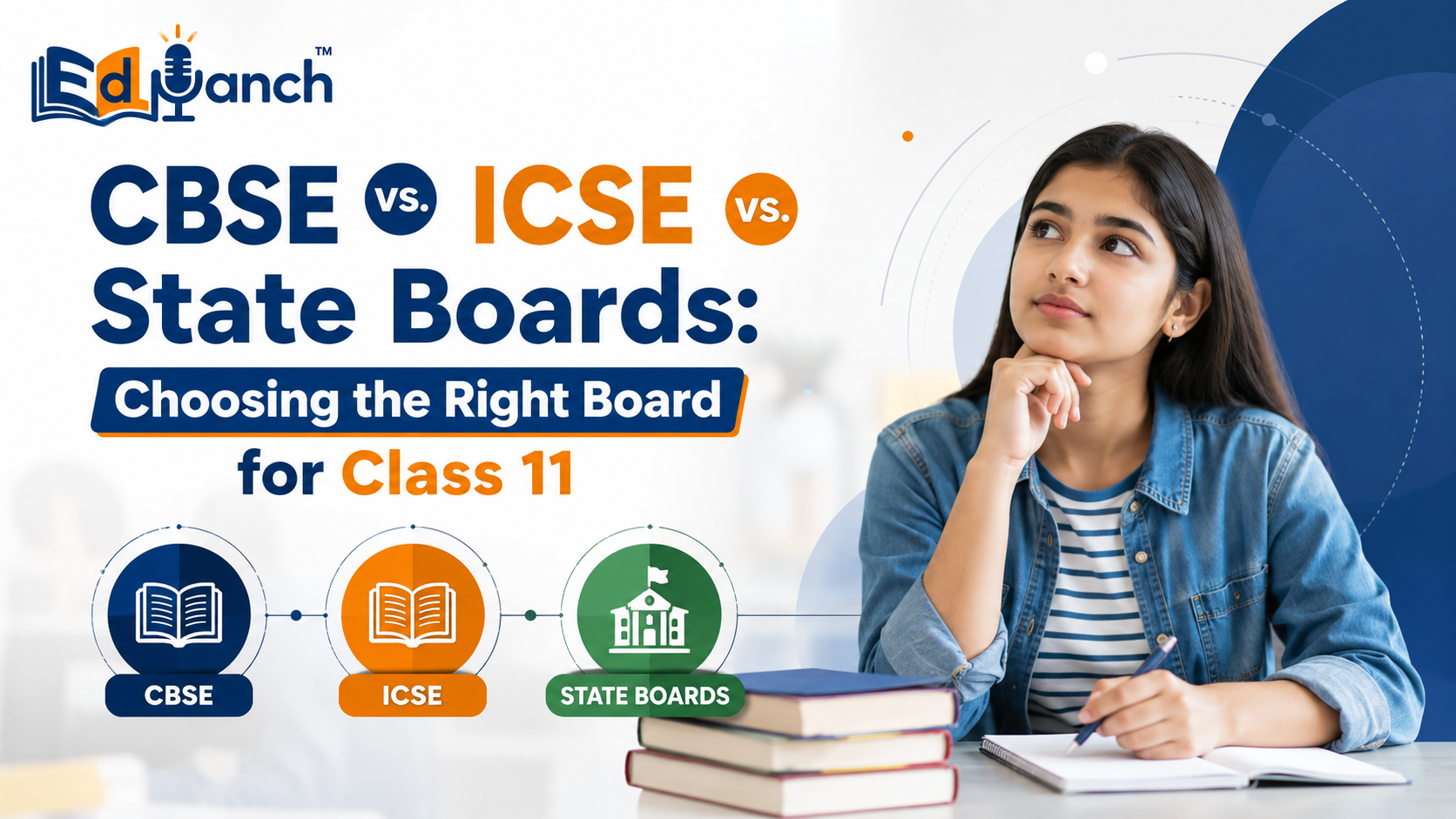
 Choosing the right board after Class 10 is a crucial decision that can influence a student's academic path, competitive exam preparation, and future career opportunities. Understanding the differences between CBSE, State Boards, and other educational systems helps students and parents make informed choices aligned with their learning goals and aspirations.




Completing Class 10 is a major academic milestone, but it immediately introduces one of the most critical decisions in a student's educational journey: selecting the right board for Class 11 and 12. According to guidelines outlined in Writers_Guide_All_Domains.pdf for Indian education news and policy platforms like edumanch.in, providing clear, objective curriculum comparisons is essential to help parents and students navigate these high-stakes academic transitions smoothly.
The choice you make for senior secondary school acts as a foundational roadmap. It directly impacts your day-to-day study style, your preparation strategy for national competitive exams, and your long-term career aspirations.
To help you make an informed choice, this comprehensive guide provides a detailed breakdown of the unique strengths, structural differences, and focus areas of CBSE, ICSE (ISC), and State Boards.
1. CBSE (Central Board of Secondary Education)
The Central Board of Secondary Education (CBSE) is India’s premier national education board, operating under the central government. It is highly regarded for its structured, uniform approach to national education.
- Syllabus Architecture: The CBSE curriculum follows the NCERT framework very closely. The syllabus is highly organized, breaking down subjects into clear, manageable units that focus heavily on core concepts in science and mathematics.
- Competitive Exam Compatibility: This board is the ideal choice for students aiming for national competitive examinations. Because major national entrance exams—such as NEET for medical streams and JEE Main/Advanced for engineering—are structured directly around the NCERT syllabus, CBSE students naturally gain a familiarity advantage during their preparation.
- National Accessibility: Because the curriculum is uniform across the country, it is highly beneficial for families who relocate frequently due to corporate or government job transfers.
2. ICSE / ISC (Council for the Indian School Certificate Examinations)
When students transition into Class 11, the ICSE board becomes the ISC (Indian School Certificate). It is widely recognized for its extensive depth and commitment to an all-round, comprehensive style of learning.
- Syllabus Architecture: The ISC curriculum offers an incredibly detailed and expansive syllabus. It places a strong emphasis on practical assignments, lab evaluations, and language skills, requiring students to engage in extensive reading and detailed text analysis.
- Language and Liberal Arts Focus: ISC is highly regarded for its rigorous English curriculum. It is an excellent fit for students who intend to pursue careers in literature, journalism, management, humanities, or law.
- Global Evaluation Alignment: The depth of the curriculum and its emphasis on practical projects align closely with international schooling standards. This provides a strong foundation for students planning to pursue higher education abroad or take global proficiency tests like the SAT, IELTS, or TOEFL.
3. State Boards (e.g., Maharashtra, Texas, UP Boards)
State Boards are managed individually by their respective state departments of education. They are custom-built to serve the distinct educational and regional needs of students within that specific state.
- Syllabus Architecture: While many state boards have updated their senior secondary science syllabi to align with the national NCERT pattern, they retain a unique focus on regional literature, local history, and state-specific geography.
- State Entrance Exam Edge: For students who plan to appear for state-specific engineering, pharmacy, or common entrance tests (such as MHT-CET in Maharashtra or KCET in Karnataka), the local state board textbook remains the primary study resource.
- Cost-Effectiveness and Local Context: State board schools generally offer lower tuition structures and provide education in both regional languages and English. Additionally, because the state curriculum can sometimes be less demanding than national boards, some students use the flexible schedule to dedicate extra hours to specialized external coaching for competitive exams.
Strategic Comparison Matrix
|
Critical Evaluation Metric |
CBSE (NCERT Pattern) |
ICSE / ISC |
State Boards |
|---|---|---|---|
|
Primary Structural Focus |
Strong focus on Science, Math, and core national concepts. |
Extensive depth in Language, Arts, and practical assessments. |
Focuses on regional language, local history, and state contexts. |
|
National Exam Edge (JEE/NEET) |
Excellent; entrance exams are designed directly around NCERT books. |
Good; covers core concepts deeply but requires extra focus on exam patterns. |
Moderate to Good; highly useful for state-level entrance exams. |
|
Global Study Alignment |
Good; recognized globally by most international universities. |
Excellent; practical projects align closely with overseas standards. |
Fair; requires additional preparation for international transitions. |
|
Syllabus Density |
Moderate; systematically broken down into clear, structured modules. |
High; requires extensive reading and comprehensive coursework. |
Low to Moderate; localized and generally easier to navigate. |
Key Factors to Consider When Making Your Choice
To select the ideal curriculum for Class 11, match your long-term goals against the specific features of each board:
[Define Career Goal] ➔ [Analyze Target Entrance Exams] ➔ [Evaluate Student Study Style] ➔ [Select Matching Board]
- Your Target Career Goal: If your immediate goal is to secure admission into top national institutions like the IITs, AIIMS, or NITs, CBSE’s alignment with national entrance exams makes it a logical path. If you are leaning toward corporate management, humanities, creative writing, or international studies, the language depth of ISC offers an excellent foundation.
- Your Learning and Study Style: Consider how you process information. Students who prefer a structured, concept-driven, and concise approach often thrive in CBSE. Those who enjoy deep-diving into topics, working on practical projects, and analyzing literature are typically better suited for the detailed ISC curriculum.
- Future Relocation Plans: If your family expects to move to different states over the next two years, choosing a national board like CBSE ensures your education remains consistent and uninterrupted.
Frequently Asked Questions (FAQs)
Q1: Is it advisable to switch from ICSE to CBSE in Class 11 for competitive exam preparation?Many students choose to switch from ICSE to CBSE for Class 11 to align their studies directly with the NCERT textbooks used in JEE and NEET exams. However, this switch is not mandatory. While CBSE matches the exam formats closely, ISC provides a deep understanding of concepts that can also support competitive preparation if the student adapts to the specific exam patterns.
Q2: Which board is considered the easiest for scoring high percentages in Class 12 boards?State boards and CBSE are often perceived as more straightforward for scoring high percentages because their exam patterns tend to be direct and structured around specific textbooks. ISC evaluation criteria place a high emphasis on detailed answers, practical execution, and language proficiency, which can make scoring top marks a bit more demanding.
Q3: Do international universities accept marks certificates issued by Indian State Boards?Yes, reputable international universities worldwide widely recognize certificates from CBSE, ISC, and Indian State Boards. However, students from State Boards may sometimes need to provide extra descriptions of their syllabus or demonstrate English proficiency through tests like IELTS or TOEFL.
Q4: Does CBSE offer a flexible choice of subjects for Class 11 students?Yes. Under recent educational guidelines, CBSE allows schools to offer a flexible mix of subjects across traditional streams. This means a student can choose combinations like Physics, Chemistry, and Mathematics alongside elective subjects like Economics or Fine Arts, depending on what their specific school has available.
Q5: Why is the ISC curriculum considered highly beneficial for studying abroad?The ISC curriculum focuses heavily on practical coursework, lab work, independent research projects, and English language skills. This comprehensive structure aligns well with international assessment standards, helping students adapt easily to the teaching styles used in overseas universities.
Q6: Can a student clear the JEE or NEET exam while studying under a State Board?Yes, absolutely. Many students from State Boards clear national exams every year. Because most state boards have updated their senior secondary science syllabi to match the core NCERT structure, success depends on how well a student masters the concepts and practices with national-level mock tests.
Q7: What is the main difference between the Science streams of CBSE and ISC?CBSE Science focuses heavily on core concepts and formulas, preparing students directly for objective-type national entrance tests. ISC Science covers identical core topics but includes deeper theoretical explanations, extensive practical lab exams, and detailed project reports.
Q8: How do schools handle internal assessment marks across these different boards?CBSE and ISC have a standardized system that splits total scores between theory board papers and internal school assessments (such as practicals, project files, and viva-voce). State boards use their own specific weightage systems, which can vary depending on the practical requirements of individual subjects in that state.
Q9: Does the choice of board impact admissions to general college courses like B.A., B.Sc., or B.Com?No. For general undergraduate courses, most central, state, and private universities look at your total aggregate percentage from Class 12 or use common entrance tests like the CUET (Common University Entrance Test), making students from all recognized boards equally eligible.
Q10: When should a student consider selecting a State Board for Class 11?A student should consider a State Board if they plan to appear for state-level entrance exams, prefer to study in a regional language medium, want a slightly more flexible schedule to balance external coaching, or prefer a lower fee structure.





.png)
.png)

.png)

.png)



.png)
.png)




.png)


.png)