 Saturday, September 26, 2026
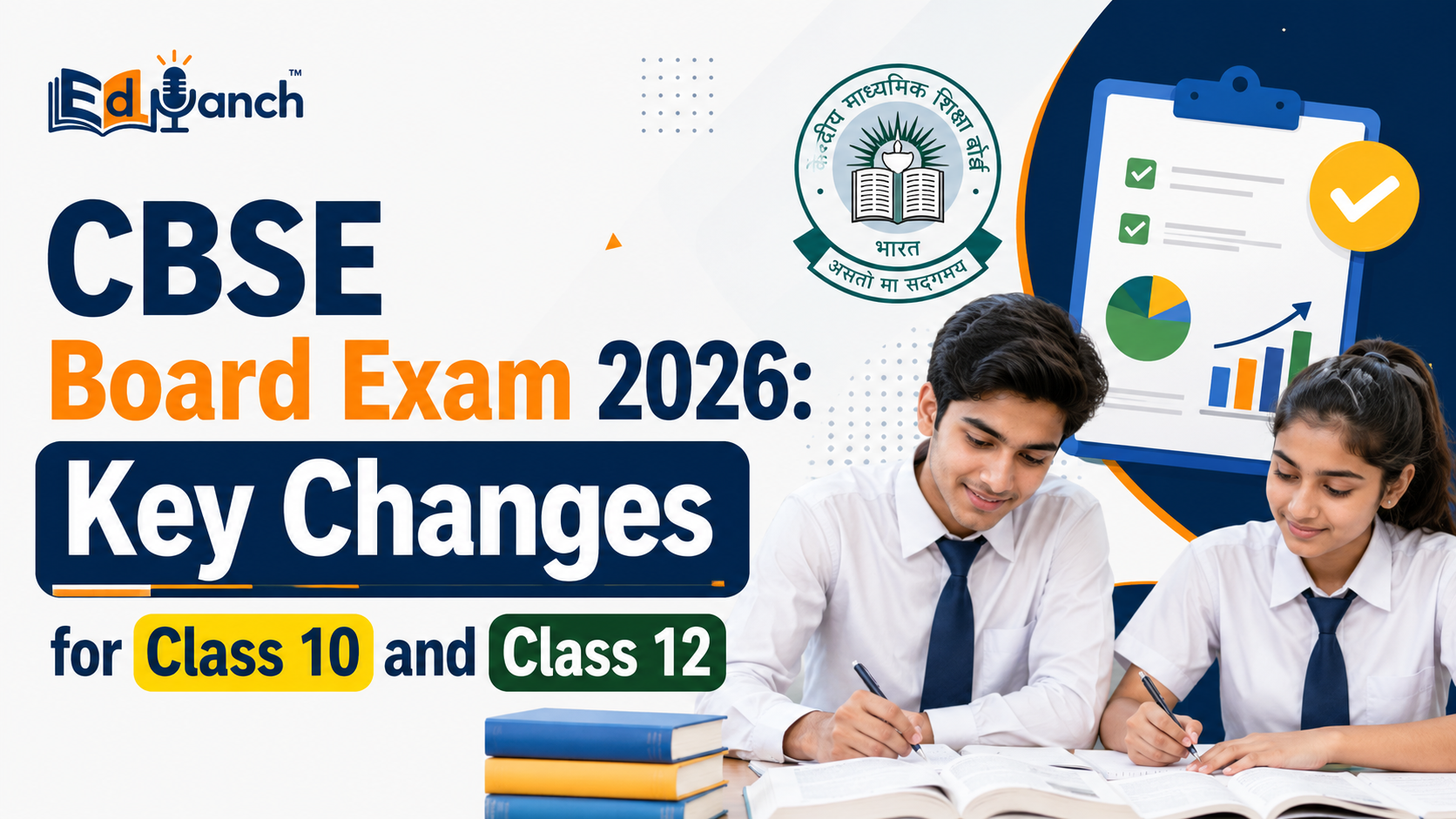
 CBSE Board Exam 2026 introduces a dual-exam system for Class 10, a 50 percent competency-based question pattern, and digital on-screen marking for Class 12, aligned with NEP 2020.




CBSE Board Exam 2026: Everything Students and Parents Need to Know About the New Rules
The Central Board of Secondary Education has introduced some of the most significant structural changes to its examination system in recent years, and the 2026 board exams are where students and parents will feel the full impact of those decisions. These are not minor adjustments to the timetable or syllabus. These are foundational shifts in how students are assessed, how many chances they get, and what kind of thinking the board expects them to demonstrate.
For millions of Class 10 and Class 12 students across India, from metro cities to smaller towns in states like Rajasthan, Madhya Pradesh, Uttar Pradesh, and Bihar, understanding these changes early is the difference between walking into the exam hall with confidence and walking in unprepared. Edumanch breaks down every key change so that students and parents can plan with full clarity.
Why CBSE Is Overhauling the Board Exam System in 2026
The reforms announced for CBSE 2026 are not happening in isolation. They are the direct result of the National Education Policy 2020, which called for a complete rethinking of how Indian students learn and how their learning is measured. For decades, CBSE board exams were largely memory-driven. Students who could reproduce textbook content accurately were rewarded, while students with strong analytical and reasoning abilities sometimes struggled to translate those skills into high marks.
The NEP 2020 challenged that model. It demanded that assessments test whether students understand concepts, can apply them to real situations, and can think critically rather than simply recall facts. CBSE has responded by redesigning the exam pattern, introducing a dual-exam system for Class 10, deploying digital evaluation technology for Class 12, and restructuring question papers for key subjects. Each of these changes serves a larger purpose: making the board exam a genuine measure of learning, not just of memorization.
The Three Major Changes Every Student Must Understand
1. Two Board Exams in a Year for Class 10 StudentsThe most discussed change in CBSE 2026 is the introduction of a two-phase board examination system for Class 10 students. This means that for the first time, Class 10 students have the opportunity to appear for their board exams twice within the same academic year.
The first examination is mandatory for all students and was scheduled from February 17 to March 10, 2026, with results declared in April. The second examination is optional and was held from May 15 to June 1, 2026, with results announced in June. Students who wish to improve their marks in up to three subjects — including Mathematics, Science, Social Science, and Languages — can use the second attempt to do so. The best of the two scores is considered for the final result.
This is a meaningful change for Indian students, particularly in a country where a single bad exam day can derail months of preparation. The second attempt is not a supplementary exam or a compartment exam in the traditional sense. It is a genuine improvement opportunity built into the regular academic calendar. Internal assessments, which include projects, periodic tests, and activities, are conducted only once before the first exam and apply equally to both attempts.
For students who missed the first exam due to participation in national or state-level sports events, CBSE has also revised the special exam schedule. Sports quota students will now sit for their special exams alongside the second board examination in May, rather than at a separately scheduled time.
2. A New Exam Pattern: 50 Percent Competency, 20 Percent MCQ, 30 Percent DescriptiveThe second major change applies to both Class 10 and Class 12. The question paper structure has been fundamentally redesigned to align with competency-based education principles. The revised distribution is as follows:
- 50 percent of the paper consists of competency-based questions. These include case studies, source-based questions, scenario-based questions, data interpretation tasks, and real-life application problems. The goal is to test whether a student can think and reason, not just recall.
- 20 percent of the paper consists of select-response MCQs, which are direct conceptual questions with multiple answer choices.
- 30 percent of the paper consists of constructed-response questions, meaning short-answer and long-answer descriptive questions that test theoretical understanding.
This shift matters enormously for how students prepare. A student who has spent years memorizing definitions and formulas will find that the exam rewards a different kind of preparation. Students who regularly practice applying concepts to real-world contexts, who read case studies, who attempt data-based questions, and who develop analytical reasoning skills will be better positioned under this pattern.
For students in government schools and lower-income families across Tier 2 and Tier 3 cities in India, this change can initially feel challenging because access to competency-based practice material is not always equal. This is precisely why platforms like Edumanch and the resources provided by CBSE itself, including sample papers and marking schemes released early in the academic year, are so important for democratizing preparation.
3. On-Screen Digital Marking for Class 12For Class 12 students, the major evaluation-side change is the introduction of On-Screen Marking, commonly referred to as OSM. Under this system, Class 12 answer sheets are scanned and evaluated digitally by examiners working on computers, rather than checking physical answer booklets in the traditional way.
This change is designed to eliminate totaling errors, reduce manual calculation mistakes, and bring greater transparency and speed to the evaluation process. With OSM in place, the process of marks verification after results, which was previously a common recourse for students who felt their papers had been mis-evaluated, is expected to be modified or discontinued in light of the improved accuracy that digital evaluation offers.
For students, the implication is that accurate, neat, and well-organized answers continue to matter. Illegible writing or disorganized responses are harder to evaluate fairly under any system. Students should focus on writing with clarity, labeling sections properly, and ensuring their answers are structured logically.
Restructured Answer Booklets for Science and Social Science in Class 10
An additional change specific to Class 10 relates to how students write their answers in Science and Social Science papers. CBSE has mandated that answer booklets for these subjects be divided into clearly labeled subject-specific sections.
For Science, students must divide their answer booklet into three sections corresponding to Physics, Chemistry, and Biology. For Social Science, the booklet must be divided into sections for History, Geography, Political Science, and Economics.
This requirement is designed to improve the evaluation process by allowing examiners to assess each subject component clearly. Students should practice this from the beginning of their preparation so that the habit of organizing responses by section becomes second nature before the actual exam day.
What Class 12 Students Need to Know
While the most dramatic structural changes in CBSE 2026 are concentrated in Class 10, Class 12 students are not untouched. The same revised exam pattern, with 50 percent competency-based questions, applies to Class 12 papers as well. The shift from rote learning to application-based assessment affects both classes equally.
CBSE has also introduced new skill-based electives for Class 12 students in the 2025-26 curriculum. These include subjects like Land Transportation Associate, Electronics and Hardware, Design Thinking and Innovation, and Physical Activity Trainer, among others. Students from Information Technology, Informatics Practices, and Computer Science streams may select one additional elective, expanding their academic profile and career readiness.
The structured curriculum framework for Class 12 now organizes subjects into seven learning areas: Languages, Humanities, Mathematics, Sciences, Skill Subjects, General Studies, and Health and Physical Education. This organization is intended to provide a more holistic and flexible academic experience in keeping with NEP 2020 objectives.
Important Exam Day Rules and Eligibility Requirements
Several exam day guidelines and eligibility rules have also been updated for 2026. Students must carry both their School ID Card and their official CBSE Admit Card to the examination hall. The List of Candidates, known as the LOC, is now mandatory for all students as part of the enrollment process for board exams.
The CBSE minimum attendance requirement of 75 percent applies strictly. Students who fall below this threshold are not eligible to appear in the board examinations unless a medical exemption has been granted by the school and approved by CBSE. Internal assessments, including periodic tests, portfolios, and practical work, are compulsory for all students and contribute meaningfully to the final score.
For private candidates and students whose additional subject is not taught by a qualified teacher at their school, specific eligibility conditions apply and students should verify these directly with their school administration or through the CBSE official website.
How Students and Parents Should Respond to These Changes
Understanding the change is only the first step. The more important question is: what should students do differently in response?
Students preparing for CBSE 2026 should make competency-based question practice a daily habit. Rather than spending all study time on reading and rewriting textbook notes, students should regularly attempt case studies, data interpretation exercises, and application-based questions from sample papers. CBSE released official sample papers and marking schemes early in the 2025-26 academic year to help students understand the new format. Working through these papers under timed conditions is one of the most effective preparation strategies available.
Parents can play a supportive role by shifting conversations about board exam preparation away from pressure and toward understanding. The new exam pattern actually rewards students who think well and understand their subjects deeply, which is a healthier basis for learning than pure memorization. Encouraging children to discuss concepts, ask why things work the way they do, and connect their studies to everyday experiences is aligned with exactly what the new CBSE pattern is trying to assess.
Schools, coaching centers, and education platforms across India are also adjusting their teaching approaches in response to these changes. Students in rural areas and smaller towns should seek out digital resources, including NCERT materials, CBSE sample papers, and guidance platforms like Edumanch, to ensure they are not disadvantaged in accessing quality preparation support.
Conclusion
The CBSE Board Exam 2026 changes represent a genuine effort to modernize India's school assessment system. The two-exam system for Class 10 reduces the high-stakes pressure that has historically made the board season an anxiety-filled experience for students and families. The shift to 50 percent competency-based questions asks students to demonstrate real understanding rather than rewarding rote recall. Digital evaluation for Class 12 brings transparency and efficiency to the marking process. Taken together, these reforms reflect where Indian education is heading under the NEP 2020 framework.
For students, the message is clear: learn to think, practice applying concepts, and use every resource available to prepare with clarity. For parents, the message is equally important: support your child by encouraging conceptual curiosity rather than placing pressure on marks alone. The board exam system is evolving, and students who evolve their preparation approach alongside it are the ones best positioned to succeed.
Frequently Asked Questions
Can Class 10 students choose to skip the first board exam and only appear for the second one in May 2026?
No. The first board examination, held in February-March, is mandatory for all Class 10 students. The second examination in May is optional and is available to students who wish to improve their scores in up to three specific subjects. Students cannot skip the first exam and appear only for the second.
Does the new 50 percent competency-based question pattern mean the exam will be harder for average students?
Not necessarily harder, but certainly different. Competency-based questions test understanding and application rather than memory. Students who prepare by practicing case studies, source-based questions, and real-life application problems will be well-equipped. CBSE has made sample papers available, and students who work through these regularly will find the new pattern manageable and even rewarding if they understand their subjects well.
Will the On-Screen Marking system for Class 12 affect how students should write their answers?
The fundamental requirement remains the same: clear, organized, and well-articulated answers. Under OSM, answer sheets are scanned and evaluated digitally. Neat handwriting, proper labeling of questions, and logical structure in answers help ensure that evaluators can assess responses accurately. Students should continue to write with clarity and avoid leaving answers incomplete or unorganized.
CBSE Board Exam 2026 introduces a dual-exam system for Class 10, a 50 percent competency-based question pattern, and digital on-screen marking for Class 12, aligned with NEP 2020.





.png)
.png)

.png)

.png)



.png)
.png)




.png)


.png)