 Monday, November 16, 2026
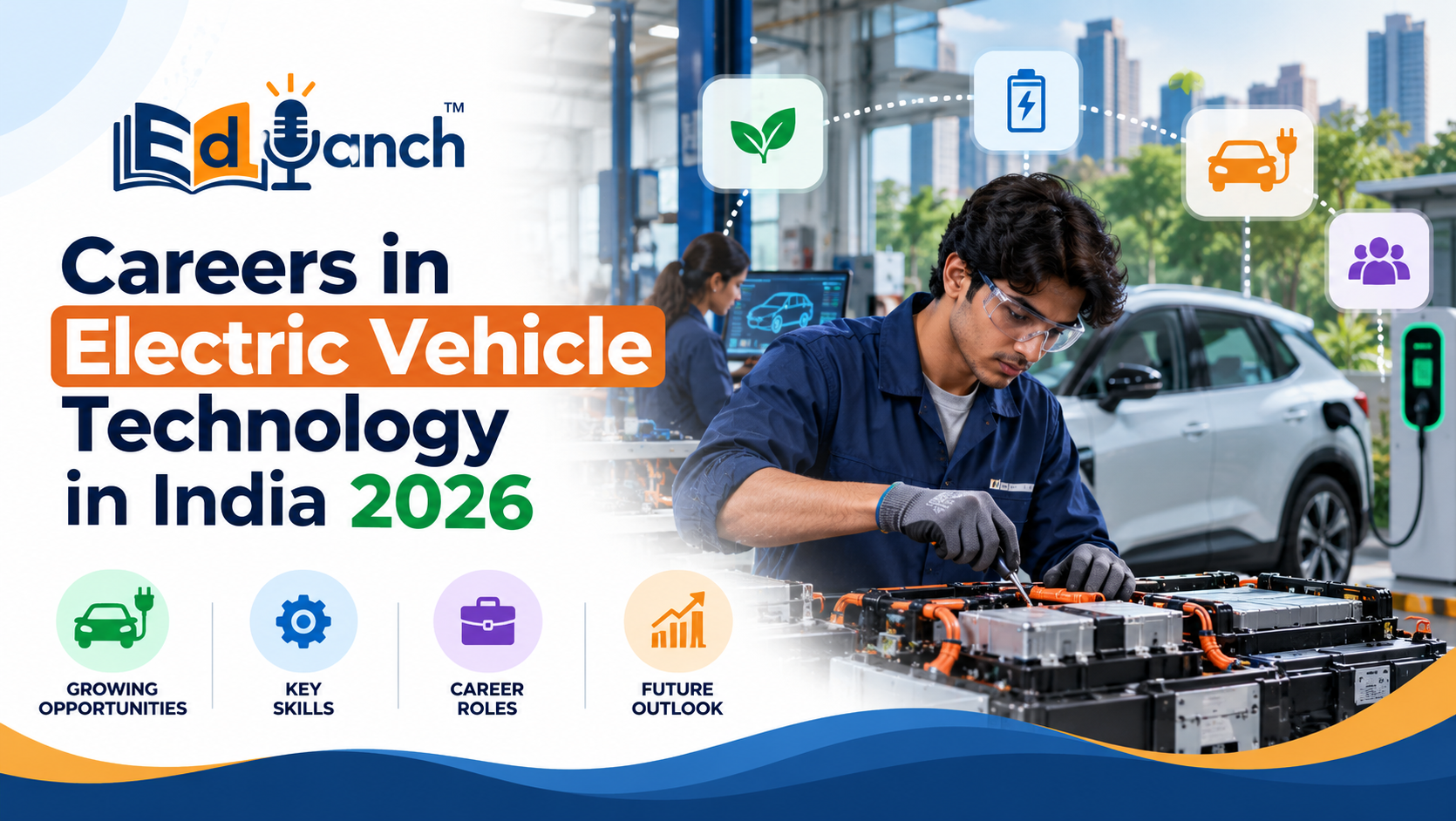
 Careers in electric vehicle technology in India are expanding rapidly, driven by government policy, growing investment, and rising EV adoption, offering strong opportunities across engineering, software, and infrastructure roles.





Introduction
India is in the middle of one of the most significant industrial transitions in its history. The country's automotive sector, long dominated by internal combustion engines, is rapidly shifting toward electric mobility. This shift is not just an environmental policy story. It is a massive career opportunity story for engineers, software developers, data scientists, supply chain professionals, and entrepreneurs across the country.
The Indian government's push through initiatives like the Faster Adoption and Manufacturing of Hybrid and Electric Vehicles scheme, better known as FAME II, and the National Electric Mobility Mission Plan has created a policy backbone that is attracting billions of rupees in investment into electric vehicle manufacturing, battery production, and charging infrastructure. According to the Society of Indian Automobile Manufacturers, electric vehicle sales in India have been growing at a rapid pace, and the target of achieving 30 percent EV penetration across all vehicle categories by 2030 has set a clear direction for the industry.
For students, fresh graduates, and working professionals thinking about their next career move, electric vehicle technology represents a field that is expanding fast, rewarding well, and is likely to remain relevant for decades to come. This article offers a clear and practical guide to understanding what careers in this space look like, what skills are needed, which companies are hiring, and how to get started in India.
Understanding Electric Vehicle Technology as a Career Domain
Electric vehicle technology is not a single job profile. It is a broad and multidisciplinary field that brings together expertise from mechanical engineering, electrical engineering, electronics, software development, materials science, and even urban planning. To understand careers in this space, it helps to first understand what goes into making an electric vehicle work.
An electric vehicle relies on a battery pack to store energy, an electric motor to convert that energy into motion, a power electronics system to manage energy flow, a battery management system to monitor cell health and safety, and a charging system to replenish energy from the grid. Each of these components represents a technical specialization, and behind each specialization is a set of career roles.
Beyond the vehicle itself, there is an entire ecosystem of careers related to EV charging infrastructure, software platforms, fleet management, grid integration, after-sales service, regulatory compliance, and consumer education. This means that careers in EV technology are not limited to manufacturing companies alone. They extend into energy companies, technology startups, government bodies, research institutions, and consultancy firms.
Key Career Roles in the Electric Vehicle Sector
The EV industry in India currently requires talent across several functional areas. Some of the most sought-after roles include the following.
Battery Engineer and Battery Management System DeveloperThe battery is the most critical and expensive component of an electric vehicle. Battery engineers work on cell chemistry, pack design, thermal management, and performance optimization. Battery management system developers create the software and hardware that monitor cell voltage, temperature, and state of charge in real time. This is one of the highest-demand specializations in the EV space globally, and India is investing heavily in local battery manufacturing under the Production Linked Incentive scheme for Advanced Chemistry Cells.
Power Electronics EngineerPower electronics engineers design and develop inverters, converters, and motor controllers that manage how electricity flows between the battery and the motor. This role requires strong knowledge of semiconductor devices, circuit design, and embedded systems.
Electric Motor and Drivetrain EngineerThese engineers work on the design and optimization of electric motors, gearboxes, and the overall drivetrain system. The role combines mechanical and electrical engineering expertise and is particularly relevant for two-wheeler and four-wheeler EV manufacturers.
Embedded Systems and Firmware DeveloperModern electric vehicles are software-intensive machines. Embedded systems engineers develop the firmware that runs on electronic control units, manages communication between vehicle systems, and enables features like regenerative braking and range estimation.
EV Software and Connectivity EngineerThis role focuses on vehicle software platforms, over-the-air update systems, telematics, connected vehicle features, and mobile app integration. As Indian consumers expect more digital features in their vehicles, this profile has become increasingly important for companies like Ola Electric and Ather Energy.
Charging Infrastructure Engineer and Project ManagerIndia needs hundreds of thousands of public and private charging points to support growing EV adoption. Engineers in this space design and deploy charging stations, manage grid connections, and ensure safety and reliability. Project managers coordinate the rollout of charging networks across cities and highways.
EV Data Analyst and AI EngineerData from electric vehicles, including battery performance data, charging patterns, and driving behavior, is enormously valuable. Data analysts and AI engineers help companies use this data to improve vehicle performance, predict battery degradation, and optimize fleet operations.
Supply Chain and Procurement SpecialistWith India working to reduce its dependence on imported battery cells and critical minerals, supply chain specialists in the EV sector play a crucial role. They manage relationships with component suppliers, identify local sourcing opportunities, and help companies navigate import regulations.
Skills That Matter Most in an EV Career
Regardless of the specific role, certain skills appear consistently in job descriptions posted by EV companies in India. These include:
- Proficiency in battery technology fundamentals and electrochemistry
- Knowledge of power electronics and circuit design
- Experience with embedded C programming and AUTOSAR frameworks
- Familiarity with CAN bus protocols and vehicle communication standards
- Competence in simulation tools such as MATLAB, Simulink, and ANSYS
- Understanding of thermal management systems
- Software development skills, particularly in Python, C++, and related languages
- Knowledge of EV charging standards such as CCS, CHAdeMO, and BIS standards applicable in India
- Familiarity with the regulatory framework, including Bureau of Indian Standards norms for EV safety
Soft skills are equally important. The EV industry is still evolving rapidly, which means professionals need to be adaptable, comfortable with learning new technologies quickly, and capable of working in cross-functional teams that often include engineers, designers, and business leaders working side by side.
Education Pathways and Courses in India
Several universities and institutions in India are now offering programs specifically aligned with EV technology careers. Students can explore the following pathways.
A Bachelor of Engineering or Bachelor of Technology in electrical engineering, electronics and communication engineering, or mechanical engineering remains the most common undergraduate entry point. From there, students can pursue specialization through postgraduate programs or certification courses.
Institutions such as the Indian Institute of Technology campuses, National Institutes of Technology, and several private engineering colleges now offer elective courses and research programs focused on electric mobility and energy storage.
On the certification side, organizations like the Automotive Research Association of India, the Society of Automotive Engineers India, and several online platforms offer short-term EV-specific courses covering topics like battery technology, power electronics, and EV charging infrastructure.
The National Skill Development Corporation has also developed competency frameworks for EV technicians and service professionals, creating vocational pathways for students who want to enter the EV workforce through technical diploma programs and industrial training institutes.
Top EV Employers in India
The range of companies hiring EV professionals in India has grown significantly over the past three years. These include:
- Tata Motors, which has committed to an all-electric product portfolio for passenger vehicles
- Mahindra Electric, which operates as the dedicated EV arm of the Mahindra Group
- Ola Electric, one of India's fastest-growing EV companies with its own gigafactory under development in Tamil Nadu
- Ather Energy, a Bengaluru-based startup known for its premium electric scooters and technology-forward approach
- TVS Motor Company and Hero Electric, which are expanding their EV lineups rapidly
- Revolt Motors and Okinawa, which serve the mid-segment two-wheeler EV market
- Tata Power, Adani Total Energies, and ChargeZone, which are building EV charging networks
- Battery manufacturers and cell technology startups receiving support under the PLI ACC scheme
Beyond these, global companies with India operations, including Bosch, Continental, and Schaeffler, are hiring EV engineers in their Indian research and development centers.
Salary Expectations in the EV Sector
Compensation in the EV sector varies widely based on specialization, experience, and employer. As a general reference:
- Entry-level engineers with relevant skills typically earn between INR 4 and 8 lakh per annum
- Mid-level professionals with three to five years of EV-specific experience earn between INR 10 and 18 lakh per annum
- Senior engineers, team leads, and specialists with rare expertise in battery chemistry or power electronics can earn between INR 20 and 35 lakh per annum
- Professionals in product management, data science, and software development for EV platforms may command comparable or higher packages
Startup companies often supplement base salaries with employee stock option plans, which can significantly increase total compensation if the company performs well.
Career Outlook and Future Opportunities
India's EV sector is expected to generate over 5 crore direct and indirect jobs by 2030, according to estimates from the Council on Energy, Environment and Water. The government's investment in domestic battery manufacturing, semiconductor development, and EV infrastructure is creating new demand for skilled professionals at every level.
Emerging opportunities include careers in vehicle-to-grid technology, solid-state battery research, hydrogen fuel cell vehicles, autonomous EV systems, and EV fleet management platforms. Professionals who build expertise in these emerging areas today are likely to find themselves in high demand as these technologies move toward commercial deployment over the next five to ten years.
For students and early-career professionals in India, the message from the EV sector is clear: the time to invest in this field is now. The ecosystem is growing, companies are hiring, and the government is committed to making India a global hub for electric mobility.
Frequently Asked Questions
Q1: What qualifications are needed for a career in electric vehicle technology?
A degree in electrical engineering, mechanical engineering, or electronics engineering is the most common entry point into EV careers. Specialized EV certification courses and postgraduate programs are also available across India and can significantly strengthen a candidate's profile. Practical skills in battery management, power electronics, and embedded systems are often weighted heavily during hiring.
Q2: Which companies are hiring EV professionals in India?
Companies including Tata Motors, Ola Electric, Mahindra Electric, Ather Energy, TVS Motor Company, Hero Electric, and several EV startups are actively recruiting EV professionals. In addition, energy companies like Tata Power and ChargeZone are hiring for charging infrastructure roles, and global automotive suppliers like Bosch and Continental are expanding their EV engineering teams in India.
Q3: What is the average salary for EV engineers in India?
Entry-level EV engineers typically earn between INR 4 and 8 lakh per annum. Mid-level professionals with relevant experience generally earn between INR 10 and 18 lakh per annum. Senior specialists in battery technology or power electronics can earn between INR 20 and 35 lakh per annum, depending on the employer and location.
Q4: Is electric vehicle technology a good career choice in India?
Yes, it is a strong career choice. India has set an ambitious target of 30 percent EV penetration by 2030 and is investing heavily in domestic manufacturing, battery production, and charging infrastructure. The sector is expected to generate crores of jobs over the next decade, and professionals with EV-specific skills are currently in short supply relative to demand.
Q5: What skills are most important for EV technology careers?
Battery management systems, power electronics, embedded software development, thermal management, CAN bus protocols, simulation tools like MATLAB and Simulink, and knowledge of Indian EV safety standards are among the most important technical skills. Adaptability, cross-functional collaboration, and a willingness to learn continuously are equally important given how quickly the sector is evolving.
Resources
- Society of Indian Automobile Manufacturers (SIAM): Industry data and reports on EV sales and sector trends in India
- National Skill Development Corporation (NSDC): Competency frameworks and vocational training programs for EV technicians and professionals
- Council on Energy, Environment and Water (CEEW): Research on India's EV transition, job creation potential, and policy landscape
- Bureau of Indian Standards (BIS): Safety standards and certification norms for electric vehicles and charging infrastructure in India
- Automotive Research Association of India (ARAI): Technical standards, testing protocols, and EV-specific training programs for automotive professionals
Interlinking Keywords
Electric vehicle courses in India, EV engineering jobs 2026, battery technology career, power electronics engineering, EV charging infrastructure India, automotive engineering careers, FAME II scheme India, EV startups India, electric mobility skills, future careers in technology
Last reviewed by:
Dr. Manthan Tripathi, Edumanch Editorial and Education Guidance Team on October 22, 2026.
Disclaimer
The information provided in this article is intended for general educational and informational purposes only. Career outcomes, salary figures, and industry projections mentioned in this article are based on publicly available information and may vary based on individual qualifications, employer, location, and market conditions. Readers are encouraged to conduct independent research and consult relevant institutions or career advisors before making educational or professional decisions.