 Monday, November 16, 2026
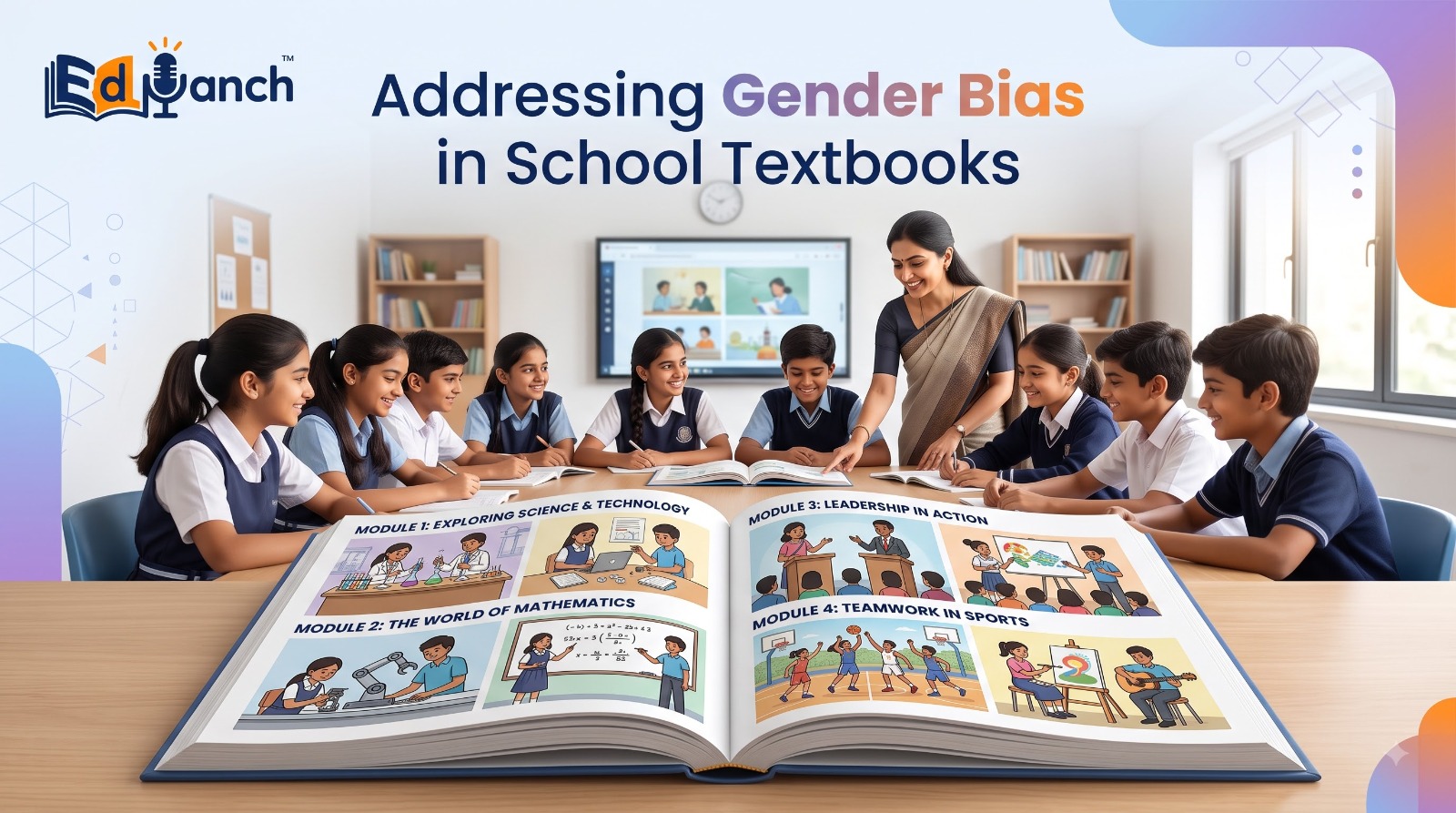
 Gender-balanced textbooks can shape inclusive attitudes, broaden career aspirations, and challenge stereotypes from an early age. Regular content audits, inclusive language, diverse role models, and teacher training can create more equitable learning environments.





School textbooks do far more than transmit academic facts; they serve as powerful socializing agents that transmit cultural norms, societal values, and behavioral expectations. During formative developmental stages, children absorb subtle visual, linguistic, and narrative cues about what roles, occupations, and personality traits are deemed appropriate for their gender.
Despite decades of educational reform, systemic content audits across national and regional curricula continue to reveal persistent gender bias, visual marginalization, and occupational stereotyping. Female figures are frequently underrepresented in STEM illustrations, depicted disproportionately in domestic caregiving roles, or framed using passive emotional language, while historical narratives remain heavily centered on male protagonists.
Eliminating gender bias from educational materials requires a comprehensive institutional approach: establishing rigorous quantitative and qualitative textbook audit rubrics, adopting gender-neutral linguistic guidelines, ensuring balanced multi-disciplinary historical representation, and providing gender-sensitivity training for curriculum authors and classroom educators.
1. The Anatomy of Gender Bias in Educational Media
Gender stereotyping in instructional materials manifests across four distinct pedagogical and structural dimensions:
- Dimension 1: Visual and Numerical Underrepresentation (Invisibility): Significant quantitative disparities in the ratio of male-to-female illustrations, named historical characters, and narrative protagonists. In many mathematics and science textbooks, male figures outnumber female figures by up to 2:1 or 3:1.
- Dimension 2: Occupational and Role Stereotyping: Depicting men almost exclusively as engineers, political leaders, scientists, and primary family breadwinners, while confining women to roles such as homemakers, primary school teachers, nurses, or passive caretakers.
- Dimension 3: Linguistic and Grammatical Bias: Pervasive use of masculine generic pronouns (he/him/his to denote any hypothetical human), gendered nouns (mankind, policeman, fireman, chairman), and descriptive adjectives that frame girls as "gentle, fearful, emotional" and boys as "brave, ambitious, assertive."
- Dimension 4: The Hidden Curriculum in Story Problems: Word problems in mathematics and economics frequently reinforce traditional divisions of labor (e.g., "Rahul invests in stocks while Neha goes grocery shopping"), subtly shaping economic aspirations from an early age.
2. Institutional Framework for Gender-Neutral Curriculum Audits
To systematically identify and eliminate bias, curriculum boards and textbook revision committees utilize structured analytical rubrics:
- Quantitative Frequency Mapping: Tracking the exact tally of male vs. female characters across text mentions, visual diagrams, chapter introductions, and end-of-chapter review questions.
- Occupational Diversity Indexing: Cataloging all professions depicted in the textbook and evaluating the gender distribution across leadership, scientific, industrial, and care-based domains.
- Character Agency and Role Assessment: Analyzing whether female and male characters are depicted as active problem-solvers (initiating action, inventing solutions, taking physical risks) versus passive observers (reacting to events, seeking rescue, or performing background support).
- Intersectionality and Regional Equity Review: Ensuring that female representation is not confined to urban, privileged demographics, but actively showcases rural, working-class, and minority women across diverse economic and scientific sectors.
3. Structural Comparison: Stereotypical vs. Gender-Balanced Curriculum Design
- STEM Visuals & Exemplars:
- Stereotypical Curriculum: Science and tech diagrams show male technicians and inventors; women appear primarily as lab assistants or patients.
- Gender-Balanced Curriculum: Equal portrayal of women and men operating lab equipment, leading space missions, and authoring mathematical proofs.
- Pedagogical Impact: Eliminates stereotype threat and boosts STEM self-efficacy and enrollment among female students.
- Language & Noun Conventions:
- Stereotypical Curriculum: Uses pseudo-generic masculine terms (mankind, forefathers, manpower, he/him).
- Gender-Balanced Curriculum: Adopts inclusive terminology (humanity, ancestors, workforce, they/them or alternating pronouns).
- Pedagogical Impact: Normalizes linguistic equality and reinforces that all professions and human achievements are universal.
- Domestic & Caregiving Depictions:
- Stereotypical Curriculum: Domestic chores (cooking, cleaning, child care) are performed exclusively by mothers and daughters.
- Gender-Balanced Curriculum: Fathers and sons are depicted cooking, cleaning, providing childcare, and managing household logistics.
- Pedagogical Impact: Fosters collaborative, egalitarian domestic values and de-stigmatizes emotional and caregiving labor for boys.
- Historical & Social Studies Narratives:
- Stereotypical Curriculum: History is framed as a succession of male military rulers, political summits, and male philosophers.
- Gender-Balanced Curriculum: Integrates female freedom fighters, social reformers, scientists, artists, and grassroots labor leaders into core historical arcs.
- Pedagogical Impact: Provides complete, accurate historical context and diverse role models for all learners.
- Physical Education & Extracurricular Activities:
- Stereotypical Curriculum: Boys play competitive sports (football, cricket); girls participate in dance or passive cheering.
- Gender-Balanced Curriculum: Shows co-educational participation across all athletic disciplines, gymnastics, chess, and robotics clubs.
- Pedagogical Impact: Encourages physical fitness, leadership, and athletic confidence across all genders.
4. Practical Strategies for Modernizing Instructional Text
Curriculum developers and authors can implement concrete linguistic and narrative refactorings across all subject domains:
- De-Gendering Occupational Nomenclature:
- Replace Fireman with Firefighter.
- Replace Policeman with Police Officer.
- Replace Chairman with Chairperson / Board Chair.
- Replace Stewardess / Air Hostess with Flight Attendant.
- Replace Mailman with Postal Carrier.
- Balancing Mathematics and Economics Word Problems:
- Legacy: "Mr. Sharma earned $50,000 and invested in mutual funds, while Mrs. Sharma budgeted for monthly vegetables."
- Modernized: "Dr. Sharma analyzed investment yields on solar energy bonds, while her partner balanced the household logistics budget."
- Highlighting Overlooked Historical Pioneers:
- In Physics and Chemistry: Highlight pioneers like Rosalind Franklin (DNA structure), Lise Meitner (nuclear fission), and Janaki Ammal (cytology and plant breeding) alongside standard historical figures.
- In Computing: Teach Ada Lovelace (the first computer programmer) and Margaret Hamilton (Apollo mission software lead) alongside Alan Turing and Charles Babbage.
5. Strategic Action Blueprint for Education Authorities and Publishers
To ensure comprehensive, long-term curriculum reform, educational boards and school administrations should follow a four-pillar roadmap:
- Pillar 1: Mandate Pre-Publication Gender Audits: Establish independent gender-sensitization review panels within state and national education boards (e.g., NCERT, SCERT) with veto power over biased textbook drafts prior to mass printing.
- Pillar 2: Issue Explicit Guidelines for Authors and Illustrators: Provide textbook publishing houses with clear style manuals mandating 50:50 gender parity in illustrations, alternating pronoun usage, and diversified role allocations.
- Pillar 3: Conduct In-Service Teacher Gender Sensitivity Training: Train classroom teachers to recognize and critically deconstruct legacy stereotypes in existing textbooks, turning dated curriculum examples into active classroom discussions on equity.
- Pillar 4: Establish Digital Continuous Feedback Portals: Create an open online reporting channel where students, teachers, and parents can flag biased questions, discriminatory illustrations, or exclusionary language in approved school books for correction in subsequent editions.
10 Frequently Asked Questions (FAQs)
Q1. Why is addressing gender bias in school textbooks so important?
Textbooks represent authoritative knowledge for young learners. When books consistently show men in leadership and science and women in domestic or subordinate roles, it shapes students' career aspirations, self-confidence, and social attitudes, reinforcing real-world gender inequality.
Q2. What is "invisibility" in textbook analysis?
Invisibility refers to the systemic underrepresentation or complete omission of female figures, contributions, and narratives from illustrations, historical timelines, scientific achievements, and literary anthologies.
Q3. How does gender bias in mathematics and science textbooks affect girls?
When physics or math problems exclusively feature male engineers or athletes, female students experience subtle "stereotype threat." This psychological barrier can lower self-efficacy in STEM disciplines and contribute to the gender gap in higher engineering and technology fields.
Q4. What are gender-neutral pronouns, and how are they used in modern textbooks?
Gender-neutral phrasing avoids using "he/him" as a default for any unspecified person. Modern texts use singular "they/them," rephrase sentences to use plurals ("students must submit their work"), or intentionally alternate between male and female pronouns across different examples.
Q5. Does making a textbook gender-balanced mean rewriting history?
No. It means providing a more complete, accurate history. Women have always made critical contributions to science, social reform, governance, literature, and labor movements, but traditional historiography frequently excluded or marginalized their achievements in favor of male-dominated political and military events.
Q6. How can teachers address gender bias in older textbooks that have not yet been updated?
Teachers can use biased text as a critical learning opportunity by asking students questions such as: "What do you notice about the people shown in these illustrations?" or "How would this story change if the protagonist were female?" This cultivates media literacy and critical thinking.
Q7. What role do illustrations play compared to written text in perpetuating stereotypes?
Visual illustrations have a powerful, immediate impact—especially on early primary learners who are still developing reading fluency. A picture showing only mothers cooking or only boys building circuits communicates strong social expectations before the child reads a single word.
Q8. What is an "intersectionality audit" in curriculum development?
An intersectional audit evaluates whether textbook representation accounts for the overlap of gender with other social identities—such as race, caste, socioeconomic class, disability, and geographic region—ensuring that depicted female figures reflect broad, diverse societal realities.
Q9. Are state and national educational boards actively updating textbook guidelines?
Yes. Major educational bodies globally and nationally (such as UNESCO guidelines and NCERT framework revisions in India) have integrated gender-auditing rubrics into new textbook preparation workflows, mandating parity in depictions and gender-neutral language.
Q10. How quickly can curriculum updates change student perceptions?
Studies show that when students are exposed to gender-balanced, non-stereotypical educational materials, girls demonstrate higher interest and confidence in STEM subjects, and all students show more egalitarian attitudes toward domestic labor and leadership within a single academic school year.