 Monday, October 05, 2026
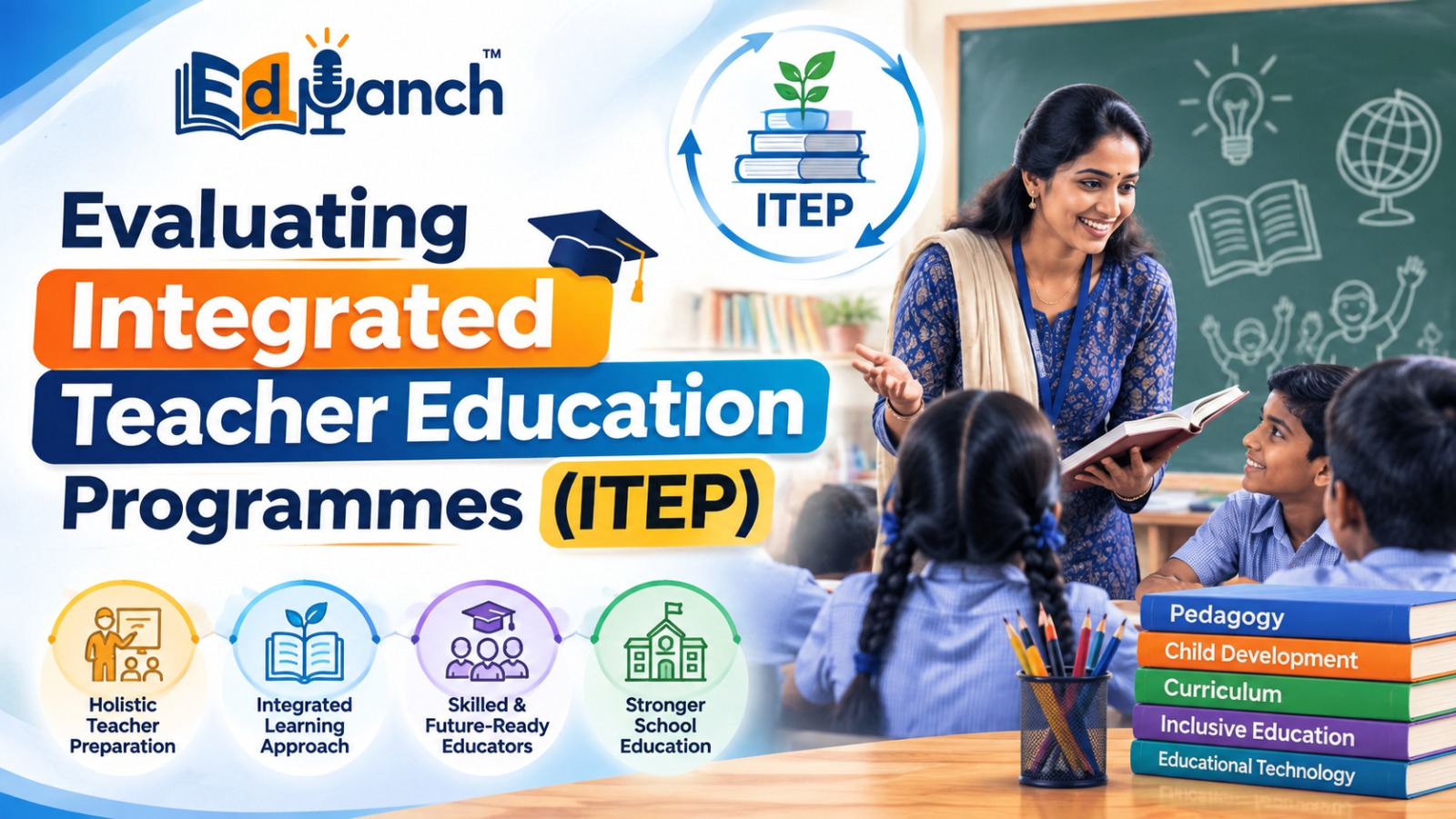
 ITEP transforms teacher education through an integrated four-year multidisciplinary degree, combining subject expertise, pedagogy, internships, inclusive education, technology, and stage-specific specialization to prepare future-ready educators.




The landscape of teacher education is undergoing a fundamental transformation. For decades, the standard pathway to entering the teaching profession relied on standalone, consecutive degree models—typically a 3-year undergraduate degree followed by a separate 1- or 2-year Bachelor of Education (B.Ed) program. This fragmented setup frequently resulted in disconnected subject-matter mastery and pedagogical training, isolating prospective educators from modern multidisciplinary learning environments.
To address these systemic gaps, policy frameworks—most notably India's National Education Policy (NEP) 2020—have introduced the Integrated Teacher Education Programme (ITEP). Designed as a 4-year dual-major holistic undergraduate degree, ITEP fundamentally modernizes teacher preparation by weaving together core disciplinary knowledge, modern pedagogical techniques, early school internships, and socio-emotional learning.
1. Deconstructing the ITEP Structural Framework
ITEP shifts teacher preparation away from isolated training institutes into vibrant, multidisciplinary higher education institutions (HEIs). Its architecture is built upon four primary structural pillars:
- 4-Year Dual-Major Curriculum: Students earn a dual-major degree (such as B.A. B.Ed, B.Sc. B.Ed, or B.Com. B.Ed) within 4 years (8 semesters), saving one full academic year compared to the traditional 3+2 pathway.
- Stage-Specific Pedagogical Alignment: Unlike legacy B.Ed degrees that offered broad, one-size-fits-all methodology courses, ITEP requires candidates to specialize in a specific school stage:
- Foundational Stage: Focuses on play-based, activity-led learning, early literacy, and numeracy.
- Preparatory Stage: Emphasizes discovery-based learning, interactive classroom strategies, and foundational language/math skills.
- Middle Stage: Focuses on experiential learning, subject-specific concepts, and interdisciplinary connections.
- Secondary Stage: Centers on deep subject mastery, critical thinking, research orientation, and career counseling skills.
2. Modernizing B.Ed Pedagogy: Key Instructional Innovations
ITEP replaces traditional rote-lecture methods with progressive, evidence-based teaching techniques:
A. Concurrent Subject and Pedagogy IntegrationRather than studying subject knowledge first and learning how to teach years later, ITEP students engage with disciplinary content and pedagogical theory simultaneously. A concept learned in advanced mathematics or history is immediately paired with lesson design, common misconception analysis, and adaptive teaching strategies.
B. Extended, Multi-Stage School InternshipsLegacy B.Ed programs often relegated student teaching to a brief, frantic 4-to-6-week block at the end of the course. ITEP embeds school-based field experiences throughout the 4-year lifecycle, progressing from classroom observation and co-teaching in early semesters to full-semester immersive teaching practice in partner schools.
C. Inclusive and Technology-Enabled ClassroomsITEP coursework integrates training in educational technology (EdTech), digital content creation, assistive tools for diverse learners, and inclusive education practices. Trainees learn to design accessible lesson plans that cater to neurodiverse students and varied learning speeds.
3. Structural Comparison: Legacy B.Ed vs. Integrated ITEP
Evaluating how traditional teacher training compares to the modernized ITEP model highlights key structural improvements:
- Program Duration: Legacy models require 5 years total (3\text{-year BA/BSc} + 2\text{-year BEd}). ITEP completes training in 4 years (8 semesters), saving 1 full academic year.
- Institutional Ecosystem: Legacy models were often hosted in isolated, standalone teacher training colleges. ITEP is embedded within multidisciplinary universities and composite higher education institutions.
- Curriculum Integration: Legacy models kept subject knowledge and teaching methods separate. ITEP offers concurrent dual-major integration of disciplinary depth and pedagogical theory.
- Specialization Track: Legacy programs offered broad secondary-focused training with limited early childhood exposure. ITEP provides stage-specific specialization (Foundational, Preparatory, Middle, Secondary).
- Practicum & Internship: Legacy programs featured a brief, end-of-course 4-to-12-week block. ITEP embeds continuous, 4-year progressive field observation and full-semester immersive internships.
4. Implementation Challenges and Policy Roadmap
While ITEP offers a transformative vision for educator preparation, successful nationwide scaling requires overcoming key operational hurdles:
- Upgrading Standalone Teacher Training Institutes: Transitioning thousands of isolated B.Ed colleges into accredited, multidisciplinary composite institutions demands significant capital investment, faculty development, and structural reorganization.
- Standardizing Assessment and Credit Frameworks: Ensuring smooth credit transfers via national Academic Bank of Credits (ABC) systems requires aligning ITEP curricula across central, state, and private universities.
- Establishing Strong School-University Partnerships: HEIs must build formal, long-term partnerships with diverse public and private schools to guarantee high-quality internship placements and mentorship for all 4 years of the program.
10 Frequently Asked Questions (FAQs)
Q1. What is the Integrated Teacher Education Programme (ITEP)?ITEP is a 4-year (8-semester) multidisciplinary dual-major undergraduate program that offers a combined bachelor's degree in a discipline (B.A., B.Sc., or B.Com.) alongside professional teacher education (B.Ed.).
Q2. How does ITEP save time for prospective teachers?Under the traditional system, completing an undergraduate degree (3 years) and a standard B.Ed. (2 years) takes 5 years. ITEP integrates both degrees into a streamlined 4-year curriculum, saving students one full academic year.
Q3. Will traditional B.Ed degrees be phased out?Yes, policy frameworks (such as NEP 2020) envision making the 4-year integrated degree (ITEP) the minimum degree qualification required for school teachers by 2030, gradually phasing out standalone 2-year B.Ed programs.
Q4. What are the four stage-specific specializations offered in ITEP?ITEP offers specialized tracks corresponding to the 5+3+3+4 school structure: Foundational (Ages 3–8), Preparatory (Ages 8–11), Middle (Ages 11–14), and Secondary (Ages 14–18).
Q5. What is the admission criteria for enrolling in an ITEP course?Admissions to ITEP in participating central, state, and private institutions are typically conducted through national-level entrance assessments (such as the National Common Entrance Test / NCET conducted by NTA) following Senior Secondary (10+2) completion.
Q6. Can a candidate who completed a regular 3-year or 4-year BA/BSc still become a teacher?Yes. Transition mechanisms exist where candidates holding a 3-year or 4-year undergraduate degree in a specific discipline can pursue specialized 2-year or 1-year B.Ed programs during the policy transition period.
Q7. Why is ITEP hosted in multidisciplinary institutions rather than standalone colleges?Hosting ITEP in multidisciplinary HEIs ensures that student-teachers benefit from rich academic environments—accessing advanced science labs, humanities departments, sports facilities, and diverse peer networks rather than being isolated in single-subject training centers.
Q8. How does ITEP address inclusive education and special needs teaching?ITEP incorporates dedicated modules on universal design for learning (UDL), assistive technology, child psychology, and adaptive classroom strategies to prepare teachers to support neurodiverse students and children with disabilities.
Q9. What role does technology play in modern ITEP pedagogy?ITEP integrates digital literacy, educational software usage, hybrid classroom management, online assessment tools, and AI-assisted lesson planning directly into its core teaching methodology modules.
Q10. How does the internship component in ITEP differ from legacy B.Ed programs?Instead of a short, single teaching block at the end of the degree, ITEP embeds progressive field exposure across all 4 years—ranging from early school observations and tutoring to an intensive, full-semester teaching internship in a partner school.









.png)
.png)
.png)

.png)
.png)

.png)

.png)



.png)
.png)