 Thursday, October 08, 2026
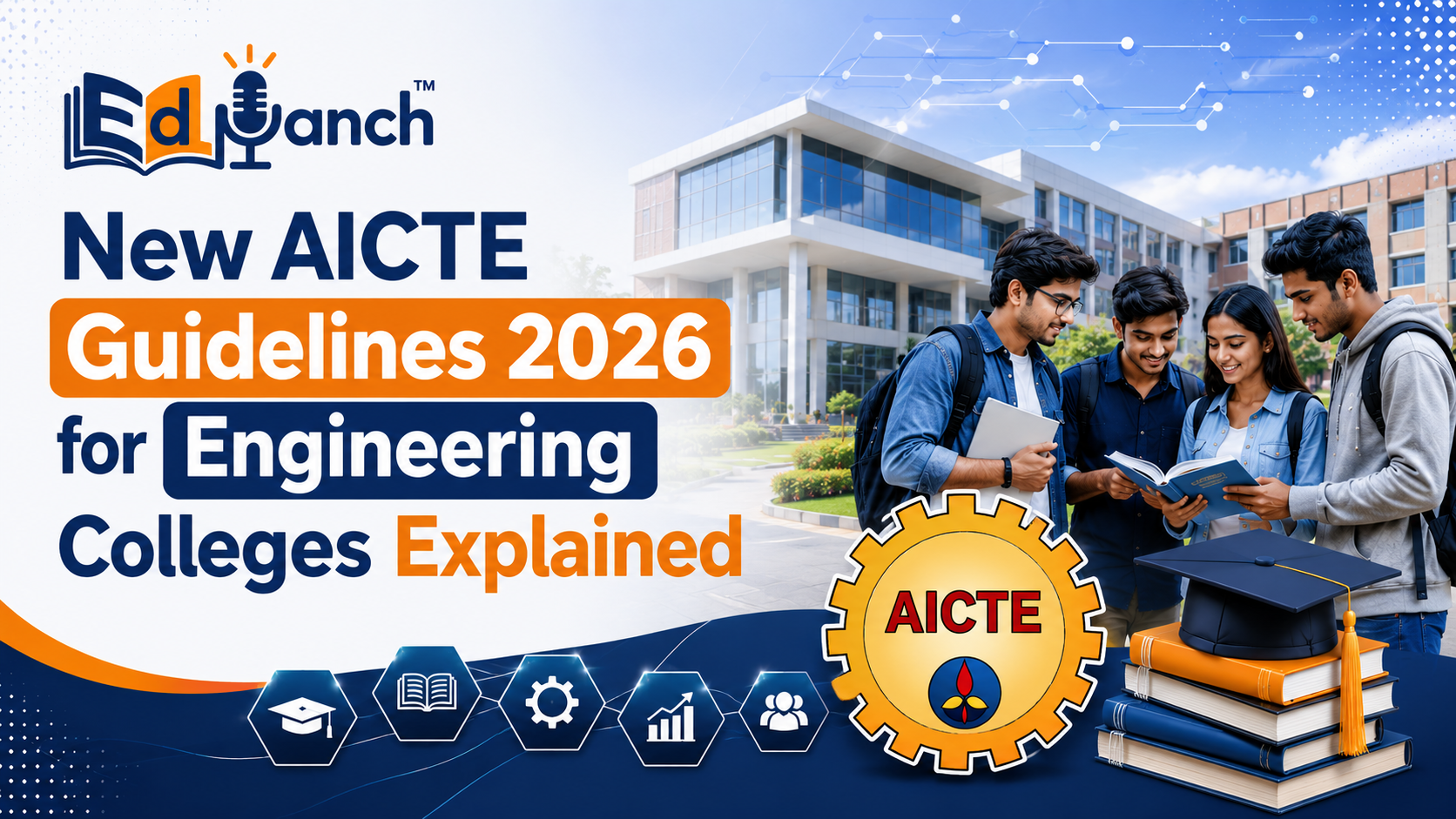
 AICTE's 2026-27 guidelines introduce a twice-yearly engineering admission cycle, revised international seat quotas, diploma minor specialisations, and clarified rules for management courses, reshaping admissions for Indian engineering aspirants and their families.




Introduction
Engineering education in India is going through one of its most significant administrative shifts in recent years. The All India Council for Technical Education, commonly known as AICTE, has rolled out a fresh set of guidelines through its Approval Process Handbook for the 2026-27 academic session, along with a separate reform that changes how and when students can take admission into BTech programmes. These changes are not minor procedural updates. They affect how many seats a college can offer, when a student can join an engineering programme, how diploma holders can broaden their skill sets, and which institutions fall under AICTE's regulatory umbrella in the first place.
For lakhs of students appearing for JEE Main, JEE Advanced, and various state-level engineering entrance examinations every year, and for the parents guiding them through this process, understanding these guidelines is no longer optional. A delayed board result, a missed counselling round, or confusion about seat availability can change the entire trajectory of an academic year. The new AICTE framework directly addresses several of these pain points while also reshaping how institutions plan their intake, faculty strength, and course offerings.
This guide breaks down the new AICTE guidelines for engineering colleges in plain language, explains what has actually changed compared to the earlier system, and helps students and parents understand what these updates mean in practical terms during admissions, counselling, and the years that follow.
Understanding AICTE and Why Its Guidelines Matter
AICTE functions as the apex statutory body responsible for planning, formulating, and maintaining quality standards across technical education in India, including engineering, management, architecture, pharmacy, applied arts, and related disciplines. Every engineering college affiliated with a state university or functioning as an autonomous or deemed institution must operate within the framework that AICTE lays down each year through its Approval Process Handbook.
This handbook is not a one-time document. It is reviewed and updated regularly to reflect changes in enrolment trends, industry needs, infrastructure realities, and national education priorities. For the 2024-27 cycle, AICTE had already introduced a three-year approval framework instead of the earlier practice of issuing fresh guidelines every single year. The 2026-27 update functions as an addendum to that three-year handbook, correcting certain provisions and introducing new policy directions based on how the sector has evolved.
For students and parents, the importance of these guidelines lies in three areas that directly touch daily academic life: how many seats are available and to whom, when admissions can actually take place, and what qualifications a student walks away with at the end of the programme. Each of these areas has seen meaningful change in the latest update.
Major Changes Introduced in the New AICTE Guidelines
Twice-a-Year Admission Cycle for Engineering CoursesOne of the most talked-about reforms in the current cycle is the introduction of a second admission window for B.Tech. and other AICTE-approved technical courses. Previously, almost all engineering admissions in India were concentrated in a single July-August cycle tied closely to JEE counselling, state-level entrance exam results, and board exam declarations. A student who missed this window, whether due to a delayed board result, a personal emergency, or simply not securing a preferred seat, generally had to wait for an entire academic year to try again.
Under the revised system, colleges can now admit students through two cycles within the same academic year, the first running from July to August and the second from January to February. This change is designed to reduce the number of students who lose a full year due to circumstances beyond their control. It also gives institutions a structured way to fill seats that remain vacant after the first counselling round, which has historically been a persistent challenge for many engineering colleges, particularly outside the top-tier institutions in metro cities.
It is worth noting that this reform aligns with the flexibility principles laid out in the National Education Policy 2020, which has consistently pushed for multiple entry and exit points across higher education rather than a rigid single-cycle structure.
Higher Supernumerary Seat Quota for International StudentsThe AICTE Approval Process Handbook addendum for 2026-27 has revised the supernumerary seat structure that allows institutions to admit international students over and above their sanctioned intake. Earlier, a single uniform slab of fifteen percent was applied across disciplines and levels. The updated norms now create a tiered structure. Engineering and technology programmes can add supernumerary seats of fifteen percent at the diploma and undergraduate level, and twenty-five percent at the postgraduate level. Management, computer applications, applied arts and crafts, design, planning, hotel management, and catering technology programmes can add twenty-five percent supernumerary seats across all levels.
These seats are reserved exclusively for international students. If a seat in this category remains unfilled, AICTE has clarified that it cannot be allotted to any other category of student. For Indian students and parents, this change does not affect domestic seat availability, since supernumerary seats sit outside the regular sanctioned intake. However, it does signal AICTE's intent to position Indian technical institutions more actively within the global higher education landscape, which can, over time, influence the academic environment, peer diversity, and international exposure available on Indian engineering campuses.
Minor Specialisation Now Extended to Diploma ProgrammesAICTE had introduced the concept of minor degrees for undergraduate engineering students a few years ago, allowing a BTech student to earn an additional eighteen to twenty credits in a different specialisation alongside their core degree. This policy has been credited with contributing to a noticeable revival in BTech enrolment, particularly in emerging areas linked to artificial intelligence and data-driven fields.
Building on that success, the new guidelines extend a similar minor specialisation option to diploma programmes. Diploma students can now pursue a minor in another technical area by earning nine to twelve additional credits. For students who choose the diploma route, often for reasons of cost, regional access, or an earlier entry into the workforce, this addition allows them to diversify their skill set without committing to a full additional qualification. It also creates a smoother pathway for diploma holders who later wish to upgrade to a full engineering degree through lateral entry or part-time BTech programmes for working professionals.
Clarity on BBA, BMS, BCA, and Non-Technical InstitutionsAICTE had brought management programmes such as BBA and BMS, along with computer application programmes such as BCA and MCA, under its regulatory purview starting from the 2024-25 academic year. The earlier framework required existing non-technical institutions offering these programmes to also seek AICTE approval. The 2026-27 addendum narrows this scope. Going forward, only programmes run by technical institutions fall under AICTE's regulation, while non-technical institutions offering BBA, BMS, or BCA programmes now sit outside its direct purview.
This distinction matters for students evaluating colleges for these specific courses, since it affects which regulatory body's curriculum framework, infrastructure norms, and approval conditions will apply to a given institution. Parents researching colleges for their children should check whether a particular institution is classified as technical or non-technical under AICTE's current framework before assuming a uniform regulatory standard across all BBA or BCA providers.
Faculty Strength, Cadre Ratio, and Infrastructure NormsFaculty availability has long been one of the more closely watched aspects of AICTE's regulatory framework, since it directly affects teaching quality and the overall learning experience. Over the past several handbook cycles, AICTE has adjusted the faculty-to-student ratio more than once in response to feedback from institutions and concerns about employment stability for teaching staff. The council has also maintained a cadre ratio guideline among professors, assistant professors, and lecturers to ensure a reasonable mix of seniority and experience within engineering departments, alongside expectations around postgraduate-qualified faculty for higher-level courses.
Infrastructure requirements covering classrooms, laboratories, workshops, and land area have also been periodically eased to reflect ground realities, particularly for institutions operating in space-constrained urban locations or in regions where land acquisition for educational use involves longer regulatory timelines. While these specific ratios and land norms are reviewed during each handbook cycle rather than being fixed permanently, the consistent direction has been toward maintaining teaching quality while giving institutions a workable degree of operational flexibility.
A New Push Toward Experiential and Industry-Ready LearningThe latest guidelines also introduce a pilot initiative around experiential learning, aimed at making engineering and technical graduates more industry-ready. The intent behind this pilot is to give students structured, hands-on exposure within actual industrial environments rather than relying solely on classroom instruction and laboratory simulations. Admission into such programmes, including for working professionals, is expected to follow a transparent, merit-based process.
This direction reflects a broader concern that has been raised repeatedly across India's engineering education ecosystem, that a meaningful share of graduates require additional skilling before they become employable in core technical roles. By embedding industry exposure earlier and more formally into the curriculum structure, AICTE is attempting to narrow the gap between what colleges teach and what employers expect on day one.
What These Changes Mean for Students and Parents
For a student currently preparing for engineering entrance examinations, the most immediately relevant change is the second admission cycle. If results are delayed, if a preferred seat is missed in the first round of counselling, or if a personal emergency disrupts the usual admission timeline, there is now a structured path to join in the January-February cycle rather than losing an entire year. This does not guarantee the same range of seat choices as the first cycle, since cutoffs and seat availability will still depend on demand and how many seats remain vacant, but it meaningfully reduces the cost of a missed deadline.
For students weighing a diploma pathway against a full degree, the extension of minor specialisation to diploma programmes adds a genuine value proposition. A diploma holder who also picks up a minor in an emerging technical area can present a more rounded skill profile to employers or while applying for lateral entry into a degree programme later.
Parents evaluating colleges, particularly for BBA, BMS, or BCA courses, should factor in the updated regulatory boundary between technical and non-technical institutions when comparing options, since this affects which body's curriculum and quality benchmarks actually apply. More broadly, families researching any AICTE-approved institution can check current approval status, supernumerary seat allocations, and infrastructure compliance directly through AICTE's official portal before finalising an admission decision, rather than relying solely on a college's own claims.
The Road Ahead for India's Engineering Education Ecosystem
These guidelines arrive at a time when India's technical education landscape is already navigating larger structural conversations, including proposals around a unified Higher Education Commission of India that could eventually reshape how bodies like AICTE, UGC, and NCTE function together. Regardless of how that broader regulatory architecture eventually settles, the immediate, practical changes introduced through the 2026-27 Approval Process Handbook addendum and the twice-a-year admission reform are already shaping how this year's admission cycle will unfold for engineering aspirants across the country.
Staying informed about these shifts, rather than relying on assumptions carried over from previous years, puts students and parents in a far better position to make confident, well-timed decisions. Edumanch will continue tracking AICTE notifications, admission cycle updates, and policy changes as they are released, so that students and families always have a clear, current picture of what is changing in India's engineering education space and how it affects their next step.
Conclusion
The new AICTE guidelines for engineering colleges mark a meaningful shift toward flexibility, broader skill development, and clearer regulatory boundaries across technical education in India. The introduction of a second admission cycle gives students a genuine second chance within the same academic year, the revised supernumerary seat structure opens more room for international participation without affecting domestic seats, and the extension of minor specialisation to diploma programmes adds real value for students choosing that pathway. Alongside clarified rules for management and computer application courses and a fresh push toward experiential, industry-linked learning, these changes collectively aim to make engineering education in India more responsive to both student needs and employer expectations. Staying updated on these developments, and verifying any college's current approval status directly, remains the most reliable way for students and parents to navigate admissions with confidence.
Frequently Asked Questions
Q1: What are the new AICTE guidelines for engineering colleges in 2026?
The new AICTE guidelines for 2026-27 introduce a twice-a-year admission cycle for BTech courses, raise the supernumerary seat cap for international students, add minor specialisation options to diploma programmes, and bring several administrative and curriculum changes for engineering, management, and other technical institutions.
Q2: Can engineering students now take admission twice a year?
Yes. AICTE has introduced two admission cycles within a single academic year, one starting in July-August and another in January-February, so students who miss the first cycle do not need to wait an entire year for admission.
Q3: What is the supernumerary seat quota under the new AICTE rules?
Under the AICTE Approval Process Handbook for 2026-27, engineering and technology institutions can add supernumerary seats for international students, fifteen percent at the diploma and undergraduate level, and twenty-five percent at the postgraduate level, over and above the sanctioned intake.
Q4: Do the new AICTE guidelines affect BBA, BCA, and BMS colleges as well?
Yes. The 2026-27 handbook clarifies that only BBA, BMS, and BCA programmes run by technical institutions remain under AICTE's purview, while those run purely by non-technical institutions are now outside its regulatory scope.
Q5: How do the new AICTE norms benefit engineering aspirants in India?
The norms give students a second admission window if they miss counselling or receive delayed board results, allow colleges to fill vacant seats more efficiently, and introduce minor specialisation options that can make diploma and degree qualifications more skill-relevant for the job market.











.png)
.png)
.png)

.png)
.png)

.png)

.png)