 Monday, October 05, 2026
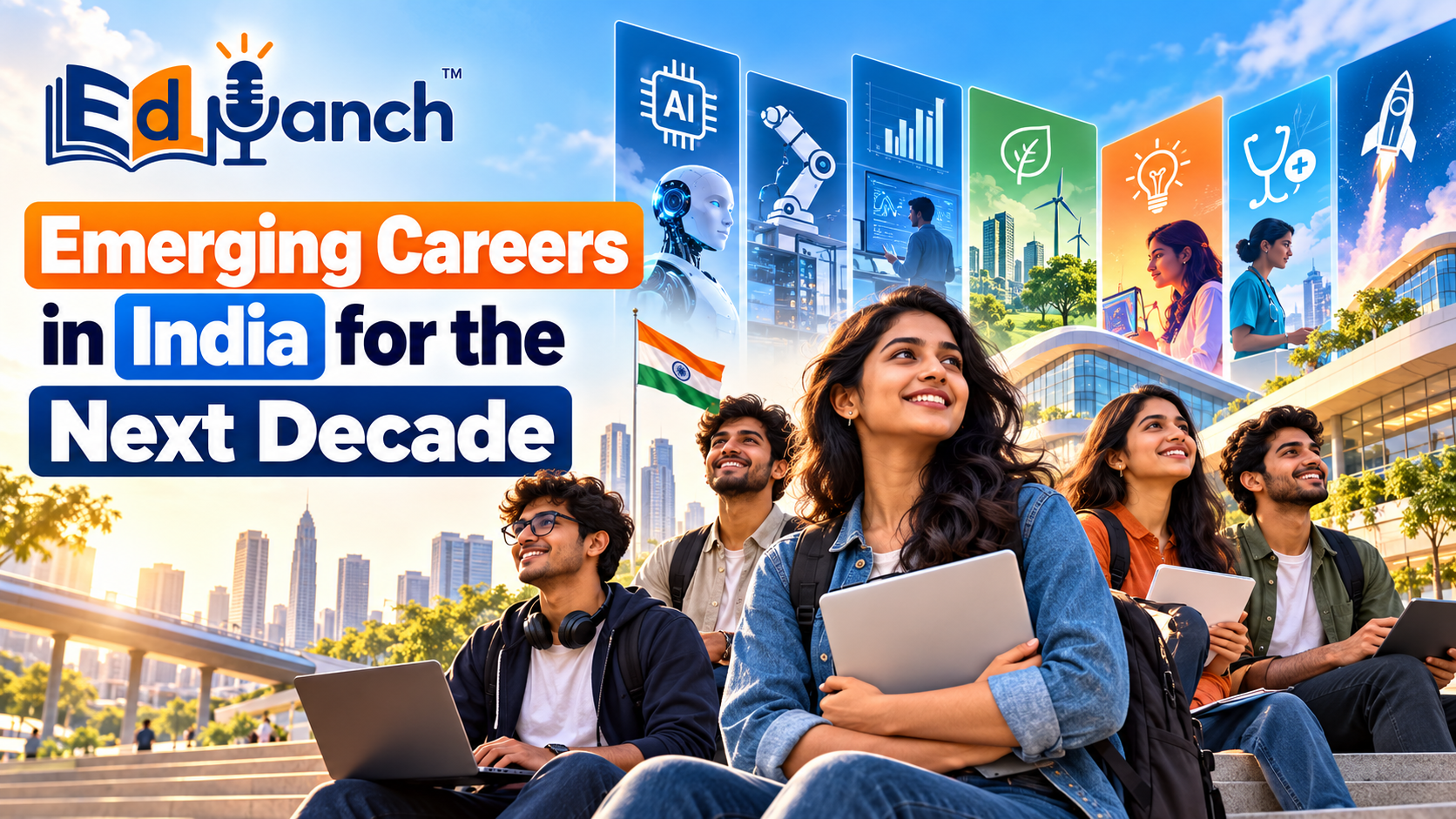
 India's next decade offers transformative career opportunities in technology, healthcare, green energy, fintech, and creative fields, shaped by policy reforms, digital growth, and a young workforce seeking future-ready pathways.





Introduction
India is standing at a remarkable inflection point in its economic and educational journey. With a median age of around 28 years, one of the world's largest youth populations, and a rapidly digitising economy, the country is uniquely positioned to lead in several high-growth industries over the next ten years. At the same time, the nature of work itself is changing at a pace that is difficult to ignore.
Automation is replacing repetitive tasks. Artificial intelligence is reshaping entire professional domains. New industries are emerging faster than traditional education systems can adapt. For students making course choices today, for parents guiding their children, and for working professionals planning a pivot, understanding which careers hold genuine promise in India's evolving economy is not a luxury but a necessity.
This article explores the most important and fastest-growing career paths that India will demand over the next decade, the skills that underpin them, and how students and professionals can prepare themselves for a future that rewards adaptability, knowledge, and initiative.
Understanding India's Changing Employment Landscape
Before exploring specific careers, it is useful to understand the forces that are reshaping India's job market.
India's economy is expected to become the third largest in the world by 2030 or 2031, according to projections from multiple international financial institutions. This growth is being driven by technology adoption, infrastructure investment, clean energy expansion, healthcare modernisation, and a booming services sector. At the same time, the World Economic Forum's Future of Jobs reports consistently highlight that millions of roles will be displaced by automation while millions of new ones will be created in their place.
In India specifically, government initiatives such as Digital India, Startup India, Make in India, and the National Education Policy 2020 are directly influencing which skills and professions will be valued. The NEP 2020, in particular, marks a significant shift by introducing multidisciplinary education, vocational integration from the school level, and a more flexible credit-based system at the university level. These reforms are designed precisely to align academic pathways with the career demands of tomorrow.
Understanding these macro forces helps students and professionals make informed decisions rather than following conventional wisdom about "safe" careers that may already be shrinking.
Technology and Artificial Intelligence Careers
Technology continues to be the most transformative force in global and Indian employment alike. Within this broad domain, several specific career paths are growing at exceptional rates.
Artificial intelligence and machine learning engineering is among the most cited high-demand roles globally, and India is no exception. Indian companies, particularly those in Bengaluru, Hyderabad, Pune, and the National Capital Region, are scaling their AI teams rapidly. Roles in AI research, prompt engineering, AI product management, and model training are all growing faster than the talent supply can currently meet.
Data science and analytics are another field where the gap between demand and skilled professionals remains wide. Businesses across banking, healthcare, retail, logistics, and government sectors are investing heavily in data infrastructure. Professionals who can collect, interpret, and communicate insights from data will continue to be highly valued.
Cybersecurity is a field that often does not receive the attention it deserves in career discussions. India reported a sharp increase in cyberattacks across industries and government systems in recent years. As digital infrastructure expands, the need for cybersecurity analysts, ethical hackers, cloud security specialists, and compliance professionals will only intensify. This is a field with strong job security and competitive compensation, even for professionals at mid-levels.
Cloud computing and DevOps are skill sets that are now embedded across virtually every technology company in India. Certifications from platforms such as AWS, Google Cloud, and Microsoft Azure continue to carry strong market value alongside formal engineering qualifications.
Healthcare and Life Sciences Careers
Healthcare has always been a stable career domain in India, but the next decade will see significant diversification within it. Beyond conventional roles in medicine, nursing, and pharmacy, several newer paths are gaining serious traction.
Health technology, often called healthtech, is a fast-growing intersection of clinical knowledge and digital capability. Roles such as health informatics specialists, telemedicine coordinators, digital health product managers, and medical data analysts are being created by startups and hospitals alike. Initiatives under the Ayushman Bharat Digital Mission, which is building India's national digital health infrastructure, are creating entirely new categories of healthcare employment.
Medical research and clinical trials management is another area where India holds a strategic advantage. As a country with a large and diverse patient population, India is increasingly attractive to global pharmaceutical companies for clinical research. Professionals trained in clinical research, regulatory affairs, pharmacovigilance, and biostatistics have strong prospects both within India and internationally.
Public health management is a career that gained visibility during the COVID-19 pandemic and continues to hold strategic importance. India needs trained public health professionals to lead disease surveillance, health communication, epidemic preparedness, and community health programmes at scale. Institutions such as AIIMS, the Public Health Foundation of India, and several state health universities now offer dedicated postgraduate programmes in this field.
Mental health professionals, including clinical psychologists, counselling psychologists, and psychiatric social workers, are in acute shortage across India. The National Mental Health Survey of India has repeatedly highlighted significant treatment gaps. As awareness grows and stigma slowly reduces, this shortage will translate into strong demand for trained and licensed professionals.
Green Economy and Sustainability Careers
India has made ambitious commitments to renewable energy and sustainability, including its target to achieve net-zero emissions by 2070 and to reach 500 gigawatts of renewable energy capacity by 2030. These commitments are not abstract policy positions but active drivers of employment creation.
Solar energy technicians and engineers, wind energy specialists, and energy storage professionals are already seeing strong demand in states such as Rajasthan, Gujarat, Tamil Nadu, and Karnataka. Environmental consultants who help companies and governments assess and manage their environmental impact are finding growing demand from regulatory compliance and corporate sustainability reporting requirements.
Sustainability managers are now being hired by major Indian corporations, particularly those seeking to report against Environmental, Social, and Governance frameworks for international investors and regulators. This is a career that rewards professionals who combine domain knowledge with strategic thinking and communication skills.
Urban planning and smart city infrastructure is another area where India will invest significantly over the coming decade. The Smart Cities Mission and various state-level urban development programmes are creating demand for planners, civil engineers with digital infrastructure expertise, GIS specialists, and urban data analysts.
Finance, Fintech, and Business Careers
India's financial sector is undergoing one of its most profound transformations. The success of the Unified Payments Interface, the expansion of digital lending, the growth of mutual fund penetration in tier 2 and tier 3 cities, and the rise of account aggregator frameworks are all creating new professional roles.
Fintech professionals who understand both financial regulations and technology systems are in high demand. This includes roles in digital lending risk management, payment systems architecture, regulatory technology, and financial data security.
Chartered Financial Analysts and professionals with expertise in investment research, asset management, and portfolio analysis continue to command strong salaries in India's growing capital markets ecosystem. The increasing participation of retail investors through platforms such as Zerodha, Groww, and Angel One has also created demand for financial educators and content specialists.
Environmental, Social, and Governance reporting specialists are a newer but rapidly growing category in the finance domain. As Indian companies seek international investment and partnerships, professionals who can build and communicate ESG metrics are becoming genuinely valuable.
Creative, Communication, and Education Careers
It would be a mistake to view emerging careers only through a technology lens. Several creative and communication-oriented fields are also experiencing strong growth in India.
Content creation and digital media is a field that has undergone enormous professionalisation over the past five years. Platforms such as YouTube, Instagram, LinkedIn, and podcasting have created sustainable careers for writers, video editors, animators, voice artists, and social media strategists. As brands increasingly invest in content marketing, the demand for skilled creators who understand both storytelling and platform algorithms is growing.
EdTech, meaning education technology, experienced rapid acceleration during and after the pandemic. While the sector has gone through consolidation, the underlying demand for quality online learning content, instructional design, e-learning development, and education product management remains strong. With NEP 2020 encouraging blended and digital learning models, professionals at the intersection of education and technology will continue to find opportunities.
Graphic design, UI and UX design, and motion graphics are fields where India's growing startup ecosystem and digital marketing industry are creating consistent demand. Designers who can work across digital platforms and understand user behaviour are valued across sectors.
Skills That Cut Across All Emerging Careers
Regardless of the specific career domain, certain foundational skills are consistently cited as critical by employers across India's growth sectors:
- Critical thinking and problem-solving, which remain irreplaceable even as AI tools become more capable
- Data literacy, meaning the ability to read, interpret, and communicate with data even in non-technical roles
- Communication skills, including written and verbal communication in English and regional languages
- Adaptability and continuous learning, given that roles and tools will continue to evolve
- Collaboration and cross-functional teamwork, especially in project-based and startup environments
- Digital tool proficiency, including familiarity with productivity software, cloud platforms, and relevant domain tools
How to Prepare for Emerging Careers in India
For students currently in school or college, the most important step is to move away from a narrow stream-based mindset and embrace a multidisciplinary approach to learning. NEP 2020 is designed to support this, but students can take proactive steps by pursuing online certifications, internships, and project-based learning in parallel with their formal degrees.
Platforms such as Coursera, edX, NPTEL, and Skill India Digital offer structured learning pathways in many high-demand fields. Industry certifications from Google, Microsoft, AWS, and sector-specific bodies add practical credibility.
For professionals considering a career change, upskilling and reskilling through short-term programmes, bootcamps, and executive education can create genuine pivots within 6 to 18 months. Many Indian universities and institutions have launched continuing education programmes in collaboration with industry partners specifically to address this need.
Staying updated through platforms such as Edumanch, which tracks education policy, career trends, and institutional developments across India, helps students and professionals make decisions based on current and reliable information rather than outdated assumptions.
Frequently Asked Questions
Q1: Which careers will be in highest demand in India in the next 10 years?
Careers in artificial intelligence, data science, cybersecurity, green energy, healthcare technology, and digital finance are expected to be in the highest demand in India over the next decade.
Q2: What skills are needed for future careers in India?
Critical thinking, digital literacy, data analysis, communication, adaptability, and domain-specific technical skills are among the most important competencies for emerging careers in India.
Q3: Is a traditional degree still valuable for future careers in India?
Traditional degrees remain valuable but are increasingly being supplemented by skill certifications, online courses, and vocational training to meet the practical demands of emerging industries.
Q4: How is the National Education Policy 2020 connected to future careers in India?
NEP 2020 introduces multidisciplinary education, vocational training from the school level, and flexibility in course selection, directly aligning academic preparation with the skill needs of future industries.
Q5: What government schemes support career development in emerging sectors in India?
Schemes such as Skill India, PM Vishwakarma, Digital India, Startup India, and the National Skill Development Corporation provide training, funding, and support for careers in emerging sectors.
Resources
- National Skill Development Corporation (NSDC): Government body overseeing skill development initiatives and sector skill councils across India
- NITI Aayog: India@2047 vision documents and reports on future economic sectors and employment projections
- World Economic Forum Future of Jobs Report: Global analysis of job displacement and creation trends relevant to Indian professionals
- Ministry of Education, Government of India: Official repository of NEP 2020 documents, implementation updates, and education policy guidelines
- Skill India Digital (skillindiadigital.gov.in): Central government portal offering free and subsidised courses across emerging career domains
Interlinking Keywords
Emerging careers in India, future jobs India 2030, career guidance for students India, NEP 2020 career impact, data science careers India, AI jobs in India, green jobs India, healthtech careers India, fintech careers India, Skill India Digital, best careers after 12th India, upskilling India, future-ready skills India
Last reviewed by:
Dr. Manthan Tripathi, Edumanch Editorial and Education Guidance Team on October 3, 2026.
Disclaimer
The information provided in this article is intended for general educational and career guidance purposes only. Career outcomes depend on individual qualifications, market conditions, institutional factors, and personal effort. Readers are advised to consult qualified career counsellors, academic institutions, and official government sources before making major academic or professional decisions. Edumanch does not guarantee employment or specific outcomes based on the information presented here.











.png)
.png)
.png)

.png)
.png)

.png)

.png)