 Monday, October 05, 2026
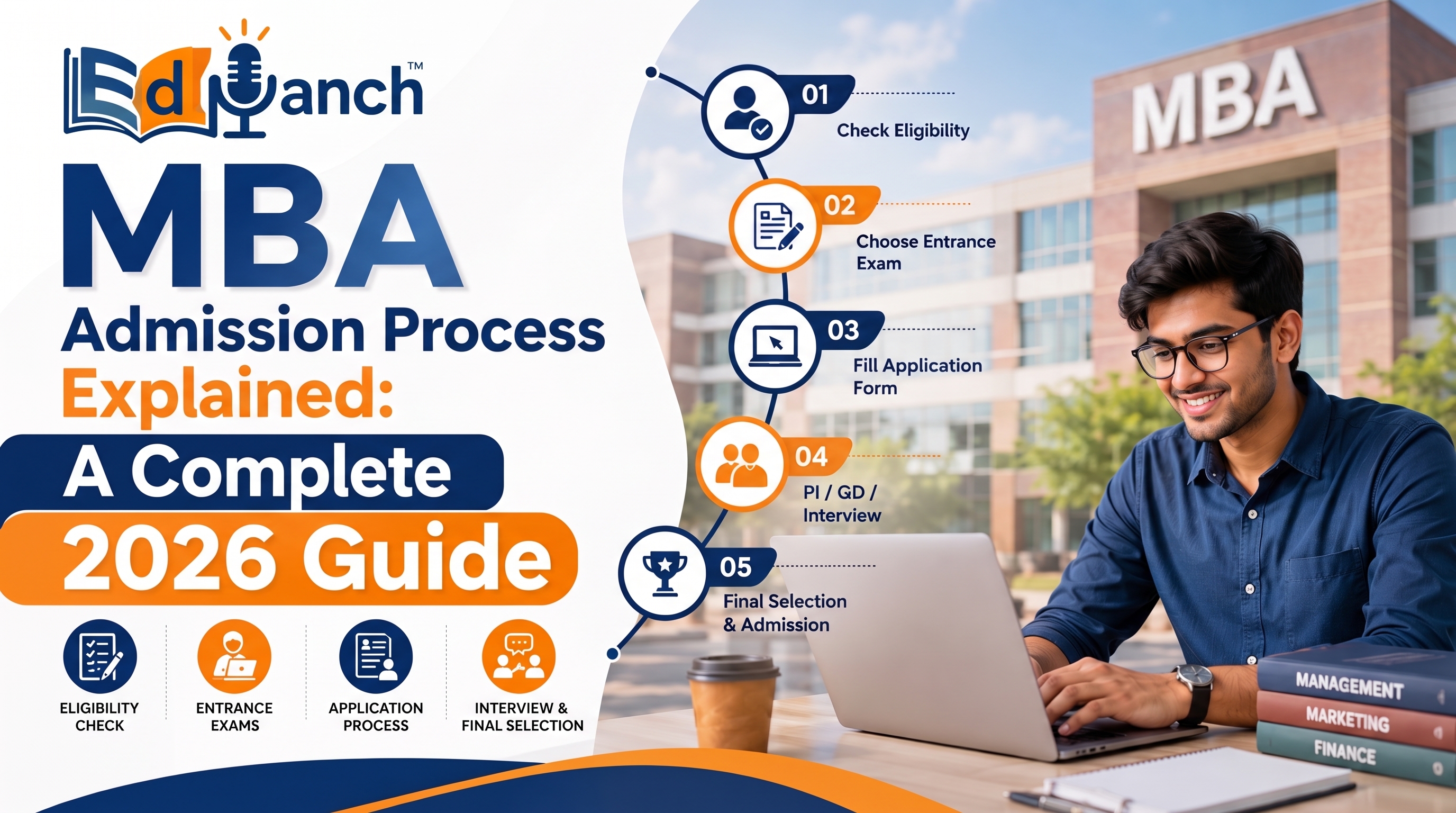
 This guide explains the complete MBA admission process in India, covering eligibility criteria, entrance exams, application documents, selection rounds and direct admission options to help candidates plan confidently.





An MBA remains one of the most sought-after postgraduate qualifications in India, and every year lakhs of graduates and working professionals apply to business schools hoping to strengthen their career prospects. Yet the admission process itself often causes more confusion than the coursework that follows it. Different institutes follow different combinations of entrance exams, eligibility rules, and selection stages, and candidates frequently find themselves unsure of where to begin. This guide breaks down the entire MBA admission process step by step, so that students and working professionals can plan their applications with clarity and confidence.
Understanding How MBA Admissions Work in India
The MBA admission process in India generally follows one of two broad routes. The first is entrance exam-based admission, where candidates appear for a national or state-level test and are shortlisted according to their score. The second is direct admission, offered mainly by private universities, where selection is based primarily on undergraduate academic performance rather than a competitive exam.
Most reputed institutes, including the Indian Institutes of Management and other top-ranked business schools, rely on the entrance exam route. Candidates first register for an exam such as CAT, XAT, CMAT, MAT, SNAP or NMAT, and their performance becomes the primary filter for shortlisting. After this, most institutes conduct a further round involving a written ability test, group discussion, or personal interview before finalising admission offers.
It is worth noting that India does not have a single centralised MBA admission system similar to what exists in undergraduate medical or engineering admissions. Each business school runs its own application and selection cycle, which means candidates typically need to apply separately to every institute they are interested in. Keeping track of multiple deadlines, application fees, and document requirements is, therefore, an important part of the process.
Eligibility Criteria Every Applicant Should Know
Before applying anywhere, candidates should confirm that they meet the basic eligibility requirements. Most business schools in India, including the IIMs, require a three-year bachelor's degree in any discipline from a university recognised by the University Grants Commission. A minimum aggregate score of fifty percent is generally expected, with a relaxation to forty-five percent for candidates from the SC, ST or PwD categories.
Final year undergraduate students are usually allowed to apply, provided they can furnish proof of having completed their degree by the time the admission process concludes. Institutes may also specify a minimum score requirement in the qualifying entrance exam, which varies significantly between colleges. A candidate aiming for a top-tier IIM might need a CAT percentile above ninety-five, while a mid-tier institute may accept scores considerably lower than that.
Work experience is another factor institutes consider, although its importance varies by programme type. Full-time MBA programmes in India do not always mandate prior work experience, but candidates with relevant professional exposure often receive additional consideration during the interview stage. Executive MBA programmes, on the other hand, typically require a minimum of five years of work experience, since these courses are designed for professionals looking to move into senior management roles.
Entrance Exams That Shape MBA Admissions
Selecting the right entrance exam is one of the most important early decisions in the MBA admission journey. Each exam has a different pattern, level of difficulty, and set of accepting institutes, so candidates should choose based on their target colleges rather than attempting every exam available.
CAT, or the Common Admission Test, remains the most prestigious and widely recognised MBA entrance exam in the country. It is accepted by all IIMs along with more than a thousand other business schools, including FMS Delhi, MDI Gurgaon, SPJIMR Mumbai and IIFT Delhi. The exam tests candidates on verbal ability and reading comprehension, data interpretation and logical reasoning, and quantitative aptitude, and is known for its high level of competition, with close to three lakh candidates appearing annually.
XAT, conducted by XLRI, includes a distinctive decision-making section along with general knowledge, and is accepted by several well-regarded institutes beyond XLRI itself. CMAT is a national-level exam that also evaluates innovation and entrepreneurship aptitude, and tends to be a good option for candidates targeting a broader set of AICTE-approved colleges. SNAP, used for admission to Symbiosis International University and its affiliated institutes, is shorter in duration and focuses on English, reasoning and quantitative aptitude. NMAT allows candidates multiple attempts within a testing window, which can help those who want a chance to improve their score. GMAT continues to be the preferred exam for candidates applying to international programmes as well as institutes such as the Indian School of Business that accept global standardised scores.
Candidates preparing for these exams should ideally begin at least six to eight months in advance, since the syllabus, though not vast, requires consistent practice to build speed and accuracy under time pressure.
Documents and Application Requirements
Once a candidate has decided on their target colleges and completed the relevant entrance exam, the next stage involves preparing a formal application. Most institutes ask for a similar set of documents, even though the exact process may differ slightly from one college to another.
Academic transcripts from the qualifying bachelor's degree are mandatory, along with the entrance exam scorecard reflecting the required cutoff. A well-written statement of purpose is often the deciding factor between two candidates with similar academic profiles, since it allows the applicant to explain their motivations, career goals and reasons for choosing a particular programme. Letters of recommendation, usually from a manager, professor or someone who has closely observed the candidate's work, add credibility to the application. A concise resume summarising academic background, professional experience and extracurricular involvement rounds out the core application package, along with standard identity proof such as an Aadhaar card or passport.
Some institutes, particularly those following international admission practices, may also request a short video introduction or additional essays addressing specific prompts. Reading each college's application guidelines carefully before submission helps avoid last-minute errors that could affect the outcome.
The Selection Process: GD, WAT and Personal Interview
After the entrance exam results are announced, shortlisted candidates typically move into the next stage of selection, which usually includes a written ability test, group discussion, or personal interview, depending on the institute's process. The Indian Institutes of Management, for instance, calculate a composite score for every shortlisted candidate that factors in the CAT percentile, performance in the written ability test and personal interview, along with academic scores from Class 10, Class 12 and graduation. Some IIMs also give weightage to work experience and academic diversity, meaning a candidate's undergraduate stream can influence their overall score.
Other well-known institutes such as MDI Gurgaon, FMS Delhi and SPJIMR Mumbai follow a broadly similar structure, though the specific weightage given to each component differs. Candidates preparing for the personal interview stage should be ready to discuss their academic background, career aspirations and reasons for pursuing an MBA in a clear and confident manner. Group discussions typically assess a candidate's ability to communicate ideas, listen actively and contribute meaningfully within a limited time frame, so practising with peers beforehand can be genuinely useful.
Direct Admission: An Alternative Pathway
Not every aspiring MBA candidate wants to go through the rigour of a national-level entrance exam, and this is where direct admission becomes relevant. A considerable number of private universities in India offer MBA seats based primarily on undergraduate academic performance rather than a competitive test score. The application process for direct admission is comparatively simpler and generally involves filling out the institute's application form, submitting transcripts and identity proof, and in some cases attending a short interview or written assessment.
While this route can be convenient, especially for candidates who may not have performed as well in entrance exams, it is important to verify that the institute holds proper accreditation from bodies such as the AICTE or UGC before enrolling. Checking placement records, faculty credentials and industry tie-ups can help candidates make a more informed decision, since not all direct admission programmes offer the same academic rigour or career outcomes as exam-based programmes.
Practical Tips to Strengthen an MBA Application
A strong MBA application goes beyond simply meeting the minimum eligibility criteria. Institutes are looking for candidates who demonstrate clarity of purpose, leadership potential and the ability to contribute meaningfully to a diverse cohort. Tailoring the statement of purpose for each college, rather than sending an identical version everywhere, tends to make a noticeable difference, since admission committees can usually tell when an essay has not been customised.
Choosing recommenders who can speak specifically to a candidate's skills and work ethic is generally more valuable than selecting someone purely for their seniority. Building a resume that highlights measurable achievements, rather than listing responsibilities alone, also helps an application stand out. Finally, proofreading every document carefully before submission and keeping track of application deadlines across multiple institutes prevents avoidable errors that could otherwise affect an otherwise strong candidacy.
For students and parents still evaluating which MBA specialisation or institute aligns best with their career goals, staying updated with verified information from platforms that track admission timelines, exam notifications and policy changes can make the decision-making process considerably less stressful.
Conclusion
The MBA admission process in India, while detailed, becomes far more manageable once a candidate understands its individual stages, from choosing the right entrance exam and meeting eligibility requirements to preparing a strong application and performing well in selection rounds. Early planning, honest self-assessment of strengths, and attention to detail at every step tend to matter far more than last-minute effort. With the CAT 2026 notification expected soon and several other exams opening registration in the coming months, candidates who start preparing now will be far better positioned to secure a seat at their preferred business school.
Frequently Asked Questions
Q1: When should I start preparing for the MBA admission process?
Candidates should ideally begin preparation at least eight to ten months before their target intake. This allows enough time to select the right entrance exam, complete coursework, gather documents, and prepare a strong application without last-minute pressure.
Q2: Which entrance exams are accepted for MBA admission in India?
The most widely accepted exams are CAT, XAT, CMAT, MAT, SNAP, and NMAT, along with GMAT for candidates targeting international-style programmes. Several state-level exams such as MAH MBA CET are also used for admission to state universities and affiliated colleges.
Q3: Is work experience compulsory for MBA admission?
Work experience is not compulsory for most full-time MBA programmes in India, though many institutes give additional weightage to candidates who have relevant work experience. Executive MBA programmes generally require a minimum of five years of professional experience.
Q4: What is the minimum eligibility for MBA admission in India?
Candidates need a three-year bachelor's degree in any discipline from a recognised university with a minimum of fifty percent marks, or forty-five percent for reserved categories. Final year students can also apply, subject to submitting proof of graduation later.
Q5: Can I get MBA admission without appearing for an entrance exam?
Yes, several private universities in India offer direct admission based on undergraduate academic performance rather than an entrance exam score. Candidates should verify that the institute is properly accredited before choosing this route.
Resources
- Indian Institutes of Management (IIM): Official information on CAT exam pattern, eligibility and participating institutes
- All India Council for Technical Education (AICTE): Accreditation status and approval records for MBA and PGDM programmes
- University Grants Commission (UGC): Guidelines on recognised universities and degree equivalence
- Graduate Management Admission Council (GMAC): Official GMAT information and global MBA admission guidance
- National Testing Agency (NTA): Notifications and schedules for national-level entrance examinations
Interlinking Keywords
MBA entrance exams in India, CAT exam eligibility, top MBA colleges in India, MBA specialisations, statement of purpose for MBA, Executive MBA admission, MBA scholarships in India, direct admission MBA colleges
Disclaimer:
This article is intended for general informational and educational purposes only. Admission dates, eligibility criteria, exam patterns and selection processes are subject to change at the discretion of individual institutes and examination authorities. Readers are strongly advised to verify all details from the official websites of the respective colleges, universities and exam conducting bodies before making any academic or financial decisions.
Last reviewed by:
Edumanch Editorial Team on July 23, 2026












.png)
.png)
.png)

.png)
.png)

.png)

.png)