 Monday, October 05, 2026
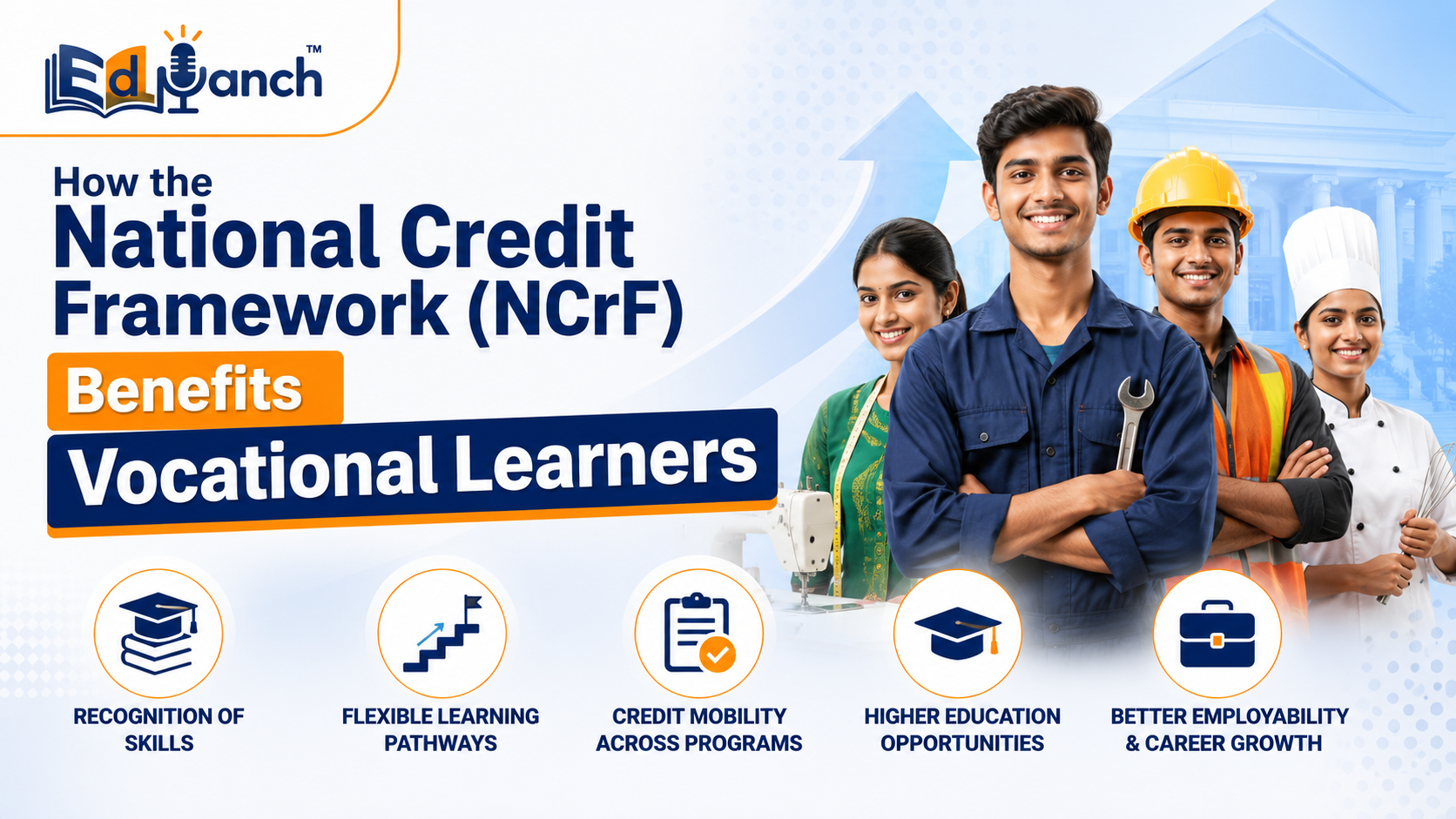
 India's education landscape is shifting from a degree-centric model to one that increasingly values practical skills and industry readiness. As vocational education, ITIs, and skill-based certifications gain recognition, learners are finding more diverse pathways to meaningful careers and long-term professional growth.




For decades, the Indian education system operated with a rigid, deep-seated hierarchy. Traditional academic degrees were placed on a pedestal, while vocational training, industrial diplomas (ITIs), and practical skill modules were often pushed to the sidelines, carrying a social stigma and offering limited career mobility.
The full implementation of the National Credit Framework (NCrF) under the National Education Policy (NEP) 2020 completely dismantles this outdated separation. Developed as an inclusive umbrella meta-framework, the NCrF seamlessly integrates school education, higher education, and vocational training into a unified system.
By defining a single, standardized "credit" currency, the NCrF bridges the historic gap between vocational and general education. It ensures that learning achieved through hands-on craftsmanship, technical apprenticeships, and specialized skilling is assigned the exact same institutional weight, economic value, and academic respect as conventional classroom learning.
1. The Core Architecture: Standardizing "Skill Currency"
The NCrF unifies the entire educational ecosystem by shifting the definition of learning success away from subjective marks or course titles to a single, mathematical metric: Academic Credits. This metric removes the distinction between sitting in a theoretical lecture and mastering an industrial trade on a workshop floor.
Credits are calculated uniformly across all learning streams: 1 Credit is awarded for every 30 hours of verified Notional Learning. This encompasses standard classroom lectures, laboratory practicals, specialized hands-on skilling workshops, industrial internships, and on-the-job training.
[ THE UNIFIED NCrF CREDIT ARCHITECTURE ]
│
┌─────────────────────────┼─────────────────────────┐
▼ ▼ ▼
[ ACADEMIC CLUSTERS ] [ VOCATIONAL / SKILLS ] [ EXPERIENTIAL MATRIX ]
• Schooling Foundations • ITI / Polytechnic Trade • Industrial Apprenticeships
• Higher Education Degrees• NSQF Level Assessments • On-The-Job Proficiency
│ │ │
└─────────────────────────┴─────────────────────────┘
▼
[ ACADEMIC BANK OF CREDITS (ABC) WALLET ]
Every single training hour accumulated by a vocational student is mathematically converted into formal credits. These credits are digitally routed and permanently stored inside the user's Academic Bank of Credits (ABC) wallet (linked to their secure APAAR ID or DigiLocker profile), establishing a lifelong, tamper-proof repository of their verified capabilities.
2. Breaking the Structural Barriers for Vocational Students
Parity of Esteem: Equating Skills with DegreesThe single most transformative operational benefit of the NCrF is the establishment of absolute equivalence between general academic education and vocational/skill education. The framework maps qualifications across structured levels, ranging from Level 1 (elementary school foundations) up to Level 8 (Doctoral degree equivalents).
An advanced technical diploma aligned with the National Skills Qualification Framework (NSQF) can carry an identical credit level descriptor as a traditional university degree. This parity ensures that corporate recruiters and government bodies evaluate an applicant based on certified competency values rather than formal stream titles.
Seamless Lateral Mobility via the Academic-Vocational BridgeHistorically, entering a vocational track was a one-way street with limited advancement. A student who exited formal schooling to learn a trade found it incredibly difficult to return to mainstream higher education later in life, as universities routinely rejected vocational certificates as valid entry prerequisites.
The NCrF resolves this bottleneck by creating a multidirectional Multiple Entry and Multiple Exit (ME-ME) highway. Because all credits speak the same digital language, a vocational learner can accumulate credit points through a technical trade course, present their ABC wallet to a mainstream university, and secure lateral entry directly into advanced semesters of a Bachelor of Science (B.Sc.), Bachelor of Commerce (B.Com.), or Bachelor of Vocational Education (B.Voc) degree.
3. Key Framework Benefits Transforming the Skilling Journey
Recognition of Prior Learning (RPL)Millions of highly skilled artisans, construction technicians, traditional craftsmen, and digital freelancers across India possess master-level capabilities acquired entirely through informal on-the-job experience or generations of family apprenticeships. Historically, because they lacked formal school degrees, they were locked out of organized corporate jobs and higher pay scales.
The NCrF utilizes a strict Recognition of Prior Learning (RPL) framework to fix this inequity. Informally skilled individuals can undergo an official competency assessment; once their mastery is verified, the system awards them formal, state-backed academic credits that map directly into their digital ABC wallet, instantly validating their career capital.
Enhanced Employability and Global EquivalencyCorporate recruiters often struggle to evaluate different vocational certificates issued by disparate local boards. The NCrF standardizes the field by ensuring all vocational courses align perfectly with the National Skills Qualification Framework (NSQF) levels and National Occupation Standards.
When a company reviews an applicant's digital ABC profile, they view a transparent, globally aligned credit sheet detailing exactly what competencies the learner has mastered. This standardization vastly accelerates corporate onboarding, simplifies human resource auditing, and matches international credit-transfer standards, opening up migration and job opportunities worldwide.
Comparative Matrix: Traditional Skill Paths vs. The NCrF Paradigm
The table below contrasts the rigid limitations of historical vocational setups with the high-performance mobility options built into the NCrF model.
|
Operational Educational Domain |
Traditional Vocational Limitations |
Modern NCrF Educational Reality |
Systemic Impact on Learners |
|---|---|---|---|
|
Learning Valuation |
Practical skill training carried zero academic credit currency. |
1 Credit assigned per 30 hours of verified vocational work. |
Grants vocational certificates equal weight with academic degrees. |
|
Mobility & Flexibility |
Rigid, dead-end tracks; vocational credits could not transfer to colleges. |
Seamless multi-entry and multi-exit lateral pathways. |
Allows workers to seamlessly return to universities later in life. |
|
Recognition of Past Skills |
Informal, on-the-job mastery was completely invisible to academia. |
Recognition of Prior Learning (RPL) awards formal credits for experience. |
Converts years of raw job experience into certified educational points. |
|
Industry Alignment |
Disconnected certificates that employers found difficult to verify. |
Credits mapped tightly to National Occupation Standards (NOS). |
Guarantees corporate recruiters clear, standardized skill metrics. |
Actionable Strategy: Maximizing Your NCrF Advantages
- Activate Your Academic Bank of Credits (ABC) Wallet Immediately: Do not leave your credit logging to chance. Visit the centralized DigiLocker platform, generate your unique APAAR ID, and ensure your vocational institute links every completed module, training hour, and internship directly to your digital portfolio.
- Leap Into Mainstream Degrees via Lateral Entry: If you hold a 3-year D.Voc (Diploma in Vocation) or a polytechnic trade certificate, look up the updated AICTE approval criteria. You are now legally eligible for direct lateral admission into the second year of mainstream B.Tech and engineering streams.
- Cross-Verify Course NSQF Alignment Prior to Enrolling: Protect your time and resource investments. Before signing up for any vocational, digital marketing, or technical skill course, explicitly verify that the training partner is officially recognized under the NCrF guidelines and that the course maps directly to standard credit awards.
Frequently Asked Questions (FAQs)
Q1. What exactly is the National Credit Framework (NCrF)?The NCrF is a comprehensive, unified credit-formulation infrastructure developed by the Government of India to blend school education, higher academic education, and vocational/skilling tracks into a single system. It establishes a standardized currency of learning points, allowing students to accumulate, store, and transfer credits across different educational streams seamlessly.
Q2. How does a vocational learner calculate their earned credits under NCrF?Credit calculations follow a strict temporal metric: 1 full credit is awarded for every 30 hours of verified learning activity. This calculation includes theoretical classroom lectures, practical laboratory assignments, hands-on industrial workshop training, field projects, and formalized corporate internship hours completed during a course.
Q3. What is the Academic Bank of Credits (ABC), and how do I access it?The ABC is a secure, national digital repository linked directly to a student's Aadhaar and DigiLocker profile. It functions precisely like a financial savings bank, but stores academic credit points instead of cash. Students can access their personal ABC dashboard online via the official portal to review their accumulated balance and authorize credit transfers to colleges.
Q4. Can an ITI diploma holder secure direct admission into a university degree program?Yes, absolutely. The NCrF explicitly enables lateral entry pathways for vocational students. An ITI graduate or polytechnic diploma holder can present their accumulated credit portfolio to an empanelled university to secure direct admission into advanced semesters of matching programs, like a Bachelor of Vocational Education (B.Voc) or a Bachelor of Technology (B.Tech).
Q5. What does "Recognition of Prior Learning" (RPL) mean for uncertified workers?RPL is a life-changing feature of the NCrF designed for uncertified professionals (such as experienced carpenters, weavers, or self-taught coders). It allows them to bypass traditional multi-year schooling. By passing a formalized competency assessment conducted by an authorized skilling board, workers can instantly convert their real-world experience into official academic credits.
Q6. Does the NCrF apply to short-term digital certifications and online skill courses?Yes, provided the online platform or technical training partner is officially empanelled and aligned with the National Skills Qualification Framework (NSQF) parameters. Short-term courses covering areas like data analytics, cloud computing, or digital design assign fixed credit values based on their total hour matrices, which route straight into your ABC file.
Q7. How does the framework prevent vocational tracks from being viewed as inferior?The NCrF removes the social and institutional stigma surrounding skill training by establishing absolute parity of credit value. When the system measures learning purely by time and verified competency levels rather than course titles, an hour of advanced robotic welding carries identical academic weight to an hour of classical economic theory, standardizing qualifications.
Q8. Can a university student drop out for a year to complete a vocational apprenticeship?Yes, this is a major flexibility feature of the multi-entry, multi-exit blueprint. A university student can finish their first year of a degree, secure an official Undergraduate Certificate exit, spend a year completing an intensive, credit-earning industrial apprenticeship, and return to college a year later to resume their degree exactly where they left off.
Q9. Are NCrF credits recognized by international universities and multinational corporations?Yes. Because the NCrF structures its credit-allocation metrics around a clean, transparent hourly matrix that mirrors international standards (such as the European Credit Transfer and Accumulation System - ECTS), it gives Indian vocational learners clear global equivalency, making it significantly easier to clear international immigration, academic matching, and global job audits.
Q10. What should a student do if their institute fails to credit their training hours?Every student should cross-verify their institute's empanelment status prior to registration. If a registered training partner delays uploading your verified credits, file a formal query through your dashboard using your unique ABC ID. If the issue persists, escalate the matter directly to the National Council for Vocational Education and Training (NCVET) portal to secure your data.











.png)
.png)
.png)

.png)
.png)

.png)

.png)