 Monday, October 05, 2026
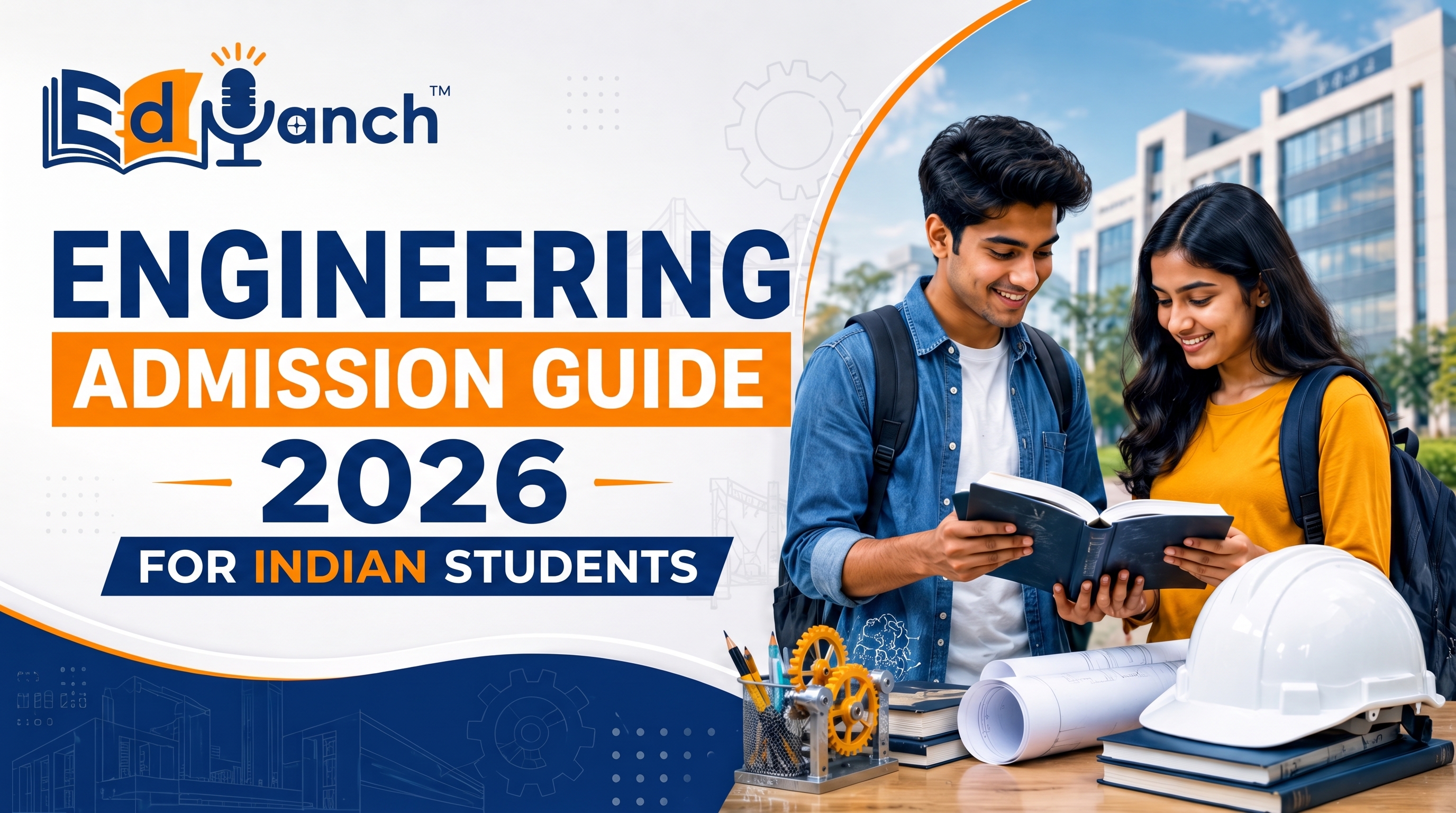
 A comprehensive 2026 engineering admission guide for Indian students covering entrance exams, counselling steps, stream selection, college evaluation, scholarships, and financial support.





Introduction
Every year, millions of students across India complete their Class 12 board exams with one central question in mind: what comes next? For a significant number of them, engineering remains the answer. The Bachelor of Technology degree, commonly known as B.Tech, continues to be one of the most sought-after undergraduate programs in the country. Yet, despite its popularity, the admission process remains one of the most misunderstood and anxiety-inducing experiences for students and their families.
The 2026 engineering admission cycle has introduced further complexity. Counselling timelines have shifted, new specializations have emerged, and the number of institutions offering engineering programs has grown considerably. Students now have more choices than ever before, but more choices also mean more confusion. Understanding how the system works, from entrance exams to seat allotment to fee payment, is no longer optional. It is essential.
This guide is written specifically for Indian students preparing for B.Tech admission in 2026 and for the parents who are supporting them through the process. It covers every major stage of the admission journey, clearly and practically, so that families can make informed decisions with confidence rather than guesswork.
Understanding the B.Tech Admission Landscape in India
Engineering education in India operates through a layered admission structure. At the national level, the Joint Entrance Examination, known as JEE, serves as the primary gateway. At the state level, individual counselling boards manage admissions to colleges affiliated with state universities or autonomous technical education bodies. Private deemed universities often conduct their own admission processes.
The National Testing Agency conducts JEE Main twice a year, typically in January and April. Students who clear JEE Main with a strong score become eligible for JoSAA counselling, which manages seat allocation for IITs, NITs, IIITs, and Government Funded Technical Institutes. Those targeting the Indian Institutes of Technology specifically must also clear JEE Advanced, which is conducted by one of the IITs on a rotational basis.
State-level exams such as TNEA in Tamil Nadu, MH CET in Maharashtra, WBJEE in West Bengal, and KEAM in Kerala cater to students who wish to study within their home states. These exams are designed to reduce competition from out-of-state candidates and give local students a fair opportunity at quality institutions.
It is worth noting that many private engineering colleges across India accept direct applications based on Class 12 marks or management quota seats, without requiring an entrance exam score. However, admission through a recognized entrance examination is always preferred, as it strengthens academic credibility and may open doors to better financial aid.
Eligibility Criteria: What Students Must Know Before Applying
Before a student begins preparing for any engineering entrance exam, meeting the basic eligibility criteria is non-negotiable. The standard requirements for B.Tech admission in India in 2026 are as follows:
- The student must have passed Class 12 or an equivalent examination from a recognized board such as CBSE, ICSE, or a state board.
- Physics, Chemistry, and Mathematics must have been core subjects in Class 12.
- Most central institutions require a minimum aggregate of 75 percent in PCM subjects. For SC and ST category students, the minimum is typically 65 percent.
- Private colleges may set their own minimum percentage, which often ranges from 45 to 60 percent depending on the institution and state.
- Students appearing in the Class 12 board examination in 2026 are also eligible to apply provisionally.
Students who have passed Class 12 with subjects other than Mathematics, or who studied vocational streams without the required PCM combination, are generally not eligible for B.Tech programs. It is important to verify eligibility requirements institution by institution, since deemed and private universities sometimes offer lateral entry pathways for diploma holders.
Major Entrance Exams for Engineering Admission in 2026
The entrance exam landscape for engineering in India is diverse. No single exam serves all students equally, which is why understanding the differences between them is critical.
JEE Main 2026 remains the most important national-level engineering entrance examination. Conducted by the National Testing Agency, it tests students in Physics, Chemistry, and Mathematics through multiple-choice and numerical-based questions. A strong JEE Main score allows students to compete for seats in NITs, IIITs, and other centrally funded colleges through JoSAA counselling.
JEE Advanced 2026 is the gateway to the Indian Institutes of Technology. Only the top 2.5 lakh rank holders in JEE Main are eligible to appear for JEE Advanced. The exam is significantly more demanding and tests conceptual depth rather than rote preparation.
State-Level Examinations such as TNEA, MH CET, KEAM, WBJEE, AP EAMCET, and TS EAMCET serve students applying to state government and private colleges within their respective states. These exams typically follow Class 12 syllabi and place importance on consistent board performance as well.
BITSAT is conducted by BITS Pilani and provides admission to its three campuses in Pilani, Goa, and Hyderabad. VITEEE and SRMJEEE are conducted by VIT University and SRM University, respectively and are among the most popular private university entrance exams in India.
Students are encouraged to identify which exams align with their target colleges and to plan their preparation accordingly. Attempting multiple exams strategically increases the chances of securing a good seat.
How to Choose the Right Engineering Stream
Selecting an engineering stream is one of the most consequential academic decisions a student will make. Yet many students choose streams based on peer pressure, parental expectations, or perceived job market trends rather than genuine interest or aptitude. This mismatch often leads to disengagement and poor academic outcomes.
The most popular engineering streams in 2026 include Computer Science and Engineering, Artificial Intelligence and Data Science, Electronics and Communication Engineering, Mechanical Engineering, Civil Engineering, and Electrical Engineering. Newer interdisciplinary streams such as Biotechnology Engineering, Environmental Engineering, and Energy Systems Engineering are also gaining traction, particularly at IITs and newer technical universities.
When evaluating streams, students should ask themselves three fundamental questions. First, does this subject genuinely interest them? A student who finds programming engaging will thrive in CSE, while one drawn to physical systems may be better suited to mechanical or civil engineering. Second, what are the realistic career outcomes associated with this stream? Some streams offer wider employment options while others open doors to specialized or research-based careers. Third, does the college they are targeting offer adequate infrastructure, faculty expertise, and placement support for their chosen stream?
Parents should support this process by facilitating exploration rather than directing choices. A student who genuinely owns their stream selection is far more likely to succeed than one who chose a branch under pressure.
The Counselling Process: A Step-by-Step Walkthrough
The engineering counselling process is the bridge between a student's entrance exam performance and their final college seat. Understanding how it works prevents costly errors.
Registration: After results are declared, eligible students must register on the official counselling portal. For JoSAA, this means visiting the JoSAA website during the designated window and creating a login using JEE Main or JEE Advanced roll number and other credentials.
Choice Filling: This is perhaps the most critical step. Students must rank their preferred college and branch combinations in order of priority. The system allocates seats based on rank and availability. Students should research cut-off trends from previous years to build a realistic and strategic preference list.
Seat Allotment: After each counselling round, seat allotment results are published. Students can choose to accept the allotted seat, upgrade to a higher preference in the next round (if available), or withdraw from the process entirely.
Document Verification: Once a seat is accepted, students must report to the allotted institution or designated reporting center with original documents. These typically include Class 10 and 12 mark sheets, community or caste certificate (if applicable), date of birth proof, passport-size photographs, and JEE admit card and scorecard.
Fee Payment: A portion of the first-semester fee is paid online to confirm seat acceptance. The remaining fees are collected at the time of physical reporting.
State counselling boards follow a similar process, with variations in timelines and portal interfaces. Students applying to multiple counselling processes simultaneously must be careful to track deadlines for each separately.
Evaluating Engineering Colleges: What Actually Matters
The temptation to chase rankings is understandable, but rankings alone are an incomplete tool for evaluating engineering colleges. A college that ranks well nationally may not perform equally well across all disciplines. Conversely, a mid-ranked institution may offer exceptional outcomes in a specific stream.
Factors that genuinely matter when evaluating an engineering college include the quality and accessibility of faculty, the state of laboratory and research infrastructure, industry linkages and internship opportunities, placement records broken down by department, the quality of student life and mentoring support, and accreditation status from bodies such as NAAC and NBA.
For families in Tier 2 and Tier 3 cities considering colleges in larger metros, location and associated living costs are also practical considerations. The financial burden of four years at a private engineering college in a metro city can differ significantly from studying at a state college closer to home. This does not mean students should settle for less, but the decision should involve a clear-eyed comparison of cost versus opportunity.
Scholarships and Financial Support for Engineering Students
The cost of engineering education in India varies widely. Government colleges affiliated with state universities charge annual fees in the range of ten thousand to sixty thousand rupees. Private colleges may charge anywhere from eighty thousand to five lakh rupees per year. For many families, this is a significant financial commitment.
Fortunately, several financial support mechanisms are available. The National Scholarship Portal, maintained by the Ministry of Education, consolidates central and state government scholarships in a single interface. Students from economically weaker sections and reserved categories have access to fee waivers and post-matric scholarships. AICTE offers the Pragati Scholarship for girl students and the Saksham Scholarship for students with disabilities enrolled in AICTE-approved technical programs.
Education loans from scheduled banks are available under the Central Sector Interest Subsidy scheme, which provides full interest subsidy during the moratorium period for students from families with an annual income below a specified threshold. Students should explore these avenues early rather than waiting until after admission.
Conclusion
Engineering admission in India is a multi-stage process that demands preparation, awareness, and careful decision-making. Students who understand the system, plan their exam strategy in advance, choose streams that align with their strengths, and evaluate colleges beyond surface-level metrics are the ones who emerge from this process with the best outcomes.
For parents, the most valuable contribution is informed support. Understanding the timelines, participating in college evaluation, and encouraging children to own their choices makes the journey smoother for the entire family.
Platforms such as Edumanch exist precisely to bridge the information gap that many students and parents face during this critical period. By offering clear, reliable, and updated education guidance, Edumanch helps students move from confusion to clarity and from anxiety to action.
The engineering admission process in 2026 is demanding, but it is navigable. Start early, stay informed, and make decisions grounded in both ambition and reality.
Frequently Asked Questions
Q1: What is the basic eligibility for B.Tech admission in India in 2026?
Students must have completed Class 12 with Physics, Chemistry, and Mathematics as core subjects and secured a minimum of 45 to 75 percent marks depending on the institution and category. A valid entrance exam score such as JEE Main is required for most central and state colleges.
Q2: Which entrance exam is best for engineering admission in India?
JEE Main is the most widely accepted exam for engineering admission in India. It gives access to NITs, IIITs, and Government Funded Technical Institutes. JEE Advanced is required for IIT admissions. State-level exams such as TNEA, MH CET, WBJEE, and KEAM serve students applying within their respective states.
Q3: What is JoSAA counselling and who is eligible?
JoSAA stands for Joint Seat Allocation Authority. It manages centralized counselling for admission to IITs, NITs, IIITs, and other Government Funded Technical Institutes. Any student with a valid JEE Main or JEE Advanced rank is eligible to participate in JoSAA counselling rounds.
Q4: How should a student choose the right engineering stream?
Students should consider their academic strengths, genuine interests, industry demand, and long-term career goals. Popular streams in 2026 include Computer Science and Engineering, Artificial Intelligence, Electronics and Communication, Mechanical Engineering, and Civil Engineering. Researching placement records and industry relevance of each stream is highly recommended.
Q5: Are there scholarships available for engineering students in India?
Yes, several scholarships are available. The National Scholarship Portal lists central and state government scholarships. AICTE offers the Pragati and Saksham scholarships for female and differently-abled students. Banks also offer education loans with interest subsidies under the Central Sector Interest Subsidy scheme for students from economically weaker sections.
Resources
- National Testing Agency (NTA): Official body conducting JEE Main and publishing results, eligibility norms, and counselling schedules.
- Joint Seat Allocation Authority (JoSAA): Manages centralized seat allocation for IITs, NITs, IIITs, and Government Funded Technical Institutes.
- All India Council for Technical Education (AICTE): Regulatory body for technical education in India; publishes approved college lists, scholarship details, and policy updates.
- National Scholarship Portal (NSP): Government of India portal consolidating all central and state scholarship schemes for students.
- University Grants Commission (UGC): Provides guidelines on recognized universities and quality benchmarks for higher education in India.
Interlinking Keywords
JEE Main 2026, engineering counselling India, B.Tech eligibility criteria, JoSAA counselling process, engineering stream selection, engineering scholarships India, AICTE approved colleges, state engineering entrance exams, engineering admission 2026
Disclaimer
The information provided in this article is intended for general educational and guidance purposes only. Admission eligibility criteria, exam schedules, counselling timelines, scholarship details, and fee structures are subject to change by respective regulatory authorities and institutions. Students and parents are strongly advised to verify all details directly from official sources such as NTA, JoSAA, AICTE, and the respective college or state counselling board before making any admission-related decisions. Edumanch does not represent any specific institution and does not take responsibility for decisions made solely on the basis of the information presented here.
Last reviewed by:
Edumanch Editorial Team on July 27, 2026











.png)
.png)
.png)
.png)
.png)

.png)

.png)