 Monday, October 05, 2026
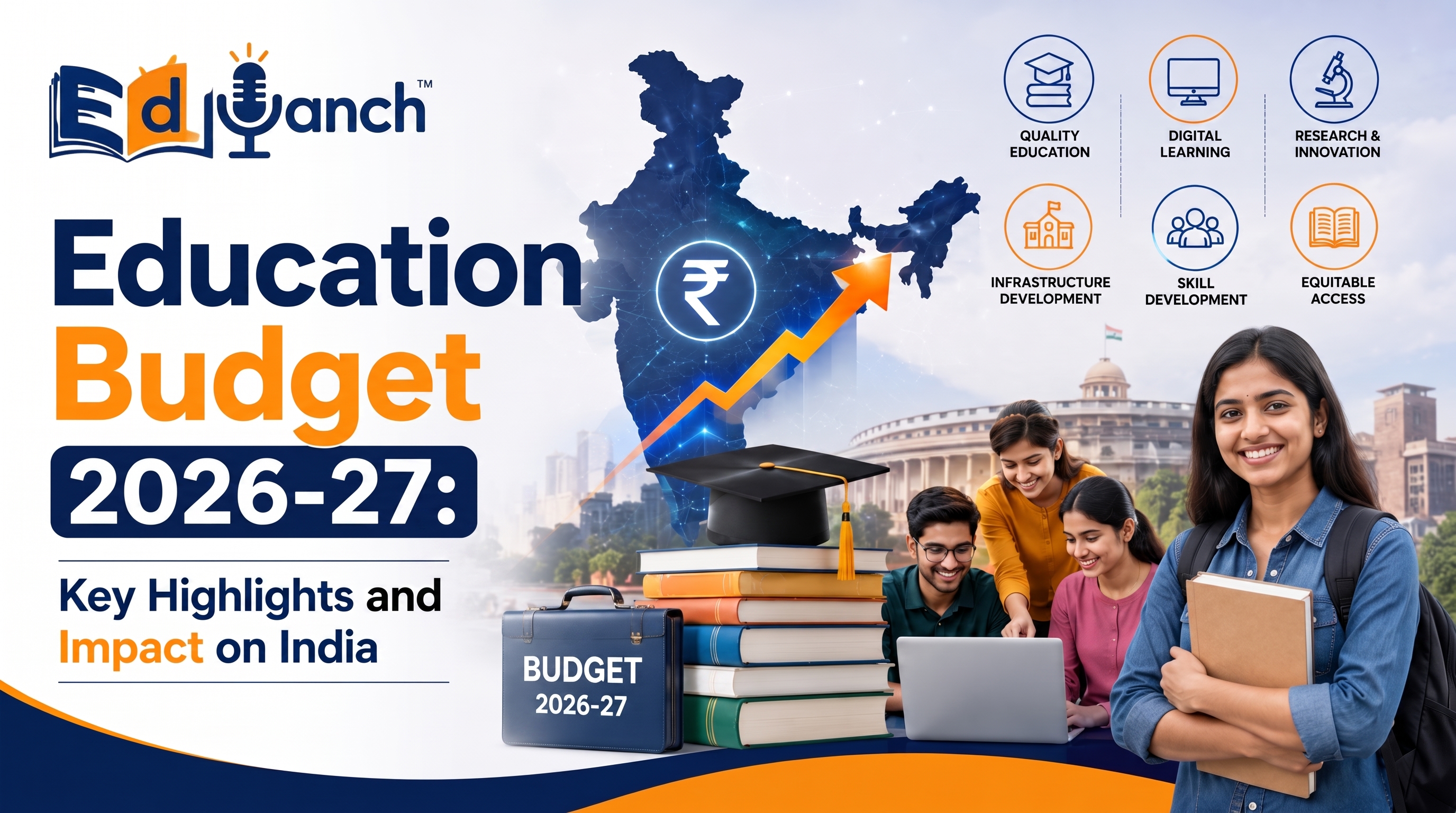
 India's Education Budget 2026-27 allocates a record Rs 1.39 lakh crore, introducing university townships, girls' hostels, and creative technology labs while significant challenges around spending efficiency and learning outcomes persist.





Introduction
Every year, the Union Budget offers a clear window into the government's priorities for the country. When it comes to education, the numbers in this year's budget speak with unusual clarity. On February 1, 2026, Finance Minister Nirmala Sitharaman presented the Union Budget 2026-27, allocating Rs 1,39,289.48 crore to the Ministry of Education, the highest-ever education allocation in India's budgetary history. This figure represents a 14 percent increase over the revised estimates of 2025-26.
For students preparing for college admissions, parents navigating school choices, educators seeking better infrastructure, and institutions awaiting policy clarity, this budget carries direct and practical significance. It is not simply a set of financial numbers. It is a statement of where the country believes education must go in the coming years.
At the same time, the budget arrives against a backdrop of persistent challenges. India's combined public spending on education, at around 4.1 percent of GDP as of 2022-23, continues to fall short of the 6 percent target recommended by the National Education Policy 2020. Secondary school dropout rates remain concerning in several states. Faculty vacancies in central universities are alarmingly high. And the gap between what students learn in classrooms and what the job market requires has not yet closed meaningfully.
Understanding the Education Budget 2026-27 means looking closely at both the promises it holds and the gaps it still needs to bridge.
Understanding the Education Budget 2026-27: The Allocation Breakdown
The Ministry of Education's total allocation of Rs 1,39,289.48 crore is divided between two departments. The Department of School Education and Literacy receives Rs 83,562 crore, which accounts for 60 percent of the total budget. This is the highest-ever allocation for school education in India. The Department of Higher Education receives Rs 55,727 crore, constituting the remaining 40 percent and representing an 11.28 percent increase over the previous year's budget estimates.
These numbers reflect a clear emphasis on expanding access, improving infrastructure, and aligning the education system with the vision of Viksit Bharat 2047.
School Education: Flagship Schemes and Their Updated AllocationsThe largest share within school education continues to go to Samagra Shiksha, the centrally sponsored scheme that acts as the spine of school reform across India. For 2026-27, the scheme receives Rs 42,100 crore, an 11 percent increase over the revised estimates of 2025-26. Samagra Shiksha supports states in implementing the National Education Policy 2020, strengthening teacher training, reducing dropouts, and ensuring equity and inclusion at all levels.
PM POSHAN, the mid-day meal program that provides a nutritious meal daily to nearly 11.2 crore children in government and government-aided schools, has been allocated Rs 12,750 crore. This is a 20 percent jump from the previous revised estimates, a meaningful increase given persistent concerns about adolescent malnutrition in school-going children.
PM SHRI, the scheme to upgrade approximately 14,500 government schools as model NEP-aligned institutions, receives Rs 7,500 crore, a striking 67 percent increase over last year's revised estimates. As of January 2026, over 13,000 PM SHRI schools had already been upgraded, and this fresh infusion of funds is expected to accelerate progress toward the scheme's completion by 2027-28.
A significant new addition in 2026-27 is the Atal Tinkering Labs initiative, which receives Rs 3,200 crore under the school education department. This scheme promotes problem-solving, innovation, and science-technology-engineering-mathematics thinking among secondary school students, placing creativity and analytical skills at the heart of school learning.
Higher Education: Institutions, Research, and Student SupportOn the higher education side, central universities receive Rs 17,440 crore, while IITs are allocated Rs 12,123 crore. NITs receive Rs 6,260 crore, a 10 percent increase. UGC receives Rs 3,709 crore, reflecting an 11 percent rise. IIMs see a 15.92 percent increase, bringing their allocation to Rs 292 crore.
For research and innovation, Rs 418 crore has been allocated, representing a 207 percent increase over the revised estimates of 2025-26. However, this must be seen in context. The scheme has faced consistent underutilisation, with only around 47 percent of allocated funds used on average between 2017-18 and 2024-25. Converting this allocation into actual research output will require stronger implementation and state-level engagement.
The PM USHA scheme, which supports infrastructure and quality improvements in state higher education institutions, receives Rs 1,850 crore. For student financial aid, Rs 2,160 crore has been allocated, a 24 percent increase that includes support under PM-USP for scholarships and interest subsidies, and Rs 600 crore for doctoral fellowships.
Key Announcements That Students and Parents Must Know
Beyond the allocation numbers, the Union Budget 2026-27 carries several structural announcements that will shape how education is accessed and delivered across India.
Five University Townships in Industrial and Logistics CorridorsThe budget proposes the establishment of five university townships in the vicinity of India's major industrial and logistics corridors. Each township will host multiple universities, colleges, research institutions, skill centres, and residential complexes. For students in regions where higher education access has historically been limited, this is a transformative step. It brings quality education infrastructure closer to emerging economic hubs, potentially reducing migration pressures and making advanced learning locally accessible.
One Girls' Hostel in Every DistrictOne of the most socially significant announcements is the plan to establish a girls' hostel in every district across the country through Viability Gap Funding and capital support. Girls from rural and semi-urban areas consistently face accommodation as a primary barrier to pursuing higher education beyond their home districts. This initiative directly addresses that barrier. India has already achieved one of the highest rates of female participation in STEM education globally, and this hostel network is expected to sustain and deepen that progress.
AVGC Content Creator Labs in Schools and CollegesThe budget proposes support to the Indian Institute of Creative Technologies in Mumbai to establish Animation, Visual Effects, Gaming, and Comics content creator labs in 15,000 secondary schools and 500 colleges. This initiative aims to build a pipeline of skilled professionals for India's fast-growing AVGC sector, with a target of creating a platform for two million professionals by 2030. For students who aspire to careers in digital media, gaming, and creative technology, this marks a formal entry of those career paths into mainstream school education.
Education to Employment and Enterprise Standing CommitteeA high-powered standing committee has been proposed to examine how education can be better aligned with employment and entrepreneurship, particularly in the services sector. The committee will study the impact of artificial intelligence and other emerging technologies on skill requirements, propose integration of AI into school curricula, and recommend upgrades for State Councils of Educational Research and Training for teacher development.
Recognising the Gaps: Challenges That the Budget Must Address
The Education Budget 2026-27 carries genuine ambition. But a responsible reading requires acknowledging the unfinished work.
India's public education spending at 4.1 percent of GDP remains below the NEP 2020 target of 6 percent and also falls behind countries like Germany at 5.2 percent, the United States at 5.4 percent, and South Africa at 6 percent. The Standing Committee on Education has recommended annual increases of 8 to 10 percent in education allocations to keep pace with inflation. The current 14 percent increase over revised estimates is encouraging, but the long-term trajectory needs sustained commitment.
The Gross Enrolment Ratio at the secondary level stands at 79 percent and at the higher secondary level at just 58 percent as of 2024-25. Nearly 13 percent of students drop out at the secondary level nationally, with states like West Bengal at 20 percent and Karnataka at 18.3 percent recording even higher rates. Economic compulsions push many adolescents into employment rather than classrooms. The budget's vocational education push is a step in the right direction, but scale and monitoring remain critical.
Teacher vacancies continue to pose a structural challenge. Nearly 10 lakh teaching posts were vacant in schools as of 2024-25. In central universities, 29 percent of faculty positions were lying vacant as of December 2024. IITs had a 39 percent vacancy rate, and IIITs faced a troubling 54 percent gap. These vacancies directly affect the Pupil Teacher Ratio and, consequently, the quality of instruction.
Research and development spending by Indian universities remains low. Universities account for only 9 percent of India's total research expenditure, compared to 51 percent in Mexico, 39 percent in Canada, and 36 percent in Australia. The PM USHA scheme, despite receiving a substantial allocation, has historically seen very low fund utilisation, averaging around 16 percent between 2022-23 and 2024-25. Without strong monitoring and state partnership, this year's sharp increase in research funding may face similar absorption challenges.
The NEP 2020 and Budget 2026-27: Reading Them Together
The National Education Policy 2020 serves as the guiding document for India's education transformation. The Budget 2026-27 carries several NEP-aligned signals.
The push for university townships reflects NEP's vision of multidisciplinary research universities. The vocational education emphasis in both school and higher education aligns with NEP's goal that at least 50 percent of students experience vocational training by 2035. The AVGC labs and digital content creation initiatives reflect NEP's focus on technology integration and creativity. The girls' hostel network addresses NEP's emphasis on equity and inclusion.
However, NEP's foundational learning goals deserve closer attention. The PARAKH 2024 assessment shows that average scores in language and mathematics decline as children move from grade 3 to grade 9. Foundational literacy and numeracy under NIPUN Bharat remain work in progress, with 70 percent of approved funds spent between 2021-22 and 2023-24. The budget would benefit from a more explicit emphasis on early childhood education infrastructure and primary-level learning outcomes rather than focusing predominantly on higher education visibility.
What This Means for Students, Parents, and Institutions
For students in secondary school, the AVGC labs and Atal Tinkering Labs represent access to skill environments that were previously available only in private schools or urban settings. The PM SHRI school upgrades will improve learning infrastructure across thousands of government schools.
For students in higher education, the 24 percent increase in financial aid, the expanded PM Vidyalaxmi scheme, and doctoral fellowship funding offer meaningful support. As of February 2026, approximately 2.5 lakh students had already benefitted from PM Vidyalaxmi, with loan disbursals of around Rs 7,000 crore.
For parents, especially those in Tier 2 and Tier 3 cities and rural areas, the university township initiative and the girls' hostel network offer a genuine expansion of quality options without the burden of long-distance relocation. Understanding these options is exactly the kind of guidance that platforms like Edumanch provide, helping families navigate a rapidly evolving education landscape with accurate information and practical direction.
For institutions, the increased allocations to central universities, IITs, NITs, and IIMs signal continued government commitment. However, institutions that rely on PM USHA or state-level implementation mechanisms will need to build stronger project pipelines to ensure that allocated funds are actually drawn and utilised.
Frequently Asked Questions
Q1: What is the total education budget allocation for 2026-27 in India?
The total allocation for the Ministry of Education in the Union Budget 2026-27 is Rs 1,39,289.48 crore, which is 14 percent higher than the revised estimates of 2025-26. Of this, Rs 83,562 crore goes to school education and Rs 55,727 crore to higher education.
Q2: What are the key education announcements in Union Budget 2026-27?
Key announcements include five university townships in industrial corridors, one girls' hostel in every district, AVGC content creator labs in 15,000 secondary schools and 500 colleges, a new Education to Employment and Enterprise Standing Committee, and new NIPERs and a National Institute of Design.
Q3: How does the Education Budget 2026-27 support girls' education in India?
The budget proposes establishing one girls' hostel in every district through Viability Gap Funding and capital support. This directly addresses accommodation barriers that prevent many girls, particularly from rural and semi-urban areas, from pursuing higher education away from home.
Q4: What is India spending on education as a percentage of GDP?
As of 2022-23, India's combined central and state spending on education stands at approximately 4.1 percent of GDP. This falls below the 6 percent target recommended by the National Education Policy 2020 and remains a significant concern for long-term education reform.
Q5: How does the Education Budget 2026-27 address skill development and employment?
The budget proposes a high-powered Education to Employment and Enterprise Standing Committee to align education with industry and emerging technology needs. It also supports AVGC labs in schools, vocational integration, the PM Internship Scheme, and NATS funding to improve graduate employability.
Resources
- Ministry of Education, Government of India: Official source for budget allocations, scheme updates, and policy documents for both school and higher education departments.
Press Information Bureau (PIB), Government of India: Official press releases on Union Budget 2026-27 education announcements and scheme allocation details. - PRS Legislative Research: Detailed analysis of Demand for Grants 2026-27 for education, including expenditure trends, GER data, and scheme-wise breakdowns.
- National Education Policy 2020, Ministry of Education: The foundational policy document guiding India's education transformation across school, higher education, and vocational sectors.
- Unified District Information System for Education Plus (UDISE+), 2024-25: State-wise data on enrolment, Gross Enrolment Ratio, teacher availability, and school infrastructure across India.
Interlinking Keywords
Education Budget 2026-27 India, Union Budget education allocation, NEP 2020 implementation, Samagra Shiksha scheme, higher education funding India, girls hostel every district, university township India, PM SHRI schools, Gross Enrolment Ratio India, vocational education NEP, AVGC content creator labs, PM POSHAN scheme, education policy India 2026, student financial aid India
Disclaimer:
This article is intended for informational and educational purposes only. The data, figures, and policy details referenced are sourced from publicly available government documents, official press releases, and authoritative research publications as of the date of writing. Education policies and budget allocations are subject to revision. Readers are encouraged to refer to official government sources, including the Ministry of Education and the Press Information Bureau, for the most current and verified information before making any academic or financial decisions.
Last reviewed by:
Edumanch Editorial Team on July 24, 2026











.png)
.png)
.png)

.png)
.png)

.png)

.png)