 Thursday, October 08, 2026
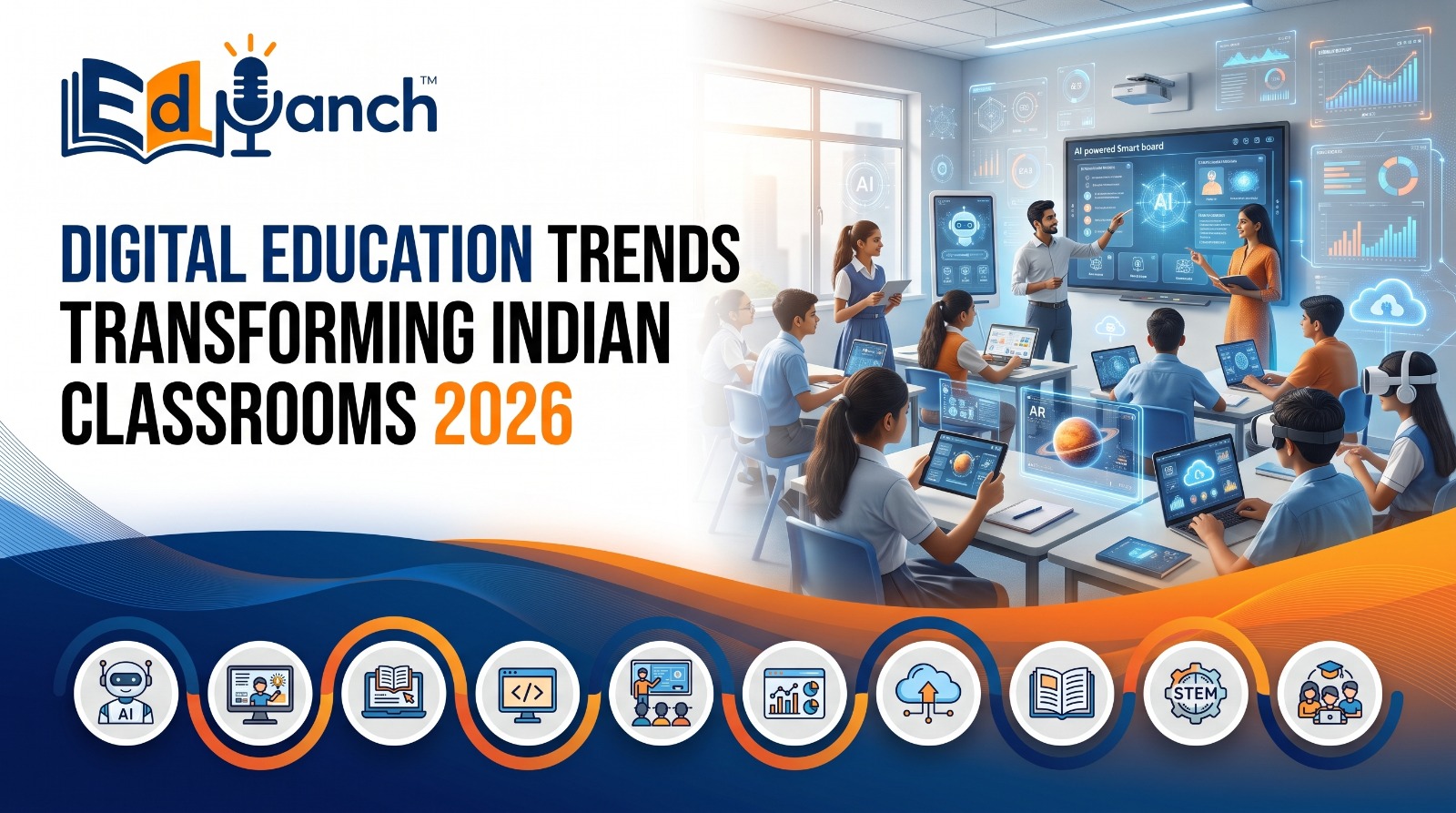
 Digital education is reshaping Indian classrooms through AI-driven personalisation, NEP 2020 reforms, and government platforms, while connectivity gaps and teacher training remain key challenges ahead.





Introduction
Indian classrooms are changing faster than they have in decades. Blackboards and chalk have not disappeared, but they now share space with smart boards, tablets, and adaptive learning platforms. This shift is not happening in isolation. It is being driven by the National Education Policy 2020, rising government investment in digital infrastructure, and a generation of students who have grown up with smartphones in their hands.
For students, parents, and educators trying to make sense of this transformation, the question is not whether digital education will matter. It already does. The real question is how these tools are being used, where they are working well, where gaps remain, and what this means for the choices families and institutions make in the years ahead. This article looks closely at the digital education trends shaping Indian classrooms today, grounded in current data and policy developments, so that readers can understand the bigger picture without wading through jargon.
Understanding the Shift Toward Digital Classrooms
The move toward digital classrooms in India did not begin with the COVID-19 pandemic, but the pandemic accelerated it by several years. What started as an emergency response to school closures has since matured into a structural feature of how Indian education operates. The Union Budget 2026 to 2027 increased education spending to approximately 1.39 lakh crore rupees, with a clear focus on digital skilling and equitable access to technology across regions and income groups. This has expanded the reach of platforms such as DIKSHA, which schools now use regularly to access curriculum-aligned digital resources rather than treating them as backup options.
NEP 2020 also restructured the foundational architecture of schooling itself, replacing the older 10 plus 2 system with a 5 plus 3 plus 3 plus 4 model that spans early childhood through Class 12. This structural change matters because it created space for technology to be woven into each stage of learning rather than bolted on as an afterthought. Blended learning, where digital tools support daily teaching instead of sitting on the sidelines, has become the norm in a growing number of schools across Tier 1 and Tier 2 cities.
Government platforms remain central to this ecosystem. DIKSHA offers curriculum content in multiple languages, SWAYAM provides free online courses for higher education, PM eVIDYA supports multi-mode digital education, and BharatNet continues extending broadband connectivity into rural areas. Together, these initiatives form the backbone of what is often called the National Digital Education Architecture, or NDEAR, under NEP 2020.
Artificial Intelligence and Personalised Learning
Artificial intelligence has moved from a talking point to an active feature of Indian classrooms. AI-powered platforms now track how individual students progress, identify where they struggle, and adjust content difficulty accordingly. Globally, AI in education is projected to reach around 23 billion dollars in 2026, growing at a rapid pace of over 40 percent annually, and India is one of the largest markets for this growth given its base of digital learners.
Indian EdTech platforms use AI chatbots and virtual tutors to answer student queries outside school hours, effectively extending the classroom into the evening and weekend. Adaptive learning apps analyse a student's pace and learning style to recommend lessons suited to their needs rather than applying a single template to an entire classroom. This kind of personalisation is particularly valuable in a country where student-to-teacher ratios remain high in many government schools, making one-on-one attention difficult to provide consistently.
At the higher education level, AI is also supporting research, administrative planning, and campus management. Universities are using AI tools to analyse large datasets for academic research and to manage everything from admissions to resource allocation more efficiently. The Union Budget has also announced a dedicated Centre of Excellence in AI for the education sector, signalling that this is expected to remain a policy priority rather than a passing trend.
Competency Based Learning Over Rote Memorisation
One of the most meaningful shifts inside Indian classrooms is the gradual move away from memorisation toward competency-based education. This change is central to NEP 2020 and is being reinforced through the National Curriculum Framework 2023, which pushes schools toward credit-based progression rather than marks alone. Instead of testing how much a student can recall, assessments increasingly measure understanding, application, and the ability to think critically.
This shift is especially visible at the foundational level through the NIPUN Bharat Mission, which aims for universal foundational literacy and numeracy by Grade 3. Early grade classrooms are integrating playful, activity-based learning through initiatives like Jaadui Pitara, moving away from worksheets and toward hands-on exploration. Anganwadis are increasingly co-located with primary schools, easing the transition for young learners and strengthening early childhood education as envisioned under NEP.
At the same time, the Academic Bank of Credits system is giving higher education students more flexibility to combine subjects across disciplines according to their interests, something that was uncommon a decade ago. This reflects a broader philosophy running through NEP 2020: learning should be flexible, interdisciplinary, and centred on genuine understanding rather than rigid, exam-driven pathways.
Teacher Training and Professional Development
None of these changes matters much if teachers are not equipped to deliver them, and this remains one of the more delicate parts of India's digital education story. Continuous professional development has become more structured in recent years, with online and hybrid training programmes gradually replacing one-time workshops. Teachers are being trained in blended pedagogy, assessment literacy, and student well-being, aligning their skills with the demands of a more digital classroom.
The Union Budget 2026 to 2027 also announced capacity building initiatives for teachers, including upgrades to State Councils of Educational Research and Training institutes. This is a recognition that policy intent alone does not change classrooms. Execution depends heavily on whether teachers, particularly in rural and under-resourced schools, receive the training and support needed to use new tools effectively.
Challenges remain significant here. Many teachers, especially outside major cities, still lack confidence or opportunity to integrate technology meaningfully into their teaching. Professional development programmes are expanding, but consistency across states and school boards varies considerably, and this unevenness is likely to remain one of the defining challenges of the next few years.
Immersive Technology and Smart Classrooms
Beyond AI and adaptive platforms, immersive technologies such as augmented reality and virtual reality are beginning to find a place in Indian education, though largely within urban and well-funded schools for now. These tools allow students to explore virtual science labs, walk through historical events, or visualise complex concepts in three dimensions rather than through static diagrams. In states like Karnataka, large-scale collaborations have already brought AI-based learning tools to hundreds of thousands of students, showing what is possible when infrastructure and partnerships align.
Smart classrooms equipped with interactive boards and connected devices are becoming more common, though the pace of adoption differs sharply between private and government schools, and between urban and rural regions. Rural schools often rely on more modest solutions such as shared tablets or projector-based content, reflecting continued cost and infrastructure constraints even as ambition grows.
Persistent Challenges in Digital Education
It would be misleading to describe this transformation as smooth or complete. India's digital divide remains real and consequential. Rural connectivity, device access, and digital literacy among students, teachers, and parents continue to lag behind urban centres, even as overall internet penetration improves. Students from lower-income households or remote regions are still more likely to face gaps in access compared to their urban counterparts.
Data privacy is another growing concern as more student information moves onto digital platforms. Institutions are expected to follow safeguards consistent with India's data protection framework, and schools adopting new EdTech tools need to consider how student data is stored, used, and protected. There is also the human dimension to consider. Technology can support learning, but it cannot replace the mentorship, empathy, and encouragement that come from a present, engaged teacher. Overreliance on digital tools without adequate human interaction risks weakening the social and emotional dimensions of education that matter just as much as academic performance.
Institutions like Edumanch play a useful role here by helping students, parents, and educators make sense of these overlapping changes, whether that means understanding a new admission process shaped by digital platforms or evaluating which skill-based courses align with where education policy is heading.
The Road Ahead for Indian Classrooms
Looking toward the rest of this decade, digital education in India is likely to deepen rather than plateau. Vocational and skill-based learning is expanding steadily, with vocational training already being delivered in tens of thousands of schools covering lakhs of students, aligned with NEP's goal of extending vocational exposure to a much larger share of students by the mid 2030s. Higher education institutions are also globalising, with Indian universities opening overseas campuses and platforms consolidating around India's growing base of digital learners, which already numbers in the hundreds of millions.
The direction is fairly clear even where execution remains uneven. Foundational learning, competency-based assessment, teacher capacity building, and AI-assisted personalisation are all reinforcing each other rather than competing. The next few years will likely determine how consistently these reforms translate from policy documents into everyday classroom practice across every state, not just the better-funded ones.
Conclusion
Digital education in India has moved well past the experimental stage. It is now a structural part of how classrooms function, supported by sustained government investment, a reshaped policy framework under NEP 2020, and rapidly maturing AI tools that personalise learning at scale. At the same time, real challenges around connectivity, teacher readiness, and equitable access mean that this transformation is still very much a work in progress rather than a finished story.
For students and parents, understanding these shifts is not just useful background information. It shapes real decisions about schools, courses, and the skills worth building for the future. As India continues refining how technology and traditional teaching work together, staying informed will remain one of the most practical steps any student or parent can take.
Frequently Asked Questions
Q1: What are the main digital education trends in Indian classrooms right now?
The most significant trends include AI-powered personalised learning, blended or hybrid classrooms, competency-based assessment under NEP 2020, expanding vocational education, and growing use of government platforms such as DIKSHA and SWAYAM.
Q2: How is NEP 2020 influencing digital education in India?
NEP 2020 has restructured schooling into a 5 plus 3 plus 3 plus 4 model, pushed for foundational literacy by Grade 3 through the NIPUN Bharat Mission, and encouraged the integration of technology across teaching, assessment, and teacher training.
Q3: Is artificial intelligence actually being used in Indian schools today?
Yes. AI is used for personalised learning paths, virtual tutoring, adaptive content difficulty, and administrative automation such as grading. Its use is expanding quickly across both school-level and higher education institutions.
Q4: What are the biggest challenges facing digital education in India?
The digital divide between rural and urban access, uneven teacher training, device affordability, and data privacy concerns remain the most significant obstacles to equitable digital education.
Q5: Will digital tools replace traditional classroom teaching in India?
Unlikely in the near term. Most policy direction and classroom practice point toward blended models where digital tools support teachers rather than replace them, since mentorship and human interaction remain central to effective learning.
Resources
- Ministry of Education, Government of India: Official updates on NEP 2020 implementation and school education schemes.
- NCERT and CIET-NCERT: Digital education training programmes and curriculum resources aligned with NEP 2020.
- DIKSHA National Platform: Government repository of curriculum-aligned digital learning content.
- India Brand Equity Foundation (IBEF): Sector data and statistics on Indian education and higher education trends.
- TRAI (Telecom Regulatory Authority of India): Data on internet penetration and digital connectivity across India.
Interlinking Keywords
NEP 2020, digital classrooms in India, AI in education, skill-based education, career guidance for students, competency-based learning, education policy updates, higher education trends India
Last reviewed by:
Edumanch Editorial Team on July 4, 2026
Disclaimer:
This article is intended for general informational and educational purposes only. While every effort has been made to ensure accuracy using the latest available data, government reports, and policy updates at the time of writing, education policies, schemes, budgets, and statistics are subject to change. Readers are advised to verify current details from official sources such as the Ministry of Education, NCERT, or relevant state education departments before making academic, institutional, or career-related decisions. Edumanch does not guarantee outcomes based on the information provided and recommends consulting appropriate educational counsellors or institutions for personalised guidance.











.png)
.png)
.png)
.png)
.png)

.png)

.png)