 Thursday, October 08, 2026
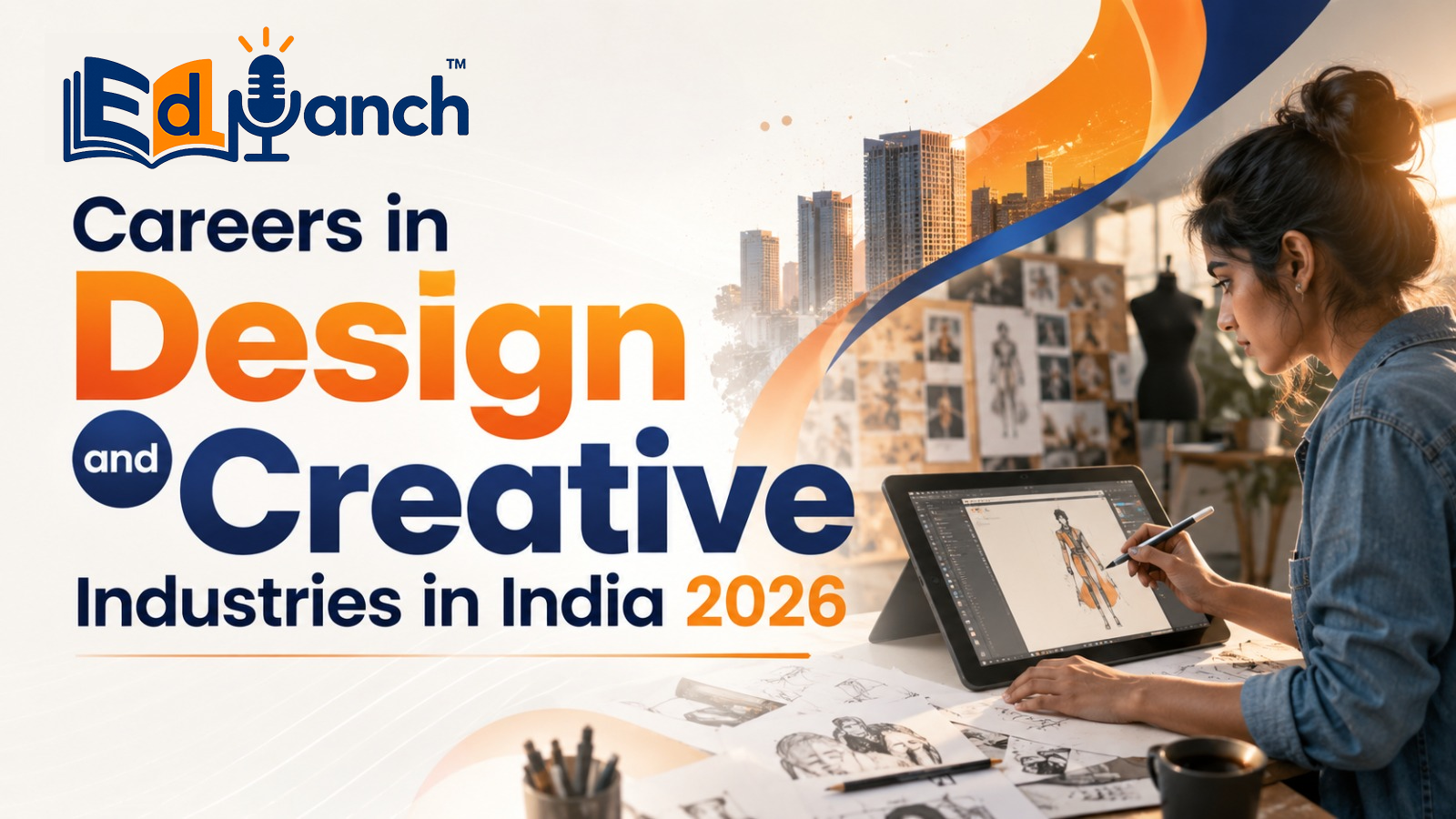
 This guide covers major careers in India's design and creative industries, including roles, salaries, skills, and educational pathways to help students make informed decisions.





Introduction
Design is no longer a niche profession reserved for artists sitting at a drawing table. It is one of the most dynamic, fast-growing, and economically significant career fields in India today. From the mobile applications that millions of Indians use every morning to the packaging on a product sitting on a supermarket shelf in Jaipur or Pune, design is woven into every touchpoint of modern life. And behind each of those experiences is a trained professional who made a deliberate creative and technical decision.
India's creative economy is expanding at a pace that is creating real career opportunities for young people who combine artistic sensibility with professional training. The Indian animation and visual effects industry alone is projected to cross Rs 30,000 crore in the coming years, while digital-first companies, gaming studios, fashion houses, architecture firms, and advertising agencies continue to hire trained designers in significant numbers. For a student or young professional considering a creative path, understanding the range of careers available in the design industry is not just helpful; it is essential for making a well-informed choice.
This guide covers the most prominent design careers in India, what each role involves, what salaries to expect, and what skills are genuinely needed to build a lasting and rewarding future in this field.
Understanding the Design Industry in India
The design industry in India spans multiple sectors and goes far beyond traditional art. It includes digital product design, visual communication, spatial design, fashion, animation, and interactive technology. Historically, design was seen as supplementary to engineering or business, but that perception has changed significantly over the past decade.
The National Design Policy introduced by the Government of India recognised design as a key driver of industry and innovation. Institutions such as the National Institute of Design (NID) in Ahmedabad and the National Institute of Fashion Technology (NIFT) with campuses across the country, have played a significant role in professionalising design education. Today, graduating from a recognised design institution opens doors to careers in both India and internationally.
A crucial distinction that students often miss is that design is not a single discipline. It is an umbrella term for specialised fields that require very different skill sets, educational pathways, and career trajectories. Choosing the right specialisation early can significantly shape the kind of work, income, and growth a professional will experience.
Key Careers in the Design and Creative Industries
Graphic Designer
Graphic design is one of the most widely recognised and accessible entry points into a design career. Graphic designers create visual content for brands, businesses, publications, and digital platforms. Their work includes designing logos, social media creatives, product packaging, advertisements, brochures, and website visuals.
In India, graphic designers work across advertising agencies, digital marketing firms, media companies, e-commerce businesses, and in-house brand teams. Freshers typically earn between Rs 2.5 lakh and Rs 4 lakh per year, while experienced professionals with a strong portfolio can earn substantially more, particularly in metro cities like Mumbai, Bengaluru, and Delhi.
The core skills required include proficiency in Adobe Creative Suite (Photoshop, Illustrator, InDesign), an understanding of typography and colour theory, and the ability to interpret a client's brief creatively. Increasingly, knowledge of motion graphics is becoming an added advantage.
UX and UI Designer
User experience (UX) and user interface (UI) design are among the fastest-growing and highest-paying creative roles in India's technology-driven economy. UX designers focus on how users interact with a digital product, conducting research, mapping user journeys, and designing intuitive interfaces. UI designers take those research-backed decisions and translate them into the visual screens and interactive elements that users actually see and touch.
With India's booming startup ecosystem, fintech industry, and the expansion of super-apps, skilled UX and UI designers are in exceptionally high demand. Entry-level professionals can expect salaries starting from Rs 4 lakh per year, while senior designers and lead UX professionals at product companies can earn between Rs 12 lakh and Rs 25 lakh per year.
Key skills for this role include UX research methods, wireframing, prototyping tools like Figma and Adobe XD, an understanding of human psychology, and the ability to collaborate with product managers and developers.
Fashion Designer
India's fashion industry is one of the largest in the world, both in terms of domestic consumption and export. Career opportunities in fashion design are diverse and extend beyond runway collections to include ready-to-wear clothing, textiles, accessories, sustainable fashion, and costume design for film and television.
Fashion designers in India find employment with retail brands, export houses, couture labels, OTT production companies, and increasingly through their own labels and independent ventures. Institutions such as NIFT, Pearl Academy, and Symbiosis Institute of Design offer structured programmes that combine design theory with industry exposure.
Starting salaries in fashion design can be modest, ranging from Rs 2 lakh to Rs 3.5 lakh per year, but designers who establish their own label or rise to senior positions in established fashion houses can earn significantly more. India's large and growing middle class, combined with the global appetite for Indian ethnic wear and fusion fashion, makes this a field with strong long-term potential.
Animation and Visual Effects Artist
The animation and visual effects (VFX) industry in India has seen explosive growth, driven by the rise of OTT platforms, global outsourcing of animation work, and the expansion of the Indian gaming industry. Studios across Hyderabad, Mumbai, Pune, and Bengaluru are producing content for global streaming platforms and film productions.
Animators create characters, environments, and motion sequences for films, television, video games, and advertising. VFX artists work on live-action footage to enhance or create visual elements that are difficult or impossible to capture on camera.
Skills required in this field include proficiency in software such as Autodesk Maya, Adobe After Effects, Blender, and Nuke. A strong understanding of movement, physics, and storytelling is equally important. Diploma and degree programmes in animation from institutions like Arena Animation, Whistling Woods International, and several university programmes provide the foundational training.
Product Designer
Product design is a career that sits at the intersection of aesthetics, engineering, and human psychology. Product designers develop the form and function of physical and digital products, ensuring that what gets built is both beautiful and genuinely useful to the person who will use it.
In the digital world, product design often overlaps with UX design. In the physical world, product designers work on everything from household appliances and consumer electronics to medical devices and furniture. India's manufacturing sector, growing consumer goods market, and the ambitions of homegrown startups have created meaningful demand for skilled product designers.
A Bachelor of Design degree with a product design specialisation, often from institutions like NID or IIT's design schools, is a strong foundation for this career. Salaries at the senior level can be among the highest in the design profession.
Interior Designer
Interior design is a profession that goes well beyond decoration. Qualified interior designers plan and execute the functional and aesthetic transformation of residential, commercial, hospitality, and retail spaces. They work with architects, civil contractors, furniture vendors, and clients to bring a spatial vision to life.
India's real estate expansion, the growth of co-working spaces, boutique hospitality properties, and high-end residential projects have created strong demand for skilled interior designers. Many interior designers in India work independently or run their own studios after gaining a few years of professional experience.
The skills needed include spatial planning, knowledge of materials and finishes, proficiency in AutoCAD and 3D visualisation software, and strong client communication abilities.
Architectural Designer
Architectural designers work alongside licensed architects to develop plans, models, and technical drawings for buildings and urban spaces. While an architectural designer may not yet hold a full architectural licence, the role is a critical part of the architecture profession and serves as the standard entry path for graduates of a five-year B.Arch programme.
India's urbanisation story, along with government infrastructure investment and the growth of smart city projects, has kept demand for architectural talent consistently strong. The Council of Architecture (COA) regulates the profession in India, and registration with the COA is required to practise as an architect.
Video Game Designer
India's gaming industry is one of the fastest-growing in the world in terms of player base and increasingly in terms of game development. Video game designers conceptualise and develop the gameplay mechanics, storylines, visual environments, and character designs that make a game engaging.
This is a career that requires a unique combination of technical skill and creative vision. Game design programmes at institutions like Backstage Pass and Arena Animation, as well as international programmes with online access, are helping build a generation of Indian game designers who can compete globally. Employment opportunities exist in dedicated gaming studios, and many designers also choose the freelance or independent game development path.
Skills That Define a Successful Design Career
While each design specialisation has its own technical requirements, certain foundational skills run across virtually all creative careers in the design industry:
- Creative problem-solving: Design is fundamentally about finding the most elegant solution to a problem, whether that problem is visual, spatial, or experiential.
- Digital tool proficiency: Across almost every design role, expertise in at least one industry-standard software suite is non-negotiable.
- Communication and collaboration: Designers rarely work in isolation. The ability to present ideas, accept feedback, and work alongside professionals from non-design backgrounds is a daily requirement.
- Research and user empathy: Particularly in UX, product, and interior design, the best outcomes come from genuinely understanding the needs and behaviours of the end user.
- Portfolio development: A strong, well-curated portfolio of real or self-initiated projects is often more important than academic qualifications when applying for design roles.
Educational Pathways Into Design in India
Students who wish to enter the design profession have several structured pathways available after Class 12. The most respected route is through entrance examinations for premier institutions such as NID (National Design Policy Examination), NIFT (NIFT Entrance Test), CEED (for postgraduate design programmes at IITs), and UCEED (undergraduate design at IITs).
Private institutions such as Symbiosis Institute of Design, Pearl Academy, MIT Institute of Design (Pune), and several other AICTE or UGC-recognised colleges also offer excellent programmes. The duration of undergraduate design programmes is typically four years for a B. Des degree, while B. Arch is a five-year programme.
For students who have already completed a different undergraduate degree and wish to transition into design, postgraduate programmes and short-term professional courses are widely available both offline and online. Platforms offering structured, industry-aligned design courses have made it significantly more accessible for working professionals to build design skills without relocating or taking a full career break.
The Future of Design Careers in India
The design industry in India is at a genuinely exciting inflection point. Several converging trends are creating new opportunities for creative professionals:
The rapid expansion of India's digital economy means that demand for UX and product designers will continue to rise sharply. The entertainment sector's growth, particularly animation and gaming, is creating specialised roles that did not exist a decade ago. Sustainable design is emerging as a meaningful sub-field as businesses and consumers increasingly prioritise environmental responsibility. Artificial intelligence tools are also changing how designers work, making efficiency tools available but simultaneously raising the bar for the quality of human creative judgment and strategy.
For students and young professionals in India, the most important step is to identify which design specialisation aligns with their natural strengths, begin building relevant skills early, and develop a portfolio that demonstrates genuine capability rather than just theoretical knowledge.
Platforms like Edumanch can help students stay informed about design entrance examinations, institutional rankings, scholarship opportunities, and emerging career trends so that every decision made along the creative education journey is based on accurate and current information.
Frequently Asked Questions
Q1: Which design career has the highest salary in India?
Product design and UX design are among the highest-paying design careers in India. Experienced professionals in senior roles at product-driven technology companies often earn between Rs 10 lakh and Rs 25 lakh per year or more, depending on the organisation and city.
Q2: What courses should I do after 12th to build a career in design?
Students can pursue a B.Des (Bachelor of Design), B.F.A. (Bachelor of Fine Arts), or B.Arch (for architecture), or specialised diploma programmes in graphic design, animation, fashion design, or UI/UX after completing Class 12. Entrance examinations such as NID DAT, NIFT Entrance Test, and UCEED are key gateways to premier institutions.
Q3: Is a design career a good option in India?
Yes, design careers are growing rapidly in India due to the expansion of digital industries, e-commerce, gaming, media, and entertainment sectors. Skilled designers are in high demand across both startups and established companies, and the field offers strong scope for both salaried employment and independent practice.
Q4: Do I need to be good at drawing to pursue a design career?
Drawing skills are helpful in fields like fashion design and animation, but many design roles such as UX design, product design, and web design rely more on software proficiency, logical thinking, and user empathy than on hand-drawing ability.
Q5: Can students from science or commerce streams pursue design?
Yes. While some programmes prefer an arts background, many design entrance examinations and courses accept students from science and commerce streams. Institutions such as NID, NIFT, and several private design schools have their own entrance tests open to students from all academic streams.
Resources
- National Institute of Design (NID): Official information on undergraduate and postgraduate design programmes and entrance examinations in India.
- National Institute of Fashion Technology (NIFT): Details on fashion design programmes, admission processes, and campus information across India.
- Council of Architecture, India (COA): Regulatory body for the architecture profession in India, including licensing and registered institutions.
- All India Council for Technical Education (AICTE): Provides an approved list of design and technical institutions in India.
- University Grants Commission (UGC): Guidelines and policies on design-related academic programmes offered by recognised universities in India.
Interlinking Keywords
design courses after 12th India, NID entrance exam, NIFT admission process, UX designer career India, graphic design salary India, animation courses India, B.Des programme, product design career, fashion design colleges India, creative careers for students
Disclaimer:
The career information, salary figures, and institutional details provided in this article are for general guidance and informational purposes only. Salary ranges are approximate and may vary based on experience, location, employer, and industry conditions. Readers are encouraged to verify current admission requirements, salary data, and institutional accreditation directly from the respective institutions or official regulatory bodies before making any academic or career decisions. Edumanch does not guarantee specific career outcomes or placement results.
Last reviewed by:
Edumanch Editorial Team on August 3, 2026










.png)
.png)
.png)

.png)
.png)

.png)

.png)